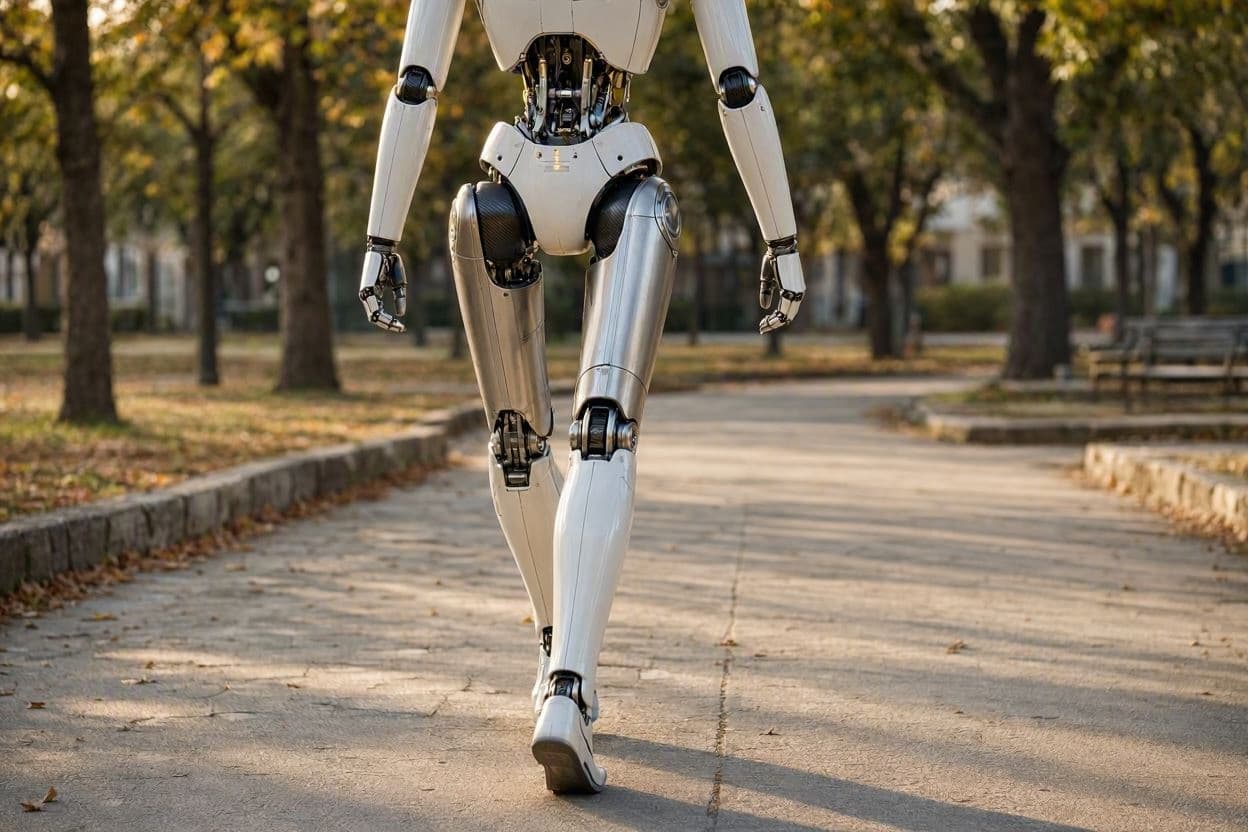
The act of walking is something humans perform with unconscious grace, a rhythmic dance of balance and momentum that we rarely pause to analyze. Yet, for engineers striving to replicate this natural fluidity in machines, every step is a complex puzzle of physics and control. Recent research into bipedal robotics has focused on a subtle but critical element: the vertical motion of the hips. This up-and-down movement, often overlooked in early robotic designs, turns out to be essential for energy efficiency and stability. It invites us to reflect on how much we can learn from our own bodies when teaching machines to move like us.
Traditional bipedal robots often moved with a stiff, rigid gait, keeping their center of mass at a constant height to simplify control algorithms. While this approach reduced computational complexity, it resulted in jerky, unnatural movements that consumed excessive energy. By allowing the hips to rise and fall slightly with each step, researchers have found that robots can mimic the spring-like mechanics of human legs. This vertical oscillation helps store and release kinetic energy, much like a pendulum, making locomotion smoother and more sustainable.
The study highlights the importance of biomimicry in robotics. Instead of forcing machines to move in ways that are easy to program, engineers are increasingly looking to biology for solutions that have been refined over millions of years of evolution. The human hip acts as a shock absorber and a power generator, smoothing out the impact of foot strikes and propelling the body forward. Incorporating this dynamic into robot design requires sophisticated sensors and actuators, but the payoff is a significant improvement in performance.
Energy efficiency is a major hurdle for mobile robots, especially those intended for long-duration tasks such as search and rescue or exploration. A gait that minimizes energy waste allows these machines to operate longer on limited battery power. The vertical hip motion reduces the peak forces required from motors, distributing the workload more evenly across the stride. This optimization is crucial for making bipedal robots practical for real-world applications beyond the laboratory.
Stability is another key benefit of this approach. A rigid gait can make robots prone to falling when encountering uneven terrain or unexpected disturbances. The compliance introduced by vertical hip movement allows the robot to adapt to small changes in ground height, maintaining balance more effectively. This adaptability is essential for navigating the chaotic and unpredictable environments where humans typically walk.
Control systems for these new gaits are becoming increasingly advanced, using machine learning to refine movements in real time. Algorithms can adjust the amplitude and timing of the hip motion based on speed, load, and terrain conditions. This level of responsiveness brings robots closer to the intuitive agility of human walkers, who adjust their gait without conscious thought. The integration of artificial intelligence with mechanical design is pushing the boundaries of what is possible.
Public interest in humanoid robots is growing, driven by visions of future assistants and companions. Seeing a robot walk with a natural, human-like rhythm changes our perception of these machines, making them seem less alien and more approachable. This psychological aspect is important for social acceptance, as people are more likely to trust and interact with robots that move in familiar ways. The aesthetic of movement matters as much as the function.
As research continues, we may see bipedal robots becoming common sights in homes, hospitals, and public spaces. Their ability to navigate stairs, curbs, and cluttered rooms will depend largely on the sophistication of their gait. The humble up-and-down motion of the hip is a small detail with profound implications, bridging the gap between mechanical rigidity and biological grace. It is a step toward a future where machines move among us with ease.
Research into hip vertical motion is transforming the way bipedal robots walk, making them more efficient and stable. It highlights the value of learning from human biology. Let us appreciate the engineering elegance behind every step.
AI Image Disclaimer: Please note that any visual representations in this article are AI-generated illustrations created for conceptual clarity.
Sources: IEEE Spectrum Science Robotics MIT News
Published by Banx Network. This article is part of the Banx decentralized media programme, powered by the BXE token on the XRP Ledger.