

Key Highlights
- Ripple's XRP Ledger is designed to modernize cross-border financial transactions.
- XRP acts as a bridge asset, facilitating faster and cheaper money transfers.
- The ledger supports various assets, including stablecoins and tokenized assets.
Ripple's ecosystem is revolutionizing the way money moves across borders, institutions, and currencies. At the heart of this transformation is the XRP Ledger (XRPL), a decentralized blockchain specifically engineered for speed, liquidity, and regulatory compliance. Unlike many speculative cryptocurrency networks, XRPL is built for practical financial applications, making it a crucial player in the evolving landscape of global finance.
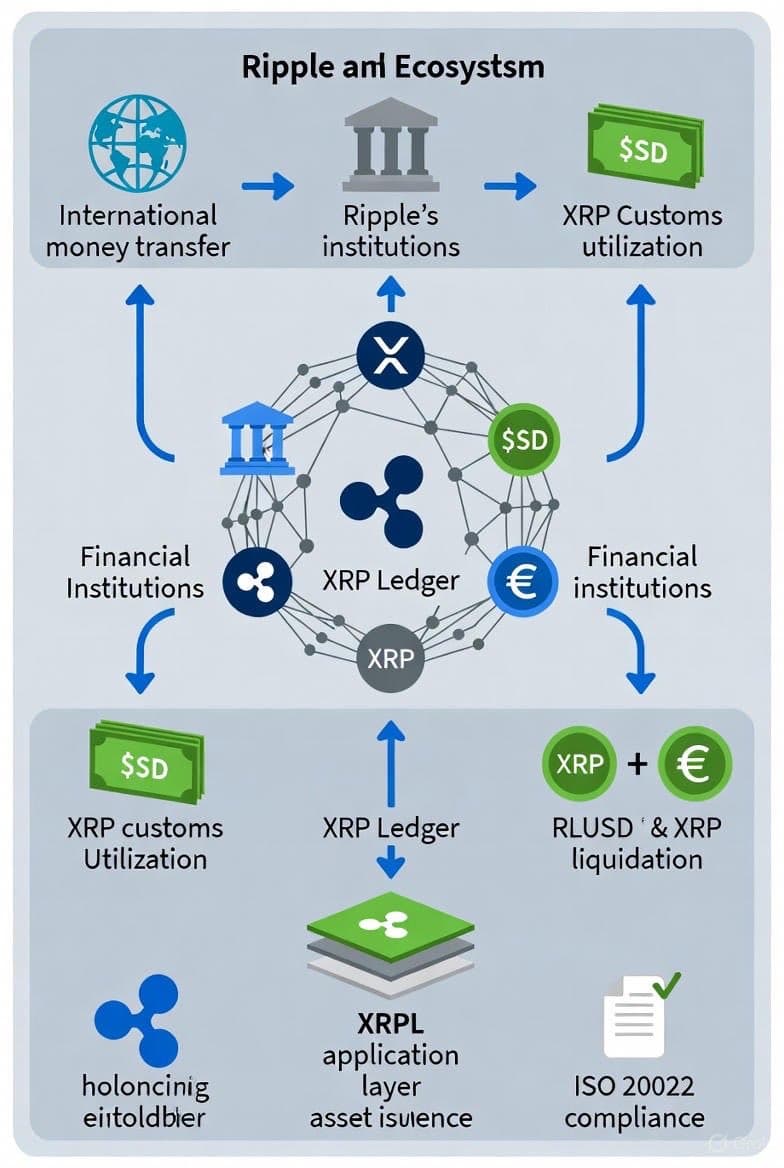
International money transfers traditionally rely on slow correspondent banking systems, which can be cumbersome and costly. Ripple's network offers a more efficient alternative. Financial institutions connected to Ripple can route transactions through its infrastructure, where XRP serves as a neutral bridge asset. This innovative approach eliminates the need for pre-funded accounts, significantly reduces transaction costs, and enables near-instant settlement, which is essential for businesses operating in a fast-paced global economy.
The XRP Ledger functions as a central liquidity engine, allowing banks, payment providers, and other financial institutions to connect directly to XRPL. This connectivity facilitates seamless movement of liquidity between various currencies, including XRP, fiat-backed stablecoins like USD and EUR, and tokenized assets. By removing friction, delays, and the need for multiple intermediaries, XRPL enhances the efficiency of cross-border transactions, making it an attractive option for financial institutions looking to streamline their operations.
A notable evolution within the Ripple ecosystem is the custom utilization of XRP. Financial institutions and enterprises can design tailored payment flows, treasury operations, and settlement systems directly on XRPL. This flexibility includes features such as on-demand liquidity, automated market making, and direct asset swaps, all of which operate 24/7. Such capabilities empower institutions to optimize their financial processes and respond swiftly to market demands.
Moreover, the application layer of XRPL allows for the issuance of various assets directly on the ledger. This includes stablecoins, tokenized fiat, bonds, and real-world assets, all of which can be traded and settled without leaving the network. This positions XRPL not just as a payment rail but as a foundational platform for tokenized finance, opening new avenues for innovation in the financial sector.
Regulatory readiness is another defining feature of the XRP Ledger. XRPL aligns with ISO 20022 messaging standards, ensuring compatibility with global banking systems. This alignment facilitates seamless integration with existing financial infrastructures while adhering to compliance and reporting requirements, a critical consideration for institutions navigating the complex regulatory landscape.
By combining liquidity, speed, interoperability, and regulatory compliance, Ripple's ecosystem is transforming XRP from a mere digital asset into a vital financial utility. As institutions increasingly demand real-time settlement and tokenized liquidity, XRPL stands as a bridge between traditional finance and the blockchain-powered economy of the future, paving the way for a more efficient and inclusive financial system.
Published by Banx Network. This article is part of the Banx decentralized media programme, powered by the BXE token on the XRP Ledger.




