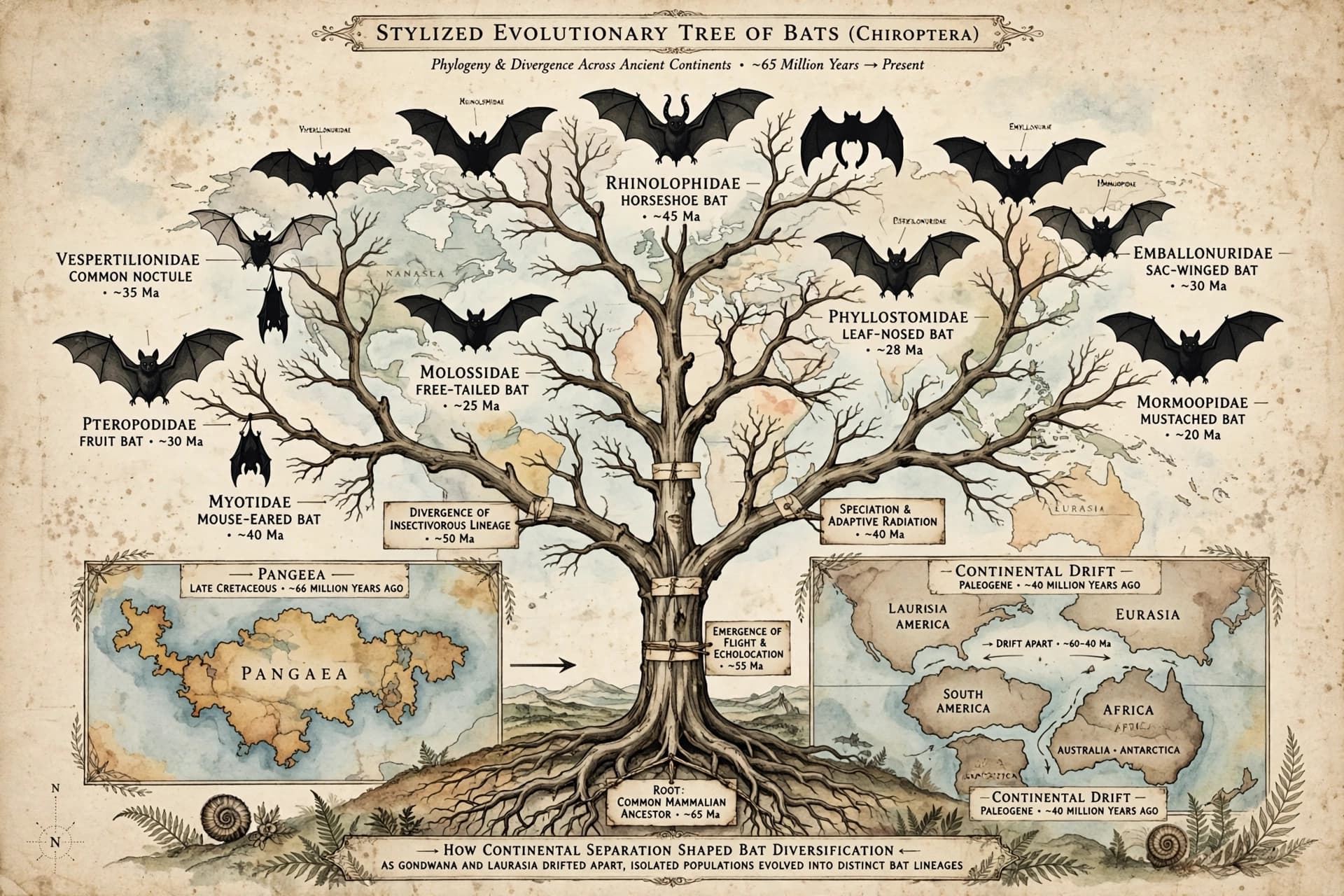
In the twilight skies of our planet, bats have long navigated the shadows, their evolutionary history written in both bone and gene. Recent advances in genomics and paleontology have converged to rewrite the family tree of these unique mammals, offering a clearer picture of their origins and spread across the globe. By combining high-quality reference genomes with fossil evidence, scientists are uncovering new chapters in the story of bat evolution, challenging old assumptions and revealing a complex web of relationships that spans millions of years.
The study of bat phylogeny has historically been difficult due to the rapid diversification of species and the limitations of morphological data. Bats, comprising over 1,400 species, are the second largest order of mammals, yet their evolutionary pathways have remained somewhat obscure. The integration of whole-genome sequencing has provided a wealth of genetic data, allowing researchers to resolve deep branching patterns that were previously unclear. These reference genomes serve as a foundational map for understanding the genetic diversity and adaptive traits of different bat families.
Fossils play a crucial role in anchoring these genetic timelines. New discoveries and re-evaluations of existing fossils have provided critical calibration points for molecular clocks, helping to estimate when different bat lineages diverged. This synergy between genetics and paleontology has led to significant revisions in the classification of bat families, particularly regarding the relationship between microbats and megabats. Some studies now suggest that certain groups previously thought to be distinct may share closer common ancestors than once believed.
Biogeography, the study of the distribution of species across space and time, has also benefited from these insights. The new phylogenetic trees indicate that bats likely originated in Laurasia, the northern supercontinent, before dispersing to other parts of the world. This contradicts earlier hypotheses that placed their origins in Gondwana. The ability to fly allowed bats to cross barriers that grounded mammals could not, leading to a global distribution that reflects both ancient geological events and more recent migratory patterns.
One of the key findings is the revision of the Yangochiroptera and Yinpterochiroptera suborders. Genetic data has clarified the placement of several families, resolving long-standing debates about their evolutionary relationships. For example, the horseshoe bats and leaf-nosed bats, once grouped separately, are now understood to share a more recent common ancestor. This reclassification has implications for understanding the evolution of echolocation and other sensory adaptations.
The research also highlights the role of climate change and continental drift in shaping bat diversity. As landmasses shifted and climates fluctuated, bat populations were isolated or brought into contact, driving speciation and adaptation. The fossil record shows periods of rapid expansion followed by contraction, mirroring the dynamic history of the Earth itself. These patterns help explain the current distribution of bat species and their ecological roles.
Understanding bat phylogeny is not just an academic exercise; it has practical implications for conservation and disease ecology. Bats are reservoirs for various viruses, and knowing their evolutionary relationships can help predict which species might be more susceptible to certain pathogens. This knowledge is vital for managing emerging infectious diseases and protecting biodiversity. It also informs conservation strategies by identifying evolutionarily distinct lineages that may require targeted protection.
As more genomes are sequenced and new fossils are discovered, the picture of bat evolution will continue to refine. Each piece of data adds depth to our understanding of these fascinating creatures. The collaboration between geneticists, paleontologists, and ecologists exemplifies the power of interdisciplinary science in unraveling the mysteries of life.
The revision of bat family phylogeny and biogeography marks a significant advance in mammalian evolutionary biology. By integrating genomic and fossil evidence, scientists have constructed a more accurate and nuanced history of these aerial mammals. This ongoing research not only satisfies our curiosity about the past but also provides valuable insights for the future of bat conservation and human health.
AI Image Disclaimer: The images accompanying this report are AI-generated illustrations intended to represent the concepts of genetic mapping and fossil discovery, not actual genomic data or specific fossil specimens.
Sources: Nature, Science, Molecular Biology and Evolution, ResearchGate
Published by Banx Network. This article is part of the Banx decentralized media programme, powered by the BXE token on the XRP Ledger.