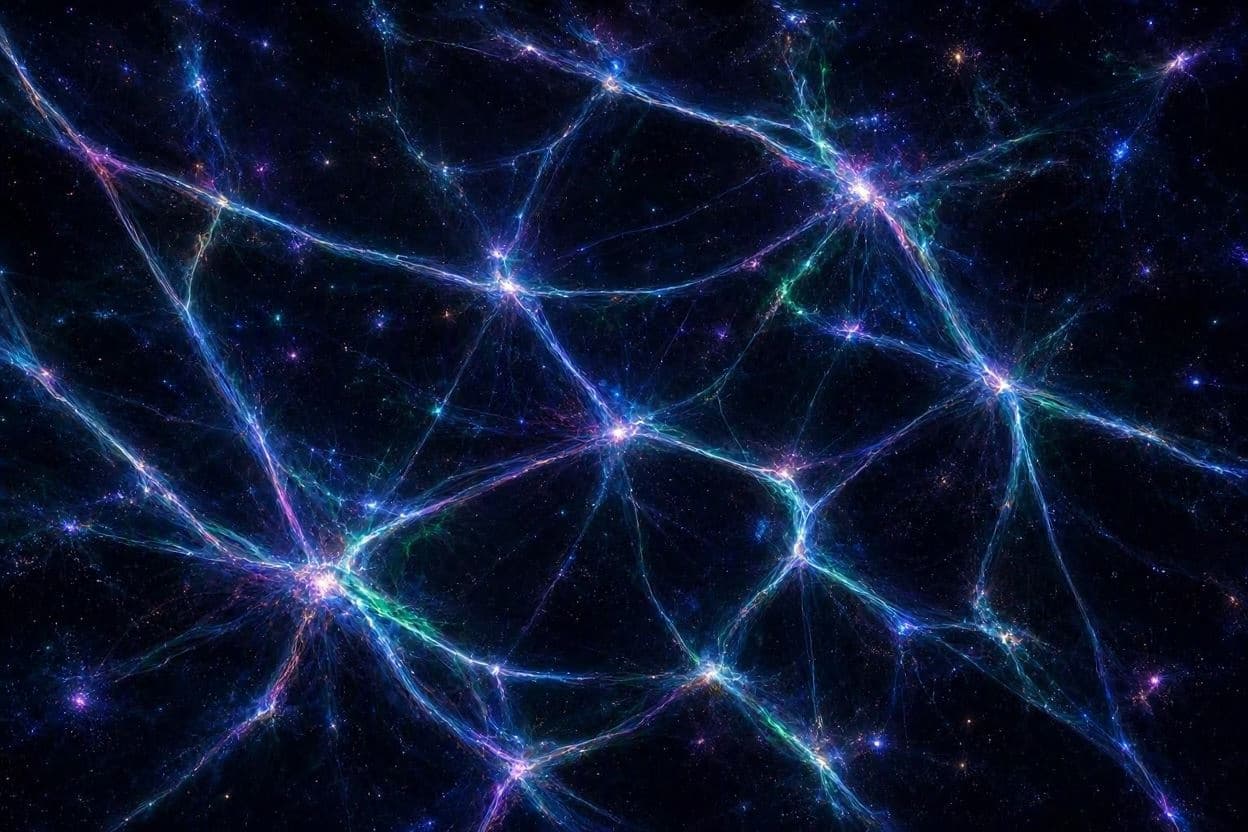
The universe is filled with invisible threads, a cosmic web of matter that connects galaxies and shapes the structure of the cosmos. Much of this matter is "missing" or hidden, difficult to detect with traditional telescopes because it does not emit light. Recently, scientists have turned to a mysterious phenomenon known as Fast Radio Bursts (FRBs) to illuminate this dark scaffold. These brief, intense flashes of radio waves from deep space are serving as cosmic flashlights, revealing the distribution of hidden matter along their path. This innovative approach invites us to reflect on the ingenuity required to see the unseen and the profound connections that bind the universe together.
Fast Radio Bursts are millisecond-long bursts of radio energy originating from distant galaxies. While their exact origins are still debated, their utility as probes of the intergalactic medium is becoming clear. As an FRB travels through space, its signal interacts with electrons in the diffuse gas that fills the voids between galaxies. This interaction causes a slight delay in the arrival time of different frequencies, a phenomenon known as dispersion. By measuring this dispersion, astronomers can estimate the amount of matter the signal has passed through.
This technique allows researchers to map the distribution of baryonic matter, the ordinary stuff of stars and planets, which is thought to make up about five percent of the universe’s total mass-energy content. Surprisingly, a significant portion of this matter has been missing from surveys, leading to the "missing baryon problem." FRBs are helping to locate this missing matter, showing that it resides in the warm-hot intergalactic medium, forming the filaments of the cosmic web.
The implications for galaxy formation are significant. Galaxies do not form in isolation; they grow by accreting gas from their surroundings and merging with other galaxies. The distribution of hidden matter influences how galaxies evolve, providing the fuel for star formation and shaping their structures. By constraining the amount and location of this matter, FRBs help refine models of galaxy evolution, offering a clearer picture of how the universe has developed over billions of years.
Recent studies have used large datasets of FRBs to create statistical maps of the cosmic web. These maps reveal the dense clusters and sparse voids that characterize the large-scale structure of the universe. The precision of these measurements is improving as more FRBs are detected by radio telescopes around the world. Each new burst adds a data point, refining our understanding of the cosmic landscape.
The technology behind FRB detection is advancing rapidly. Arrays like CHIME in Canada and ASKAP in Australia are discovering hundreds of these bursts, transforming them from rare curiosities into routine astronomical tools. This abundance of data is crucial for statistical analysis, allowing scientists to draw robust conclusions about the properties of the intergalactic medium. It marks a new era in radio astronomy.
Beyond mapping matter, FRBs also provide insights into the magnetic fields of the universe. The polarization of the radio waves can reveal the strength and direction of magnetic fields in the intervening space. This information is vital for understanding the dynamics of plasma in the cosmos and the role of magnetism in galaxy formation. It adds another dimension to the data provided by these fleeting signals.
As we continue to listen to the radio sky, FRBs are proving to be more than just puzzles to be solved; they are powerful tools for exploration. They allow us to weigh the universe, to trace its hidden skeleton, and to understand the flow of matter that sustains the lights of the galaxies. In their brief flash, they illuminate the deep structure of reality.
Fast Radio Bursts are being used to map hidden matter in the universe, helping to solve the missing baryon problem and refine models of galaxy formation. It showcases the power of innovative astronomy. Let us continue to explore the cosmic web.
AI Image Disclaimer: Please be aware that images used in this context are AI-generated visualizations for illustrative purposes.
Sources: Nature Astronomy CSIRO Scientific American
Published by Banx Network. This article is part of the Banx decentralized media programme, powered by the BXE token on the XRP Ledger.