The cosmos is a vast library of mysteries, and black holes are its most enigmatic volumes. For decades, Stephen Hawking’s laws of black hole mechanics have served as the foundational text for understanding these gravitational giants. Recently, however, new observations have added a significant chapter to this story, offering a major update to our understanding of how these celestial objects behave. This development is not a refutation of Hawking’s genius but a refinement, inviting us to reflect on the evolving nature of scientific truth and the relentless pursuit of knowledge in the face of the unknown.
Body: The update centers on the confirmation and expansion of Hawking’s area theorem, which posits that the surface area of a black hole’s event horizon can never decrease. Using data from advanced gravitational wave detectors, scientists have observed black hole mergers with unprecedented clarity. These observations confirm that while the area increases during a merger, the dynamics are more complex than previously modeled. The "ringing" of the newly formed black hole, a phase where it settles into a stable state, provides crucial insights into its structure and behavior.
This new data aligns with predictions made by Albert Einstein and Roy Kerr, suggesting that black holes are not just simple voids but complex entities governed by precise mathematical rules. The confirmation of these theories strengthens the framework of general relativity, demonstrating its robustness even in the most extreme environments. It is a testament to the power of human intellect to predict the behavior of the universe through mathematics alone.
For physicists, this update opens new avenues for exploring the intersection of gravity and quantum mechanics. The black hole information paradox, a long-standing puzzle about whether information is lost in a black hole, remains a key area of interest. By understanding the mechanics of black hole growth and stability, researchers hope to find clues that may eventually reconcile general relativity with quantum theory. It is a step toward a unified theory of physics.
The technological achievement behind this discovery is equally remarkable. The Laser Interferometer Gravitational-Wave Observatory (LIGO) and its international partners have reached a level of sensitivity that allows them to detect ripples in spacetime from billions of light-years away. This engineering marvel enables scientists to "hear" the universe in a way that was impossible just a few decades ago. It transforms abstract theory into observable reality.
Public interest in black holes remains high, fueled by their mysterious allure and recent cinematic portrayals. This latest update offers an opportunity to engage the public with real science, showing how theoretical predictions are tested and verified. It demystifies the process of discovery, revealing it as a collaborative and iterative journey rather than a series of sudden eureka moments.
As research continues, the focus will shift to observing more mergers and analyzing their unique signatures. Each event adds data points to the growing map of black hole behavior. The hope is that these observations will reveal deviations from current models, pointing the way to new physics. It is a reminder that science is never finished, only ever improving.
The legacy of Stephen Hawking is honored not by preserving his ideas as static dogma, but by testing and expanding them. This update is a tribute to his work, demonstrating that his contributions continue to guide exploration at the frontiers of knowledge. It ensures that his voice remains part of the ongoing conversation about the nature of reality.
Closing: In the end, the major update to Hawking’s black hole laws is a celebration of scientific progress. It confirms old truths while opening doors to new questions. As we look deeper into the cosmos, the hope is that each discovery brings us closer to understanding the fundamental fabric of our universe.
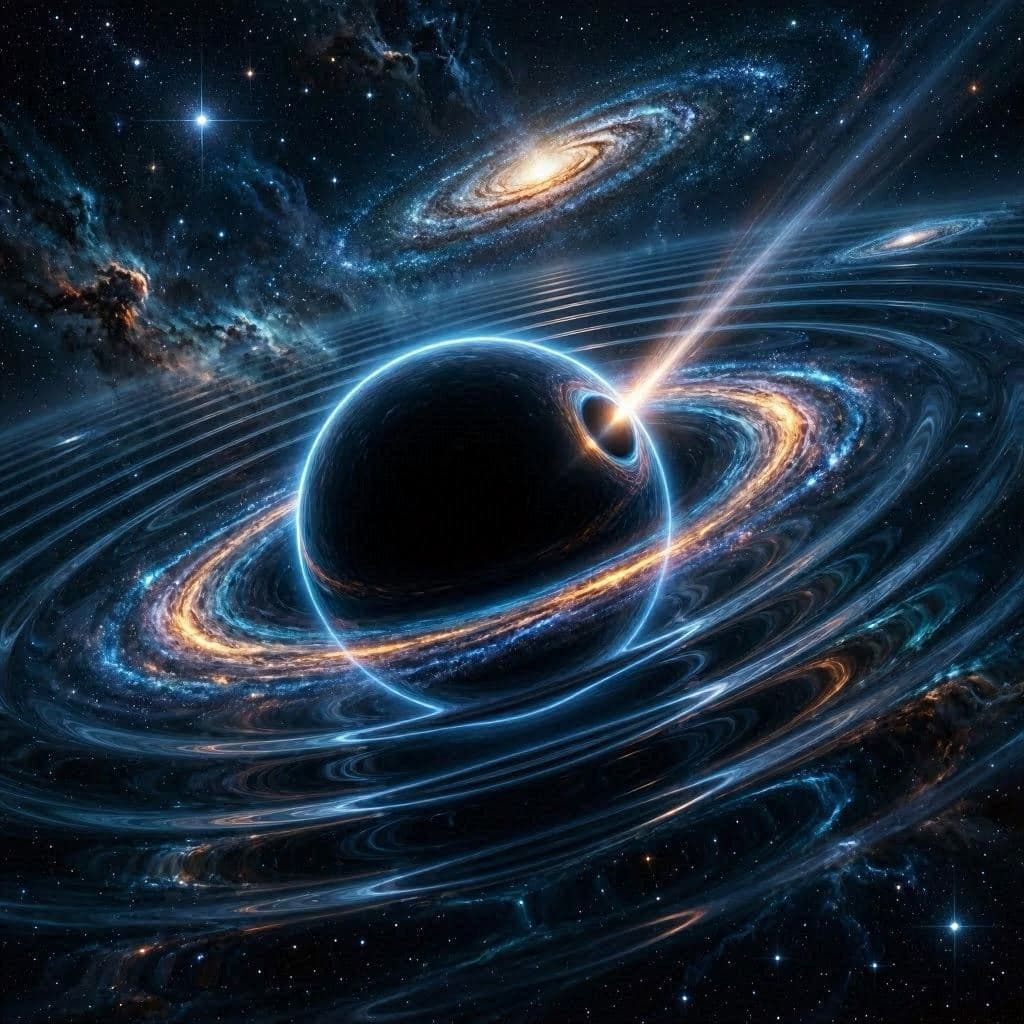
AI Image Disclaimer: Please note that any accompanying visuals for this narrative are artificially generated interpretations meant to evoke the spirit of the story, not documentary evidence.
Sources: Physical Review Letters Simons Foundation Science News
Published by Banx Network. This article is part of the Banx decentralized media programme, powered by the BXE token on the XRP Ledger.