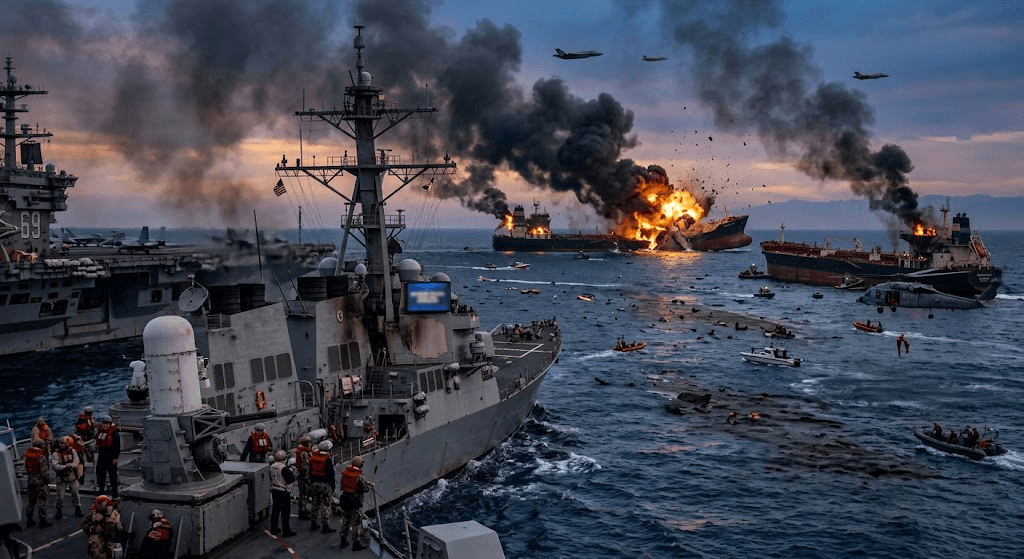
WASHINGTON — U.S. forces launched retaliatory air and naval strikes targeting three Iranian crude oil vessels after Islamic Revolutionary Guard Corps (IRGC) forces fired ballistic missiles at a U.S. Navy aircraft carrier and guided-missile destroyer operating in regional waters.
According to U.S. Central Command (CENTCOM), the American carrier strike group and its accompanying destroyer successfully evaded multiple incoming missiles during patrolling operations, reporting no casualties or structural damage to U.S. warships. In immediate response to the unprovoked attack, U.S. military assets deployed precision munitions to strike three vessels identified as part of Tehran's commercial oil infrastructure.
The targeted strikes permanently disabled two Iranian oil carriers off the Coast of Kharg Island and near Jask, while completely destroying a third, unladed vessel in the Gulf of Oman. Defense officials emphasized that the vessels were key assets in a foreign shadow fleet utilized to bypass international sanctions and fund regional paramilitary activities. Crews aboard the targeted ships were directed to abandon vessel prior to the strikes, and initial reports indicate crew members evacuated safely without sustained casualties.
Military leadership issued a stark warning following the exchange, asserting that any further aggression directed at coalition warships would draw severe economic and tactical costs against Tehran's remaining naval and commercial fleet. Meanwhile, Iranian state media condemned the retaliation as a breach of maritime protocols, heightening security alerts across critical shipping corridors near the Strait of Hormuz.
U.S. Central Command commander Admiral Brad Cooper issued a direct warning regarding the tactical shift, stating that any military aggression aimed at American naval forces will result in proportional and severe economic destruction. Defense Secretary Pete Hegseth echoed the stance, affirming that coalition forces stand prepared to systematically dismantle and sink Iran's remaining commercial oil fleet should maritime harassment against coalition vessels continue along strategic chokepoints.
The military exchange has immediately spiked volatility across international energy markets, pushing global crude oil prices upward as shipping lines re-evaluate passage risks near the Strait of Hormuz. International maritime regulators and regional diplomats from Oman and Egypt have renewed calls for restraint, urging both sides to de-escalate maneuvers to prevent a total disruption of commercial trade routes vital to global supply chains.
Published by Banx Network. This article is part of the Banx decentralized media programme, powered by the BXE token on the XRP Ledger.