
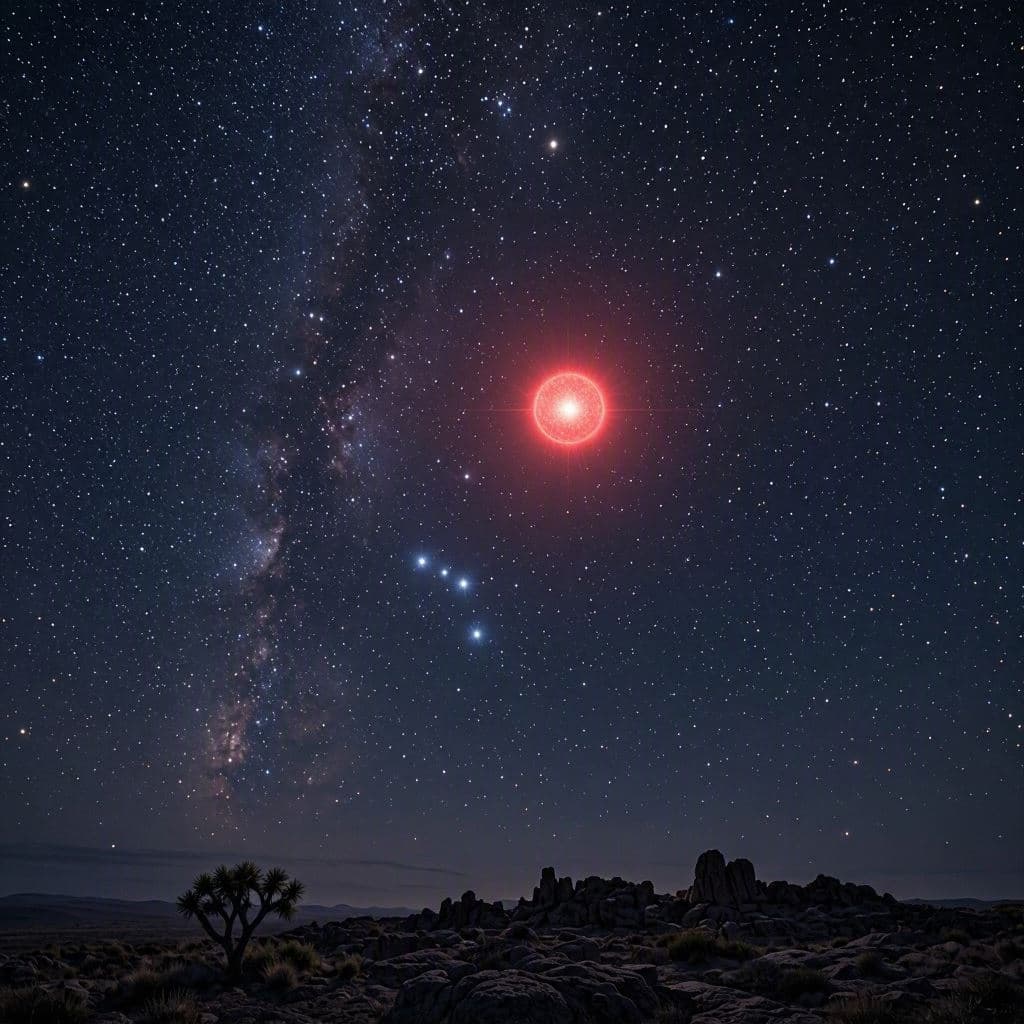
In the constellation of Orion, a red supergiant star pulses with a rhythmic brightness that has captivated astronomers for centuries. Betelgeuse, one of the largest known stars, is nearing the end of its life, leading to widespread speculation about when it might explode as a supernova. This anticipation invites reflection on the lifecycle of stars and the dramatic events that shape the universe. It is a moment where humanity watches a cosmic clock, waiting for a flash that could outshine the moon.
Betelgeuse is located approximately 640 light-years from Earth, a distance that ensures any explosion would be spectacular but harmless to our planet. Distance provides safety. Proximity offers view.
Recent dimming events have fueled rumors that the supernova is imminent, but astronomers caution that "imminent" in stellar terms could mean tomorrow or in 100,000 years. Time scales differ. Patience is required.
When the explosion finally occurs, it will release a burst of energy visible even during the day, providing scientists with a rare opportunity to study the death of a massive star in real-time. Light brings knowledge. Death reveals structure.
The remnant of Betelgeuse will likely become a neutron star or a black hole, continuing its influence on the surrounding interstellar medium. Legacy persists in gravity. Matter recycles.
For now, observers continue to monitor the star’s variability, enjoying its presence in the night sky while it lasts. The uncertainty adds to the allure, making every glance at Orion a potential historical moment. Uncertainty sparks interest. Observation connects us.
Betelgeuse, a red supergiant in Orion, is expected to go supernova eventually, though the exact timing remains uncertain and could range from years to millennia. Astronomers continue to monitor the star for signs of impending collapse. The hope is for a safe and scientifically valuable event.
AI Image Disclaimer: The images provided are AI-generated to visually represent the astronomical and theoretical aspects of the story.
Sources: NASA EarthSky Live Science Symmetry Magazine
Published by Banx Network. This article is part of the Banx decentralized media programme, powered by the BXE token on the XRP Ledger.



