Night on Mars does not fall the way it does on Earth. There is no familiar glow of cities, no steady shimmer of oceans reflecting moonlight. Instead, darkness arrives thin and fragile, stretched across a cold desert world where even shadows feel distant. When night photography succeeds on Mars, it is not by chance, but through patience, precision, and a willingness to wait for rare moments when the planet reveals itself differently.
Capturing the Martian night is difficult not because nothing happens, but because so little light does. Cameras aboard rovers and orbiters are designed primarily for daylight exploration, where surface details guide science and navigation. At night, temperatures plunge, dust settles unpredictably, and available light drops to a whisper. Each image requires careful planning, long exposure, and a measure of restraint from the machines themselves.
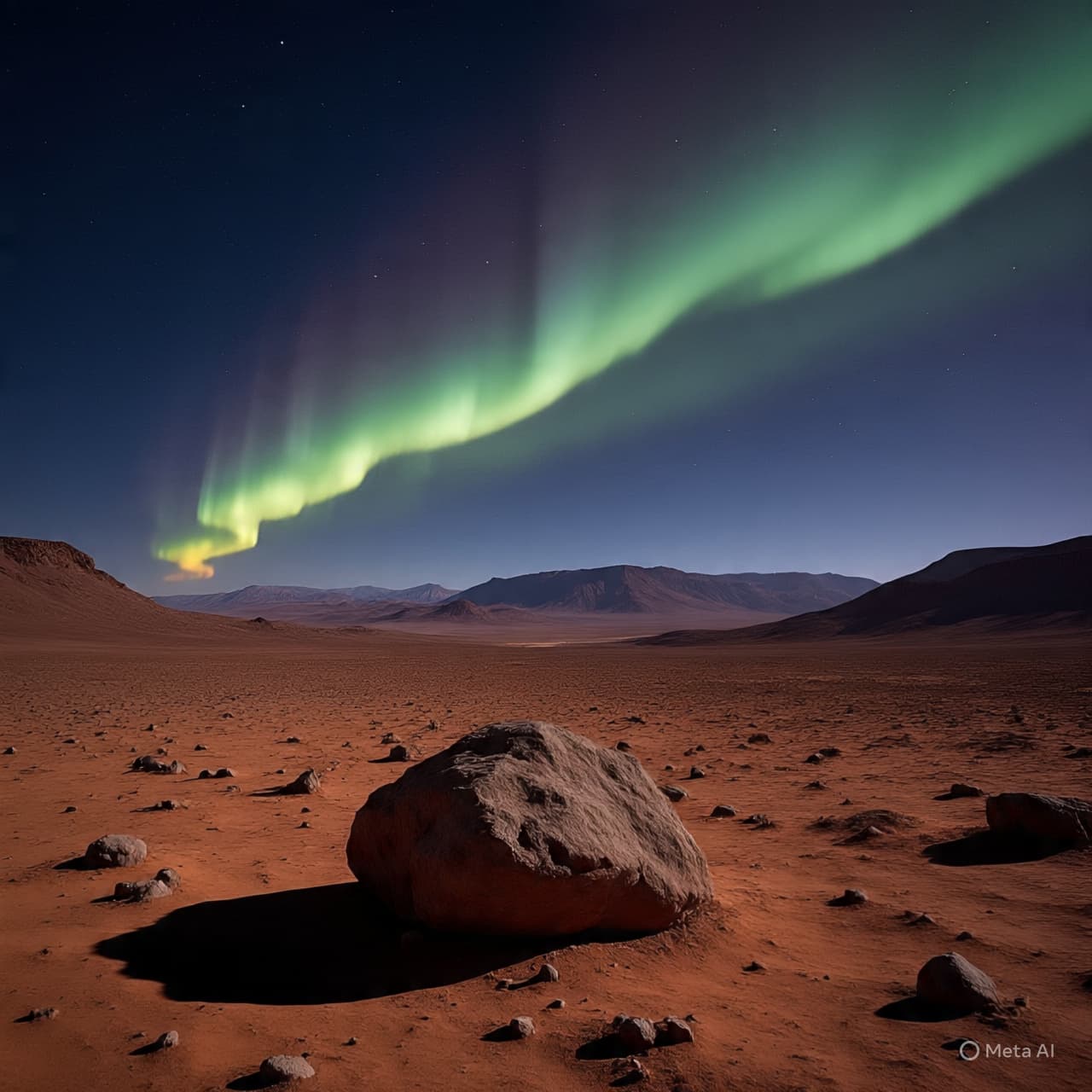
Yet when night photography does occur, it uncovers scenes that feel almost intimate. Faint aurorae have been detected rippling across the Martian sky, not dancing visibly to the human eye, but glowing in ultraviolet wavelengths. Unlike Earth’s polar light shows, Mars’ aurorae are scattered and subtle, shaped by a patchwork magnetic field left behind by an ancient planetary core. They appear quietly, without spectacle, like brief memories passing through the atmosphere.
Below the sky, darkness also reveals the planet’s hidden architecture. Openings in the surface, believed to be entrances to lava tubes, appear as deep black holes against rust-colored plains. These features, photographed from orbit, suggest sheltered spaces beneath the surface where temperatures remain stable. Scientists study them not as mysteries alone, but as potential refuges for future exploration.
Occasionally, Mars becomes a witness rather than the subject. Rare interstellar objects and distant comets have passed through the inner solar system while Mars’ instruments were watching. From this quiet vantage point, the planet has contributed to observations of travelers that did not originate around our Sun, reminding researchers that Mars, too, is part of a much larger cosmic neighborhood.
These images are few, carefully selected, and often technically imperfect. Yet their value lies in what they suggest rather than what they show. Night photography on Mars remains rare, constrained by environment and technology, but each successful frame adds depth to how the planet is understood. As missions continue, scientists expect more moments like these, recorded slowly, one night at a time.
AI Image Disclaimer
Visuals used in this article were created with AI tools and serve as conceptual illustrations, not real photographs.
Confirmed sources include:
NASA
BBC News
National Geographic
Scientific American
Reuters
Published by Banx Network. This article is part of the Banx decentralized media programme, powered by the BXE token on the XRP Ledger.