
Key Highlights
- Incident:An express commuter train derailed in rural Nagano, Japan.
- Injuries:Fifteen passengers were injured, with varying degrees of severity.
- Response:Emergency crews and railway officials are investigating the cause.
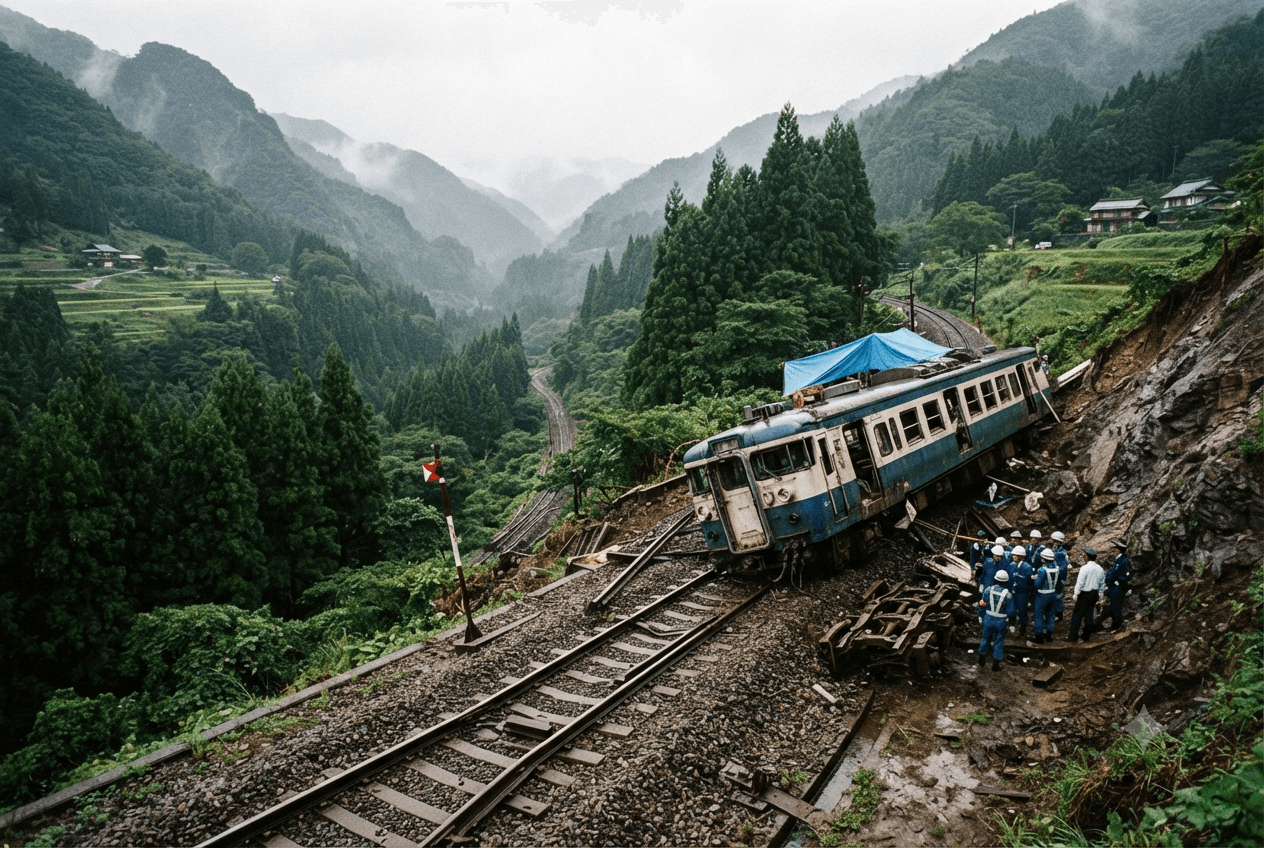
Nagano, Japan—In the early hours of the morning, an express commuter train derailed along a steep curve in rural Nagano, resulting in the lead passenger carriage tipping onto its side. The incident occurred just before sunrise, as heavy rain fell on the dense mountain forest surrounding the railway tracks. Passengers experienced a sudden jolt as the emergency brakes engaged, causing them to slam against their seats. Fire rescue crews arrived swiftly, equipped with hydraulic cutting tools and stretchers, to assist the injured travelers. Paramedics treated fifteen individuals at the scene, and medical teams promptly transported them to nearby hospitals for further evaluation.
Initial inspections by railway engineers revealed that mudslide debris had obstructed the track bed, leading to the derailment. Under portable halogen floodlights, engineers examined twisted rail segments while transport ministry investigators boarded rail inspection vehicles to survey the site. In a press conference, company executives expressed their apologies for the incident, and maintenance records from the local rail depot were scrutinized closely.
At local hospitals, fifteen patients were admitted with minor to moderate injuries, including whiplash and potential bone fractures. Attending physicians worked diligently to assess the extent of the injuries. Meanwhile, representatives from the railway company visited the injured passengers to offer formal apologies. Local community volunteers provided hot tea and blankets to stranded commuters, while station operators managed large crowds of travelers seeking ticket refunds and alternative transportation. The automated reservation systems experienced significant strain, crashing under the heavy demand.
In response to the derailment, rail safety regulators ordered immediate safety checks across all regional mountain lines. Maintenance supervisors began reviewing slope stability sensors that had been installed along vulnerable tracks. Transport unions called for improved weather monitoring protocols during the heavy seasonal rains that often affect the region. Independent rail analysts raised concerns about the frequency of track inspections in remote areas, questioning whether current practices were sufficient to ensure passenger safety.
As recovery efforts continued, repair crews worked tirelessly to hoist the derailed cars back onto the tracks. Heavy recovery cranes were deployed to lift damaged carriage sections onto flatbed rail transporters. Track maintenance teams replaced warped steel rails and shattered wooden ties to restore the railway infrastructure. Normal train operations remained suspended pending a full safety sign-off, leaving commuters crowded in platform waiting areas as alternative bus services were organized to accommodate those affected by the disruption.
The stock shares of the rail operator experienced a sharp decline during morning trading sessions, reflecting investor concerns over the incident and its implications for the company's operational safety. Public relations teams from the railway company released hourly updates regarding ongoing line clearance efforts, aiming to keep the public informed as the situation developed.
Published by Banx Network. This article is part of the Banx decentralized media programme, powered by the BXE token on the XRP Ledger.



