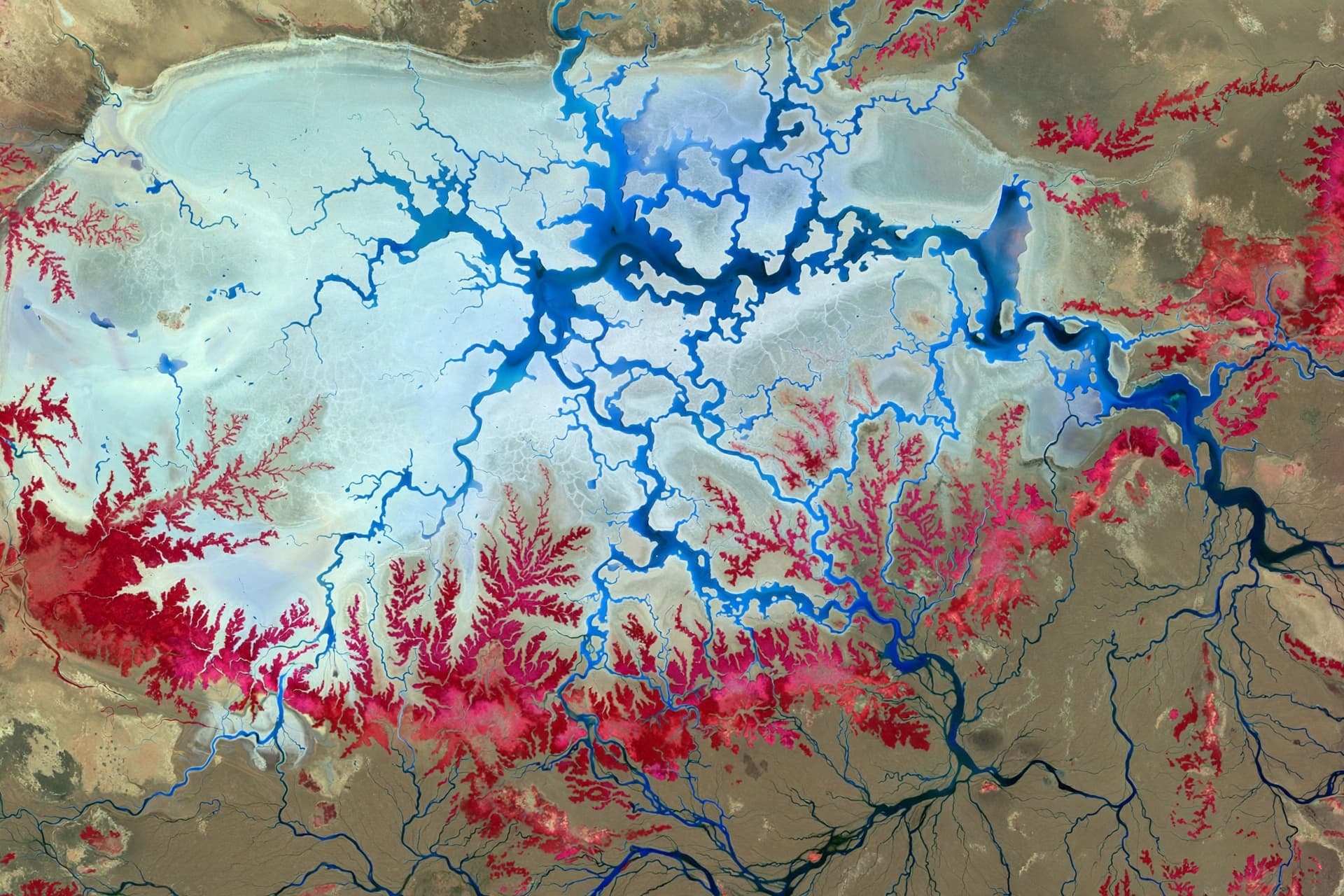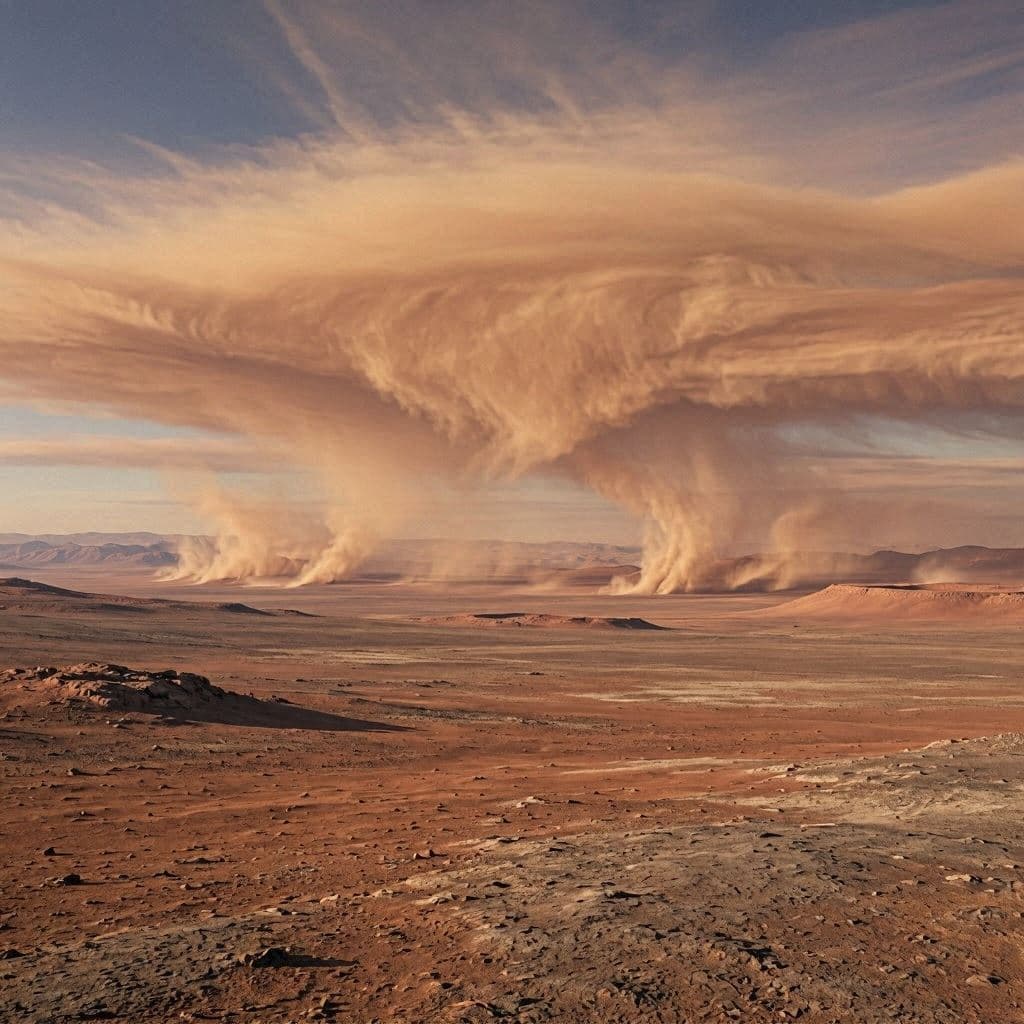
The landscapes of Mars often appear still, as though time itself has slowed beneath a pale salmon-colored sky. Yet beneath that quiet appearance lies a restless atmosphere where dust, sunlight, and wind continually reshape the planet. What seems like an empty desert from afar is, in reality, a dynamic world governed by weather patterns unlike any found on Earth. Among the greatest challenges facing scientists is what many describe as Mars' "double storm problem"—the interaction between regional and global dust storms.
Unlike Earth, where rain frequently washes particles from the atmosphere, Mars is exceptionally dry. Fine dust covers much of its surface, and seasonal winds regularly lift these particles into the air. Most storms remain local or regional, affecting areas hundreds to thousands of kilometers across. However, under favorable seasonal conditions, several regional storms can expand and merge until they envelop nearly the entire planet in a massive global dust storm.
These two types of storms influence Mars in different but connected ways. Regional dust storms occur almost every Martian year and can last for days or weeks, while planet-encircling storms are much rarer, typically appearing every three to four Martian years. Once airborne, Martian dust absorbs sunlight, warming the atmosphere while simultaneously reducing the amount of sunlight reaching the surface. This feedback can strengthen atmospheric circulation and allow storms to grow even larger.
Researchers have found that even regional storms can significantly affect the planet's upper atmosphere. Observations from NASA's MAVEN spacecraft and other orbiters show that dust-driven heating allows water vapor to rise to higher altitudes, where solar radiation can break water molecules apart. Hydrogen then escapes into space more easily, gradually contributing to Mars' long-term loss of water over billions of years. During regional storms, scientists measured roughly twice as much water loss compared with similar seasons without such storms.
The consequences also extend to robotic exploration. Thick atmospheric dust reduces the sunlight available to solar-powered spacecraft, as dramatically illustrated during the global dust storm of 2018. The event ultimately ended communication with NASA's Opportunity rover after nearly fifteen years of exploration. Nuclear-powered missions such as Curiosity are less affected by reduced sunlight, but dust can still influence atmospheric measurements, visibility, and environmental conditions across the planet.
Scientists continue using orbiters to monitor the evolution of Martian weather. Instruments aboard spacecraft such as Mars Reconnaissance Orbiter, Mars Express, and MAVEN provide detailed measurements of atmospheric temperature, dust distribution, and upper-atmosphere dynamics. Together, these observations are improving forecasting models that may one day help protect future robotic missions and eventual human explorers from severe weather events.
Beyond engineering concerns, the storms offer valuable insight into the planet's history. Because dust influences atmospheric temperatures, circulation, and the escape of water into space, understanding these processes helps scientists explain how Mars transformed from a world that once possessed rivers and lakes into the cold, arid planet observed today. Each storm becomes another opportunity to study that long geological transition.
Mars' double storm problem therefore represents more than a meteorological curiosity. It is a window into the planet's evolving climate and a practical challenge for future exploration. As spacecraft continue to observe the Red Planet through changing seasons, scientists are steadily refining their understanding of how dust, atmosphere, and time have shaped one of Earth's most intriguing planetary neighbors.
AI Image Disclaimer: The accompanying illustrations are AI-generated visual interpretations based on established scientific research and are intended to represent Martian atmospheric processes rather than actual spacecraft imagery.
Sources (Verified):
NASA NASA Jet Propulsion Laboratory (JPL) NASA Earth Observatory Nature Astronomy
Published by Banx Network. This article is part of the Banx decentralized media programme, powered by the BXE token on the XRP Ledger.