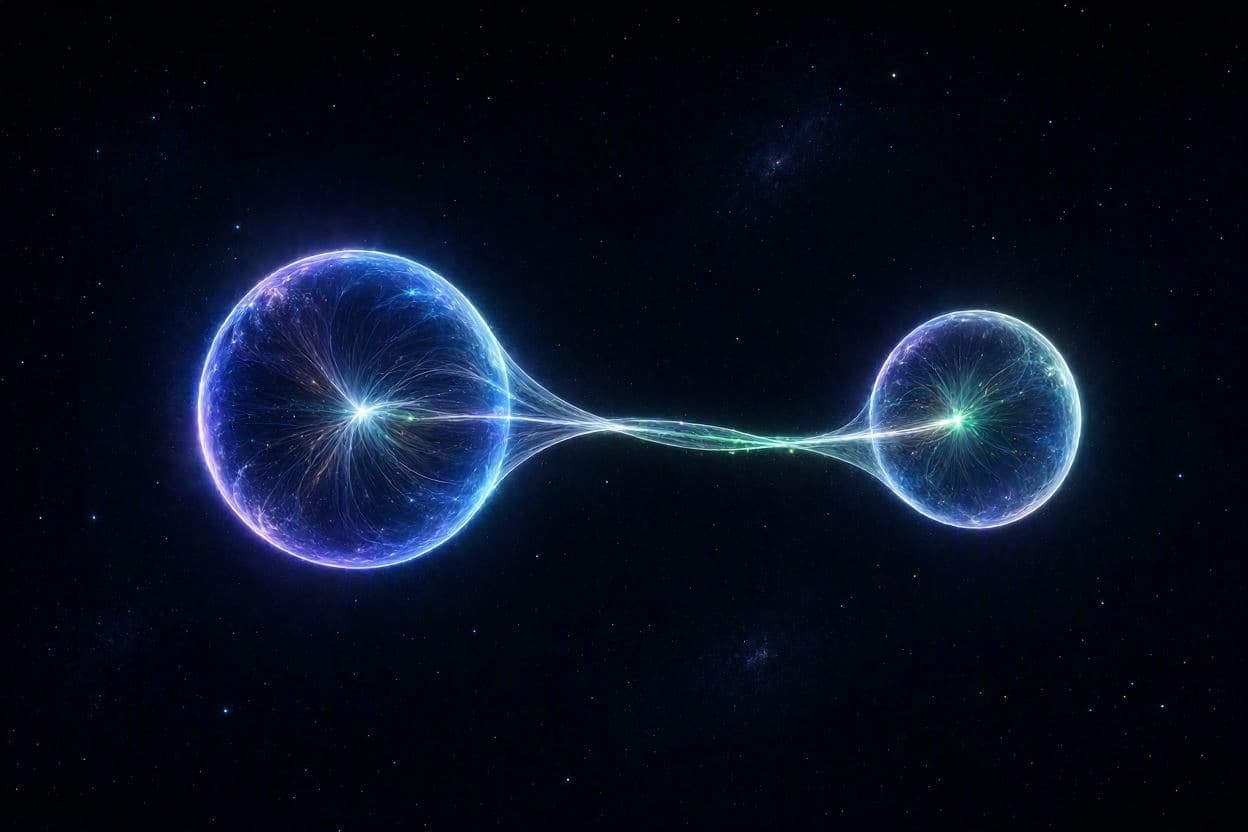
In the subatomic realm, reality behaves in ways that defy our everyday intuition. Particles can exist in multiple states at once, and pairs of them can remain connected across vast distances, a phenomenon known as quantum entanglement. While this strange behavior has been observed in photons and electrons, confirming it in heavier, short-lived particles has proven elusive. Now, researchers at the Large Hadron Collider (LHC) have reported evidence of entanglement in Z bosons, marking a significant milestone in our understanding of quantum mechanics at high energies.
Z bosons are fundamental particles that mediate the weak nuclear force, one of the four fundamental forces of nature. They are produced in high-energy collisions at the LHC and decay almost instantly into other particles. Studying their quantum properties requires precise measurements of these decay products, as the bosons themselves cannot be observed directly. The recent analysis focused on the angular correlations between the particles produced from Z boson pairs, looking for patterns that could only be explained by entanglement.
The confirmation of entanglement in Z bosons extends the reach of quantum theory into the domain of high-energy physics. Previously, tests of quantum non-locality were largely confined to low-energy systems. By demonstrating that entanglement persists in massive, unstable particles, scientists are probing the limits of quantum mechanics and testing whether it holds true under extreme conditions. This has implications for our understanding of the early universe, where such particles were abundant.
The experimental setup involved the ATLAS detector, one of the largest and most complex scientific instruments ever built. By analyzing billions of collision events, researchers were able to isolate the specific signatures of entangled Z bosons. The statistical significance of the results meets the rigorous standards required for discovery in particle physics, providing strong evidence for the phenomenon.
This finding also has potential applications in quantum information science. While Z bosons are not practical for building quantum computers due to their instability, understanding how entanglement works in different systems can inform the development of more robust quantum technologies. It helps physicists refine their models of decoherence, the process by which quantum systems lose their coherence and behave classically.
The collaboration between thousands of scientists from around the world was essential to this achievement. The LHC represents a pinnacle of international cooperation, where shared goals transcend national boundaries. The discovery of entanglement in Z bosons is a testament to the power of collective effort and the pursuit of fundamental knowledge.
As we delve deeper into the quantum world, each discovery adds a piece to the puzzle of reality. The confirmation of entanglement in Z bosons reminds us that the universe is far more interconnected and mysterious than we often assume. It invites us to question our assumptions and embrace the wonder of the unknown.
In the fleeting existence of a Z boson, we find a lasting truth about the nature of connection. It is a reminder that even in the smallest fragments of matter, the threads of quantum mechanics weave a complex and beautiful tapestry.
AI Image Disclaimer: The images accompanying this article are AI-generated artistic interpretations of particle collisions and quantum concepts, not actual data visualizations from the LHC.
Sources: CERN Physical Review Letters ScienceDaily
Published by Banx Network. This article is part of the Banx decentralized media programme, powered by the BXE token on the XRP Ledger.