
Key Highlights
- Magnitude:A 5.5-magnitude earthquake struck the Andes region of Peru late Saturday night.
- Casualties:Six people have been confirmed dead, with over 30 injured.
- Emergency Response:Local authorities and the military are mobilizing to assist affected residents.
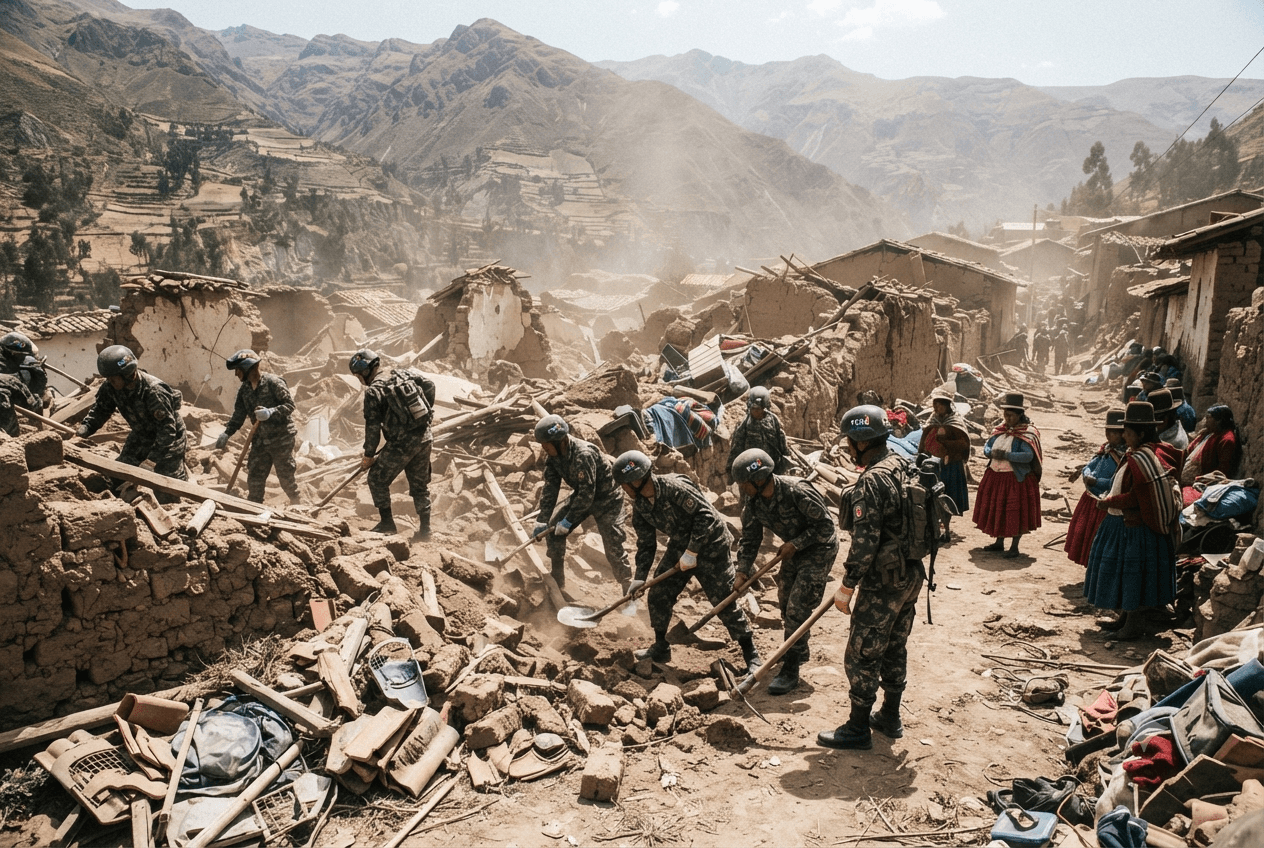
Huancayo, Peru—The earth buckled late Saturday night, sending a 5.5-magnitude shockwave through the rural heart of the Andes. Emergency responders reached the village of Pumpunya by dawn, finding the landscape transformed by collapsed mud and stone housing. Official counts confirmed six deaths within hours of the first tremors, with more than 30 people treated for injuries ranging from deep lacerations to broken bones.
The quake struck with a shallow depth of ten kilometers, which amplified the destruction of local infrastructure. Dust hung in the air for hours as residents clawed at the debris of their own homes. Local officials confirmed that the historic Santiago de León Church and Monastery suffered critical structural failures, highlighting the vulnerability of traditional buildings in seismic events.
Government agencies mobilized the Peruvian Army to assist in search efforts. Heavy machinery remained stalled on narrow, damaged mountain roads for much of the morning, forcing soldiers to rely on hand tools to shift fallen adobe bricks. Public anxiety escalated as families searched for those still missing beneath the broken masonry, underscoring the urgency of the situation.
Luis Vasquez, the regional civil defense lead, spoke at a makeshift command post near the epicenter. He noted that the reliance on traditional building materials directly fueled the high casualty rate, as these structures lack the elasticity required to withstand even moderate seismic activity. He confirmed that three emergency medical stations are now fully operational in the district, providing critical care to the injured.
By midday, the scale of displacement had reached 300 residents. Survivors huddled under salvaged wool blankets, refusing to return to the unstable remnants of their properties. Aftershocks rattled the area throughout the morning, delaying the arrival of heavy clearance equipment. Regional authorities in Junín are finalizing a state of emergency to facilitate aid and recovery efforts.
As the sun climbed higher, supplies remained scarce. Local volunteers distributed meager rations of water and bread to the shivering survivors, while communication lines remained spotty, hampering the coordination of aid deliveries from the capital. The military established a perimeter around the most dangerous sectors of the village to ensure safety as rescue operations continued.
Prime Minister Luis Arroyo Sánchez arrived by helicopter to assess the damage firsthand. He walked through the wreckage of local schools and damaged health centers, promising a swift deployment of relief funds to rebuild the shattered municipal grid. Residents watched in silence, waiting for concrete help rather than official visits, reflecting their desperation and need for immediate assistance.
Search teams began marking buildings that were deemed beyond repair, with plans for demolition to prevent further accidents. The immediate focus remains on locating anyone trapped under the fallen walls, as the situation on the ground remains fluid with the approach of darkness once more.
Published by Banx Network. This article is part of the Banx decentralized media programme, powered by the BXE token on the XRP Ledger.



