Banx Media Platform logo
WORLD

Punishment as Policy: The City-State’s Hard Line

Singapore’s parliament has expanded the list of offenses punishable by caning — a reminder that the city-state still believes deterrence can be physical, not just legal.

S

Siti Kurnia

EXPERIENCED
5 min read
12 Views
Credibility Score: 100/100
Punishment as Policy: The City-State’s Hard Line

There is a certain cold efficiency in the way Singapore writes law. Its parliament is famous for technical language, precise clauses, clean punctuation, and a belief that rules — if engineered well — actually discourage chaos. It is the city-state’s operating system. It is its myth of order turned into public code.

And this week, that code was tightened. Lawmakers in Singapore have expanded the list of offenses that can be punished by caning. On paper, this is just a legislative amendment. But beneath the clean clinical surface is a philosophical declaration: the state is not abandoning its most physical form of punishment. It is updating it.

Supporters of the bill argue this is a continuation of Singapore’s long tradition of deterrence — clear lines, bright lines, lines that make the cost of wrongdoing instantly legible. Critics abroad — more than at home — often point out that physical punishment is an outdated artifact of colonial legal history. Singapore does not seem particularly moved by that critique. And maybe that is the point: Singapore is a city-state that believes in the credibility of consequences. It believes social cohesion must be defended through architecture (CCTV, urban planning), economics (high employment, stable inflation), and law (harsh on drugs, harsh on violence, harsh on predation). In this worldview, punishments are not medieval. They are mechanical. So the update to the caning list is not the “return” of anything.

It is the continuation of a governance philosophy that never left. And in a region where public trust in institutions is becoming more fragile, Singapore, paradoxically, doubles down on something ancient — with the confidence of something modern. Because here, justice still has muscle memory. And that muscle is written into statute.

AI image disclaimer Illustrations are conceptual visualizations, not literal photos.

Published by Banx Network. This article is part of the Banx decentralized media programme, powered by the BXE token on the XRP Ledger.

#Law#SINGAPORE
Decentralized Media

Powered by the XRP Ledger & BXE Token

This article is part of the XRP Ledger decentralized media ecosystem. Become an author, publish original content, and earn rewards through the BXE token.

Newsletter

Stay ahead of the news — and win free BXE every week

Subscribe for the latest news headlines and get automatically entered into our weekly BXE token giveaway.

No spam. Unsubscribe anytime.

Share this story

Help others stay informed about crypto news

Related articles

Keep exploring the latest stories.

View more
Cargo Vessel Disaster, Central Coast: Ship Overturns During Sudden Squall, Causing Four Crew Deaths Offshore

Cargo Vessel Disaster, Central Coast: Ship Overturns During Sudden Squall, Causing Four Crew Deaths Offshore

A cargo vessel overturned during a sudden squall off the central coast of Vietnam on September 4, 2026, causing four crew deaths.

Industrial Accident, China: Factory Chemical Leak Triggers Toxic Vapor Exposure, Resulting in Three Fatalities

Industrial Accident, China: Factory Chemical Leak Triggers Toxic Vapor Exposure, Resulting in Three Fatalities

The Paper reported on September 4, 2026 that a factory chemical leak triggered toxic vapor exposure in China, resulting in 3 fatalities.

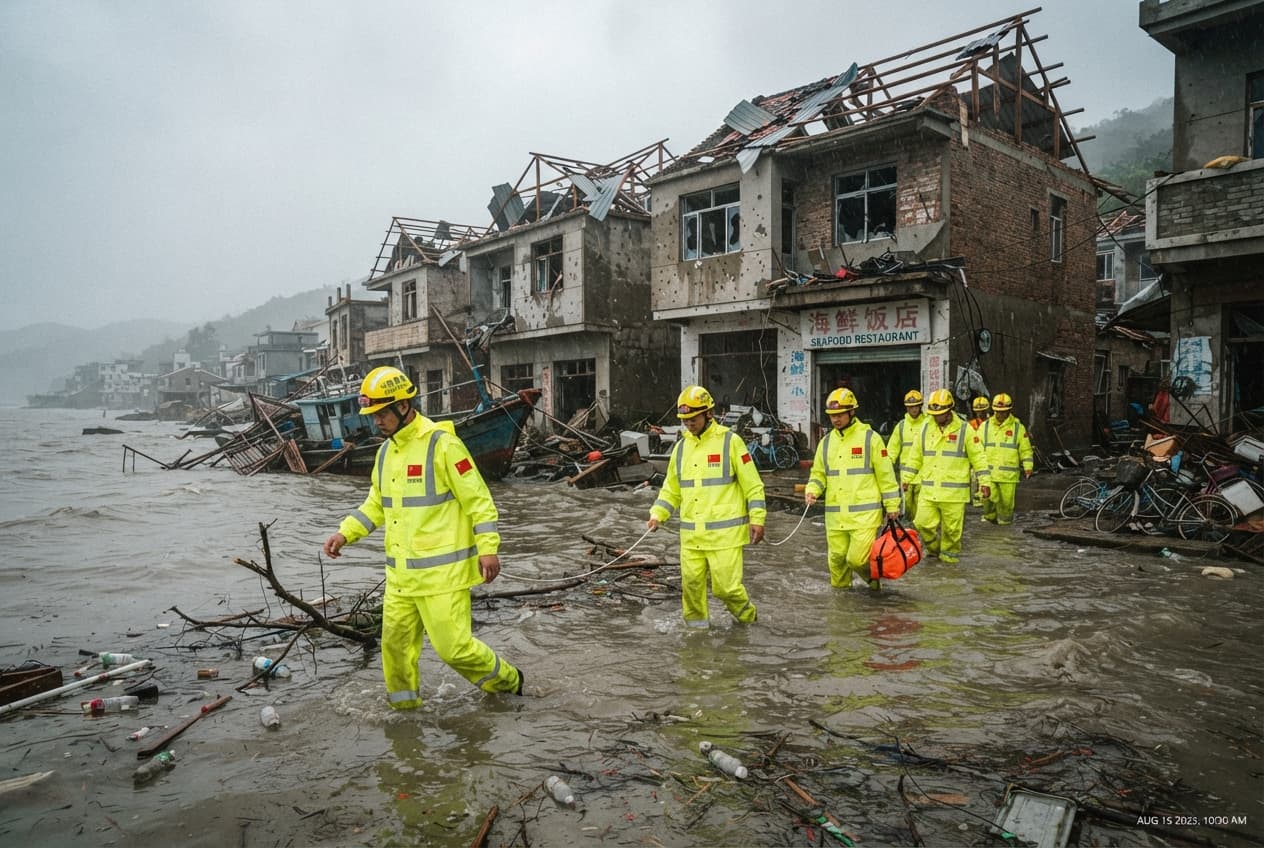
Coastal Storm Disaster, Wenzhou: Category Typhoon Landfall Destroys Buildings and Claims Nine Lives in Regional Towns

Coastal Storm Disaster, Wenzhou: Category Typhoon Landfall Destroys Buildings and Claims Nine Lives in Regional Towns

Typhoon landfall struck coastal towns in Wenzhou on September 4, 2026, causing widespread roof collapses and nine fatalities across the region.