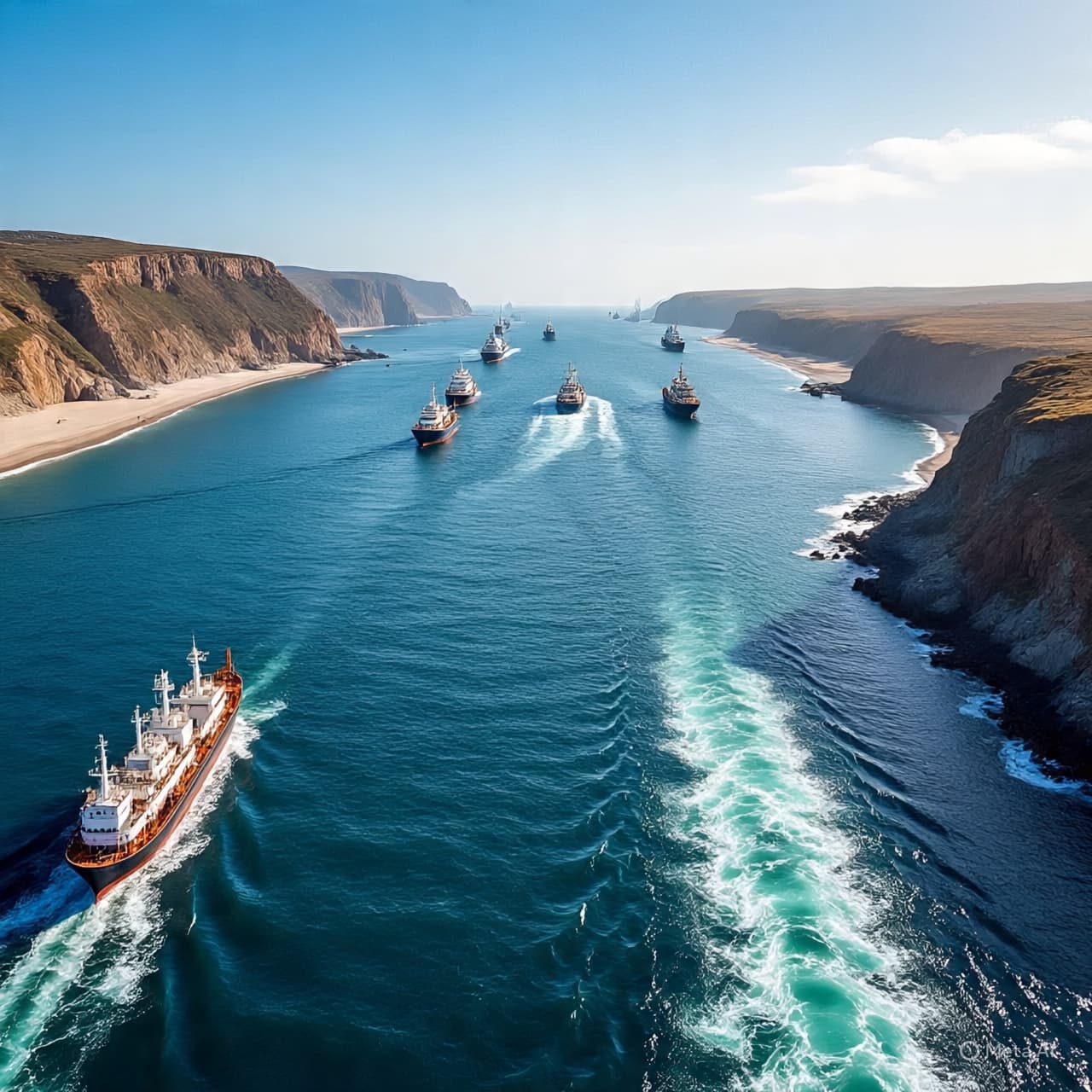
There are questions that move like currents beneath the surface—quiet at first, then gradually pulling attention toward them. They do not always announce themselves directly, but they gather weight as events unfold, inviting reflection on what may be happening beyond what is immediately visible.
In recent discussions surrounding the Strait of Hormuz, one such question has emerged: whether Iran is benefiting financially from the tensions affecting this critical maritime passage. The idea itself does not rest on a single event, but rather on the interplay between disruption, perception, and the economics of global trade.
The Strait of Hormuz has long been recognized as one of the world’s most vital shipping routes, particularly for energy supplies. Any uncertainty in its security tends to ripple outward, influencing oil prices, insurance costs, and shipping decisions. In such an environment, even the suggestion of instability can carry measurable financial consequences.
Some analysts suggest that heightened tensions can indirectly contribute to increased revenues for oil-producing states, including Iran. When risks to shipping rise, global energy markets often respond with price adjustments. These shifts, in turn, can create conditions in which exporters receive higher returns for their output, even if volumes remain constant or constrained.
At the same time, the situation is not so easily defined. Iran’s economic position is shaped by a range of factors, including sanctions, production limits, and access to markets. Any potential financial gains from rising prices are therefore balanced against structural constraints that limit the extent to which such gains can be realized.
There is also the question of intent. While speculation may arise about whether disruptions could be leveraged for economic benefit, official positions tend to emphasize stability and the continued flow of shipping—particularly for vessels deemed non-hostile. Public statements have generally framed the Strait as open, even as tensions persist around it.
For global markets, the perception of risk often matters as much as the reality. Insurance premiums for shipping through the region can rise in response to uncertainty, and companies may adjust routes or schedules accordingly. These changes create a complex web of economic effects, some direct, others more diffuse.
Observers note that in such conditions, financial outcomes are rarely straightforward. Gains in one area may be offset by losses in another, and short-term fluctuations do not always translate into sustained advantage. The relationship between tension and economic benefit is therefore best understood as conditional, rather than certain.
There is, too, a broader dimension to consider. The stability of key waterways is closely tied to global confidence. Prolonged uncertainty can have far-reaching implications, affecting not only regional actors but economies across the world. In this sense, the question extends beyond any single country.
And so the inquiry remains open-ended. Is Iran “cashing in” on the situation, or simply navigating a complex and evolving landscape where outcomes are shaped by multiple forces at once? The answer may lie somewhere in between—less a clear conclusion, more a reflection of the uncertainties that define the moment.
For now, officials and analysts continue to monitor developments in the Strait of Hormuz, with no definitive evidence of direct financial gain tied specifically to blockade conditions, even as market dynamics remain sensitive to ongoing tensions.
AI Image Disclaimer Visuals are created with AI tools and are not real photographs.
Source Check Credible coverage and analysis related to this topic exists. Key outlets discussing it include:
Reuters BBC News Financial Times The Wall Street Journal Bloomberg
Published by Banx Network. This article is part of the Banx decentralized media programme, powered by the BXE token on the XRP Ledger.