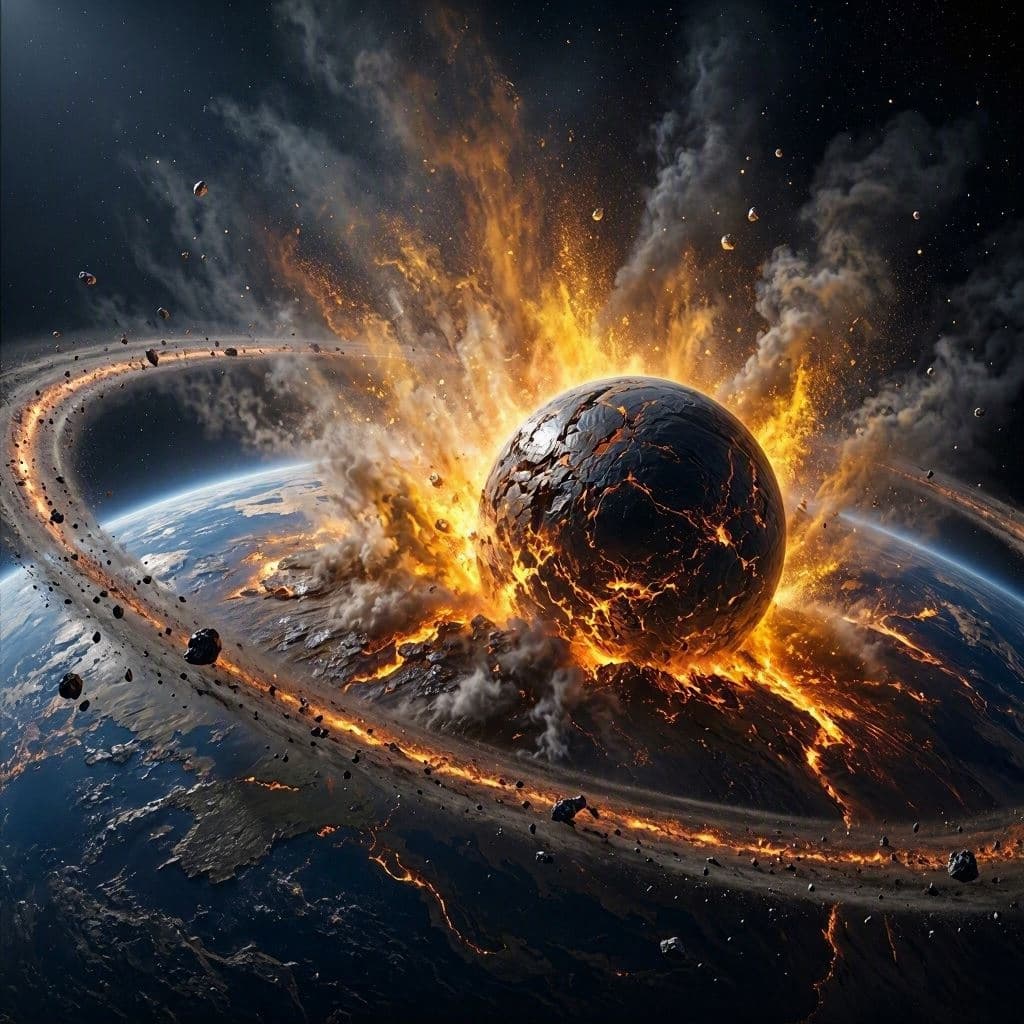
Our origin story is written in the rocks beneath our feet, a narrative of violence and creation that shaped the world we know. Scientists have identified potential remnants of Theia, the ancient protoplanet that collided with Earth billions of years ago to form the Moon. This discovery invites reflection on the chaotic early history of our solar system and the serendipitous events that made life possible. It is a moment where the past reaches out to touch the present, revealing the cosmic ancestry of our home.
The collision, known as the Giant Impact Hypothesis, is believed to have ejected debris that coalesced into the Moon. For decades, Theia’s fate was a mystery, thought to have been mostly incorporated into Earth’s mantle or lost to space. Impact shapes destiny. Debris builds moons.
New geochemical analyses of deep mantle rocks suggest that distinct isotopic signatures match those expected from Theia. These findings provide tangible evidence of the alien world that once shared our orbit. Rocks hold secrets. Isotopes tell tales.
The discovery helps explain differences in the composition of Earth and the Moon, resolving long-standing questions in planetary science. It suggests that not all of Theia was mixed evenly, leaving pockets of primordial material intact. Mixing is incomplete. History remains hidden.
For astronomers, this finding validates models of planetary formation and offers clues about the frequency of such massive collisions in other star systems. Understanding our past helps predict the dynamics of exoplanets. Models guide understanding. Past predicts future.
As we continue to probe the depths of our planet, we uncover more chapters of this ancient saga. Each discovery adds depth to our appreciation of the complex processes that created our habitable world. Depth reveals complexity. Appreciation grows with knowledge.
The identification of Theia’s remnants is a testament to the power of modern analytical techniques and the persistence of scientific inquiry. The hope is for further discoveries that illuminate the dark corners of our solar system’s infancy. Inquiry lights the way. Discovery honors history.
Scientists have discovered geochemical evidence of Theia, the protoplanet that collided with Earth 4.5 billion years ago, in deep mantle rocks. This finding supports the Giant Impact Hypothesis and provides insights into the Moon’s formation. The hope is for continued research into Earth’s early history.
AI Image Disclaimer: The images provided are AI-generated to visually represent the geological and astronomical aspects of the story.
Sources: Nature Geoscience Science Daily Smithsonian Magazine Caltech
Published by Banx Network. This article is part of the Banx decentralized media programme, powered by the BXE token on the XRP Ledger.