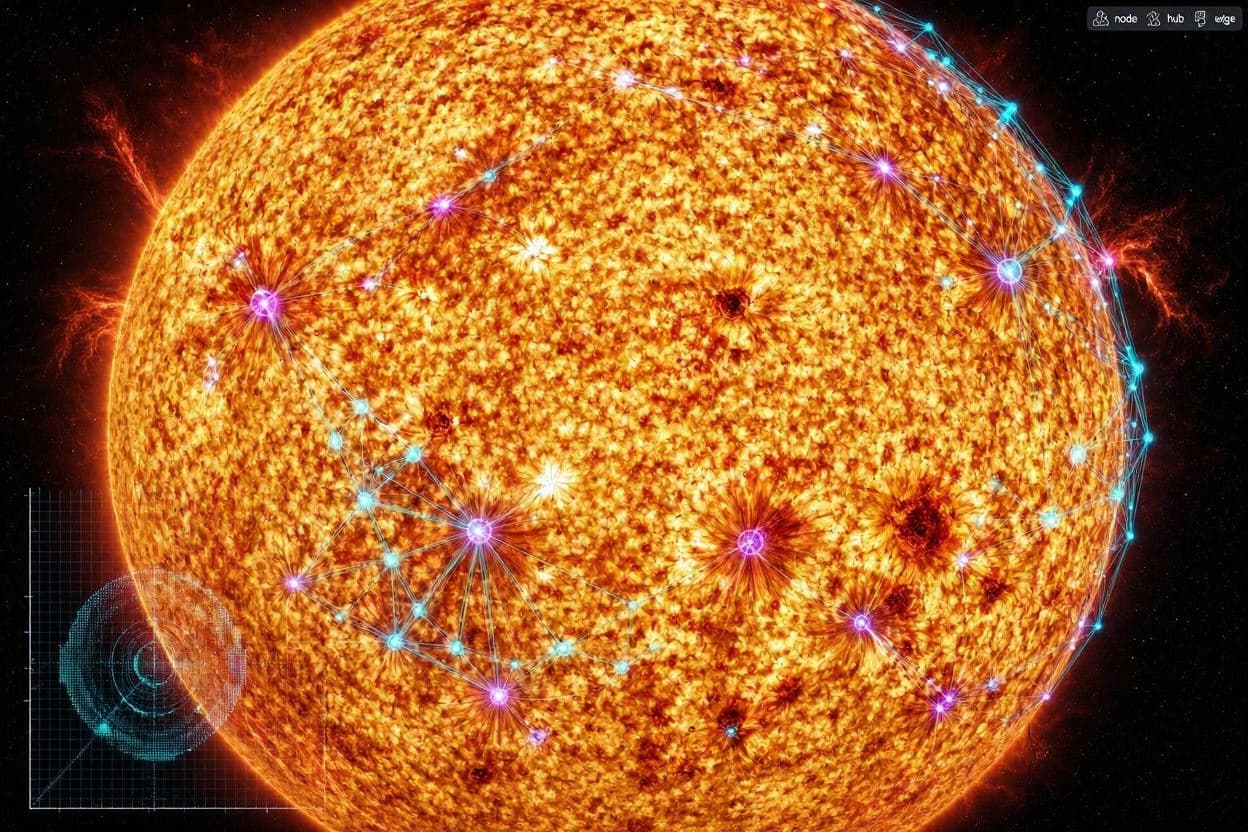
The Sun is a star of constant motion, a churning sphere of plasma that breathes fire and light into our solar system. For centuries, we have watched its spots and flares with awe and anxiety, knowing that its storms can disrupt our technology and power grids. Now, a new artificial intelligence model named COFFIES is helping us predict these stormy spots with greater accuracy. This advancement invites reflection on how machine learning is transforming our ability to foresee natural phenomena, turning chaos into pattern. It is a moment where data tames the star.
COFFIES, which stands for Convolutional Neural Network for Flare Forecasting using Integrated Solar Data, analyzes vast amounts of historical solar imagery to identify patterns preceding solar flares. Patterns hide in noise. AI finds signal.
By training on decades of observations from satellites like SDO and SOHO, the algorithm has learned to recognize the subtle magnetic configurations that lead to explosive events. Learning builds knowledge. Recognition prevents surprise.
The predictions provided by COFFIES offer valuable lead time for satellite operators and power grid managers to take protective measures. This foresight can prevent billions of dollars in damage and ensure the continuity of critical services. Foresight protects assets. Preparation ensures stability.
Traditional methods of flare prediction rely on manual analysis of sunspot complexity, which can be subjective and time-consuming. AI offers a consistent, rapid, and scalable approach that can process data in real-time. Consistency aids reliability. Speed saves time.
As solar activity enters a period of heightened intensity, the role of AI in space weather forecasting becomes increasingly vital. It represents a shift from reactive response to proactive management of solar risks. Activity demands attention. Management reduces risk.
The success of COFFIES highlights the growing partnership between astronomy and computer science, opening new avenues for understanding our nearest star. The hope is that this technology will continue to improve, offering even greater precision in the years to come. Partnership drives progress. Precision brings confidence.
The AI model COFFIES is now being used to predict solar flares by analyzing historical solar data and identifying magnetic patterns. This technology enhances space weather forecasting, helping to protect infrastructure from solar storms. The hope is for continued improvement in prediction accuracy.
AI Image Disclaimer: Visuals associated with this article are AI-generated to illustrate the themes of artificial intelligence and solar physics.
Sources: Nature Astronomy SpaceWeather.com NASA Goddard Space Flight Center Phys.org
Published by Banx Network. This article is part of the Banx decentralized media programme, powered by the BXE token on the XRP Ledger.