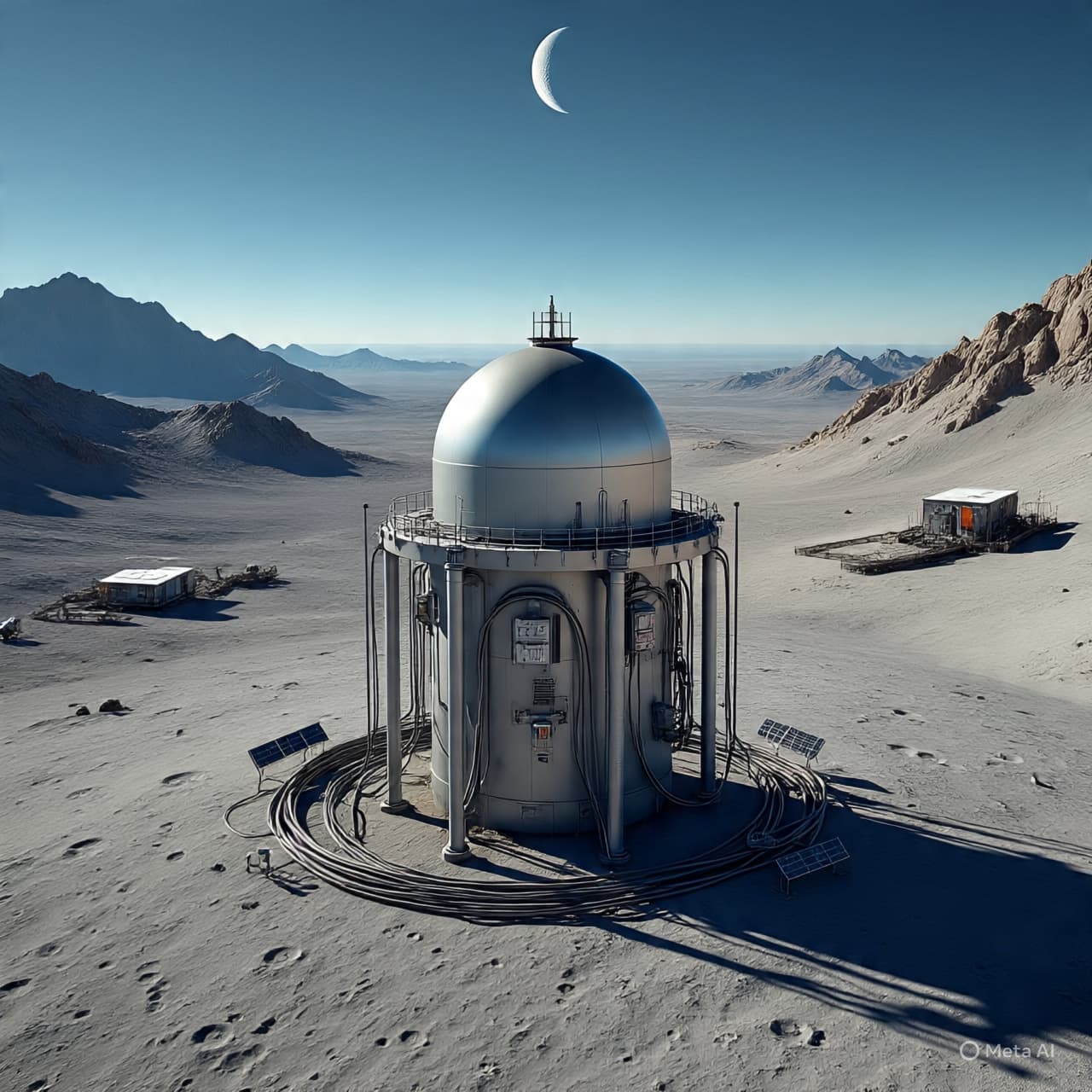
In the evolving story of humanity’s return to the Moon, a new chapter is taking shape — one that reaches far beyond rockets and rovers and into the realm of sustainable power on another world. On Tuesday, NASA and the U.S. Department of Energy (DOE) formalized a renewed collaboration to develop a nuclear fission reactor designed to operate on the lunar surface by 2030. Like a long-planned mosaic finally set into motion, this effort reflects decades of scientific ambition, strategic policy, and the practical need to provide reliable energy where sunlight alone cannot suffice.
Under a freshly signed memorandum of understanding (MOU), the two agencies will advance research and development of a fission surface power system — a nuclear reactor capable of generating continuous electrical power for future lunar missions and the broader Artemis program. This initiative builds on longstanding collaboration between NASA and DOE, and embodies goals outlined in recent U.S. national space policy to cement American leadership in space exploration and infrastructure.
Unlike solar panels that falter during the Moon’s long night, a nuclear reactor promises energy that does not depend on sunlight or temperature swings, enabling year-round operations of habitats, scientific instruments, and in-situ resource utilization systems. Continuous power will be critical for sustained human presence on the Moon, especially in permanently shadowed regions near the lunar poles where explorers hope to tap water ice and conduct long-duration missions.
Both agencies anticipate that the reactor will be safe, efficient, and capable of operating for years without refueling, laying the groundwork not only for permanent lunar bases but also for future crewed missions to Mars. Officials from NASA and DOE describe the collaboration as part of a broader legacy of American science and innovation, linking past achievements such as the Apollo program with tomorrow’s milestones in space power and exploration.
Still, reaching a functional lunar nuclear reactor by 2030 remains an ambitious target, requiring not just technological progress but also careful attention to safety, engineering challenges and regulatory approvals inherent in launching and operating nuclear systems beyond Earth. As the decade unfolds, this bold project will be watched closely by scientists, policymakers, and space enthusiasts alike — a testament to humanity’s deepening footprint off our home planet.
AI Image Disclaimer “Illustrations were produced with AI and serve as conceptual depictions.”
Sources NASA official release Energy.gov (U.S. Department of Energy) Space.com Interesting Engineering Times of India
Published by Banx Network. This article is part of the Banx decentralized media programme, powered by the BXE token on the XRP Ledger.