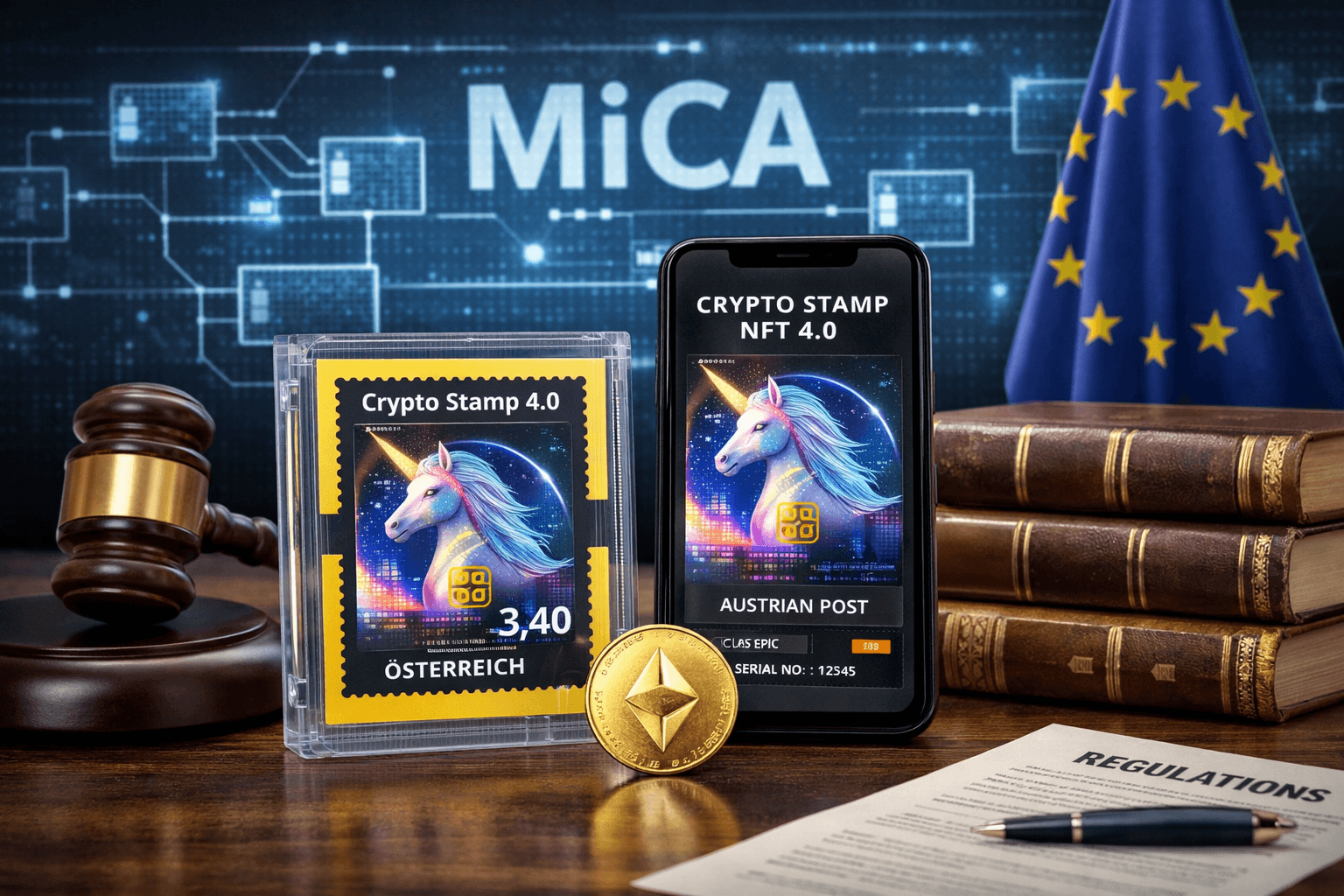
When it comes to innovation, the Österreichische Post has a peculiar talent: it manages to turn something as stubbornly analog as a postage stamp into a digital conversation piece for crypto nerds, lawyers, and collectors alike. The now-famous Crypto Stamps were less a gimmick than proof that blockchain can work in places where you least expect it—right at the post office counter.
Now, according to industry and insider sources, signs are pointing to the next evolutionary step. And this one is less playful, but far more strategically mature.
From “NFT Toy” to MiCA-Compliant Digital Collectible The upcoming generation of Crypto Stamps is expected to be fully MiCA-compliant. That may sound dry, but it’s actually a very clever move. MiCA—the EU’s Markets in Crypto-Assets regulation—forces projects to define precisely what a token is: a means of payment, a security, a utility token, or simply a digital collectible.
The Post is reportedly choosing the last option with intention. The new Crypto Stamps are to be clearly classified as digital collectibles, potentially bundled with defined usage rights, but explicitly without any promise of financial returns. In regulatory terms: not an investment product, not a stablecoin, not a security. Just digital philately, neatly labeled.
Why This Is More Than Legal Hair-Splitting This classification is not a footnote—it’s the core of the strategy. The first NFT wave was plagued by legal gray areas: overly imaginative marketing language, unclear rights, and vague obligations. MiCA is designed to clean that up, and the Austrian Post appears to be using that cleanup operation with impressive discipline.
By making its Crypto Stamps legally “adult,” the Post achieves several things at once:
Legal clarity for buyers, who know exactly what they are purchasing—and what they are not.
Protection against later reclassification by regulators.
Compatibility with institutional partners who wouldn’t touch non–MiCA-compliant assets anyway.
In short: these NFTs are no longer shipped in a regulatory bubble envelope, but sent by registered mail with return receipt.
Usage Rights Instead of Price Fantasies One of the most intriguing aspects is the idea of usage rights. This opens up possibilities well beyond pure collecting: exclusive digital content, access to special editions, or even real-world perks within the postal ecosystem. The key point is that these rights are clearly defined and carefully framed—without drifting into promises of yield or profit.
That’s a smart balance. It combines Web3 mechanics with traditional product economics, while neatly sidestepping the regulatory tripwires that caused many NFT projects to stumble. Conclusion: When Bureaucratic Logic Suddenly Becomes Sexy
Ironically, it’s a state-linked company that is demonstrating what professional tokenization in Europe can look like: sober, well-structured, legally watertight—and precisely because of that, future-proof. This new generation of Crypto Stamps feels less like a crypto gimmick and more like a blueprint for digital collectibles in the MiCA era.
Put differently: while others are still tossing JPEGs onto blockchains, the Austrian Post is stamping its NFTs with EU law. And in its own understated way, that’s rather elegant.
Published by Banx Network. This article is part of the Banx decentralized media programme, powered by the BXE token on the XRP Ledger.