Political Landscape for crypto regulation
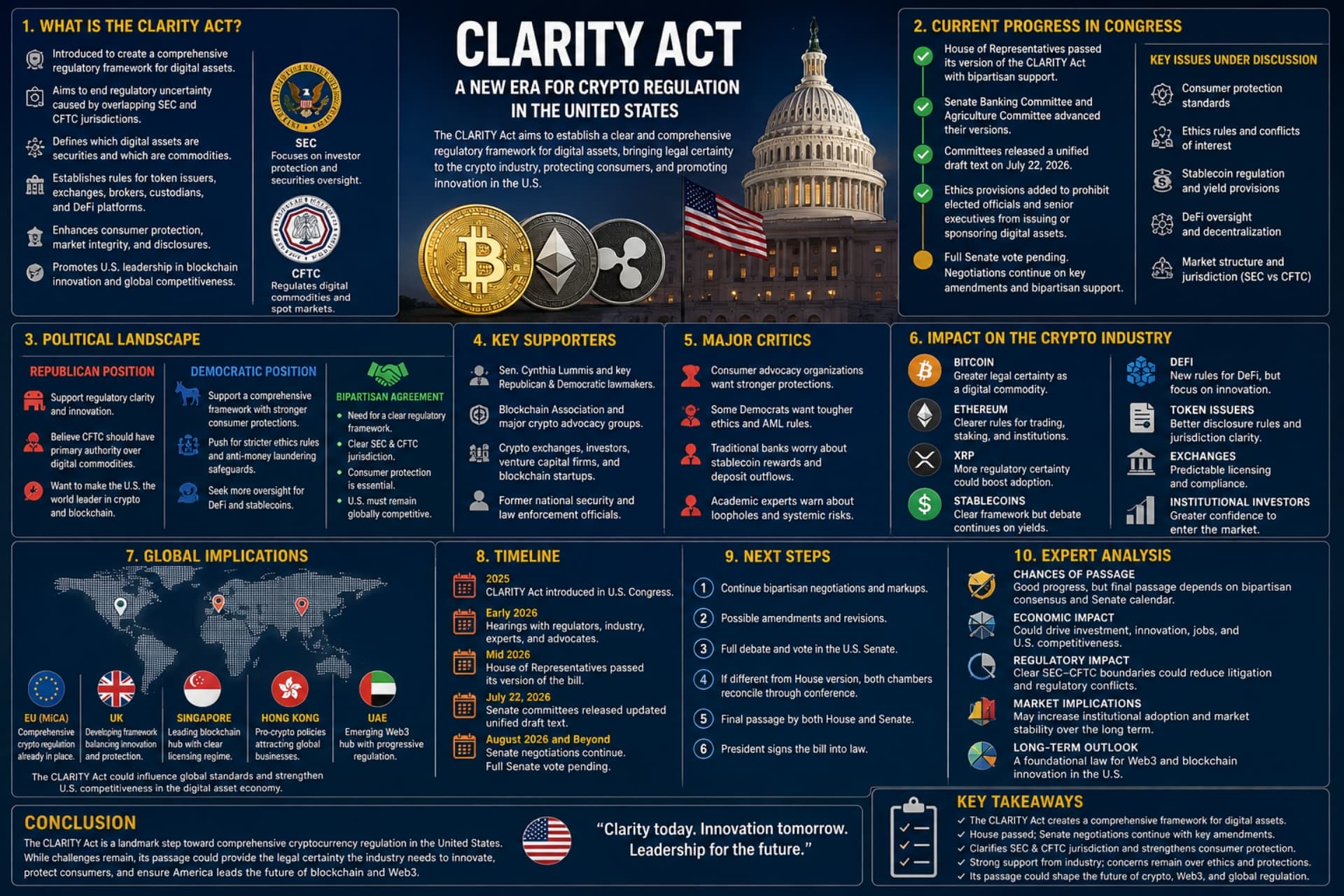
The CLARITY Act has become one of the most significant bipartisan debates on digital asset regulation in recent years. Although there is broad agreement that the United States needs clearer cryptocurrency rules, lawmakers remain divided over how those rules should be implemented.
Republican Position
Republican lawmakers have generally championed the CLARITY Act as a way to restore regulatory certainty and strengthen U.S. leadership in blockchain innovation. They argue that years of regulation through enforcement have discouraged investment, driven blockchain startups overseas, and created unnecessary legal uncertainty.
Leading Republican supporters—including Senator Cynthia Lummis and members of the House Financial Services Committee—believe the legislation would encourage innovation while preserving appropriate market oversight. They also argue that giving the Commodity Futures Trading Commission (CFTC) primary authority over qualifying digital commodities would provide a more predictable regulatory environment than the current system.
Democratic Position
Democrats have adopted a more cautious approach.
Several Democratic senators support the goal of creating a comprehensive crypto framework but insist that the legislation should include stronger consumer protections, anti-money laundering safeguards, stricter oversight of decentralized finance (DeFi), and stronger ethics provisions addressing government officials' involvement in cryptocurrency businesses.
A central point of disagreement has been the ethics language added during Senate negotiations. Some Democrats argue that the revised language still does not go far enough to prevent conflicts of interest involving senior public officials.
Areas of Bipartisan Agreement
Despite political disagreements, lawmakers from both parties generally agree that:
• The United States needs a comprehensive digital asset regulatory framework.
• Clear jurisdictional boundaries between the SEC and CFTC are necessary.
• Consumer protection should remain a priority.
• The United States should remain globally competitive in blockchain technology.
Major Disagreements
Key unresolved issues include:
• Ethics rules for senior government officials.
• Consumer protection standards.
• Regulation of decentralized finance (DeFi).
• Stablecoin reward and yield provisions.
• The precise balance of authority between the SEC and the CFTC.
These issues continue to shape negotiations as Senate leaders seek sufficient bipartisan support.
Probability of Senate Approval
At the time of writing, analysts believe Senate approval remains uncertain.
While negotiations are continuing, several policy analysts note that the legislative calendar has become increasingly crowded ahead of the August recess. Without additional bipartisan support, many observers believe passage before the recess will be difficult, although negotiations could continue afterward if congressional leadership chooses to prioritize the legislation.
1. Key Supporters
The CLARITY Act enjoys support from a broad coalition of lawmakers, blockchain organizations, and digital asset companies.
Among its leading congressional supporters is Senator Cynthia Lummis, who has played a central role in Senate negotiations. Many Republican members of both chambers have also promoted the legislation as essential to preserving American leadership in financial innovation.
Industry organizations—including the Blockchain Association and numerous digital asset advocacy groups—argue that regulatory certainty would encourage investment, create jobs, and reduce litigation. In June 2026, the Blockchain Association, joined by many former national security and law enforcement officials, urged Senate leaders to advance the bill.
Major cryptocurrency exchanges, institutional investors, venture capital firms, and blockchain startups generally support the legislation because they believe clear rules would reduce compliance uncertainty and improve long-term market confidence.
2. Major Critics
Despite broad industry support, the CLARITY Act has also attracted significant criticism.
Consumer advocacy organizations argue that certain investor protections remain insufficient, particularly regarding disclosure requirements and oversight of rapidly evolving crypto products.
Several Senate Democrats have maintained that the ethics provisions should be strengthened further before the bill advances.
Traditional banking organizations have also expressed concerns about provisions affecting stablecoins. They argue that allowing crypto firms to offer interest-like rewards on stablecoins could encourage consumers to move deposits away from commercial banks, potentially affecting lending within local communities.
Some academic experts have likewise warned that regulators should proceed carefully to avoid creating loopholes that could expose investors to excessive risk while still encouraging innovation.
3. Impact on the Cryptocurrency Industry
If enacted, the CLARITY Act would represent one of the most consequential regulatory reforms in the history of the U.S. digital asset market.
Bitcoin
Bitcoin would continue to benefit from its status as a digital commodity under federal oversight, reinforcing legal certainty for institutional investors and potentially encouraging broader adoption.
Ethereum
Ethereum would receive greater regulatory clarity regarding trading, custody, and institutional participation, reducing uncertainty that has periodically affected market sentiment.
XRP
For XRP, the legislation could be particularly significant. By establishing clearer statutory rules governing digital commodities, the CLARITY Act could strengthen long-term regulatory certainty beyond agency guidance, which many market participants view as beneficial for institutional adoption.
Stablecoins
Stablecoin issuers would receive a more comprehensive regulatory framework, although debates continue regarding interest-like rewards and consumer protections.
Decentralized Finance (DeFi)
The bill proposes new regulatory treatment for decentralized finance, but negotiations continue over how developers, interfaces, and decentralized protocols should be supervised without discouraging innovation.
Token Issuers
Projects launching new digital assets would benefit from clearer disclosure requirements and greater certainty about whether their tokens fall under SEC or CFTC jurisdiction.
Crypto Exchanges
Exchanges could gain a more predictable licensing and compliance framework, reducing legal uncertainty that has affected U.S. trading platforms for years.
Blockchain Startups
Many startups believe the legislation would reduce regulatory risk, making it easier to raise capital and build innovative blockchain products within the United States rather than relocating abroad.
Institutional Investors
Institutional investors—including banks, asset managers, pension funds, and investment firms—could gain greater confidence in entering digital asset markets once a comprehensive statutory framework replaces today's fragmented regulatory landscape.
Published by Banx Network. This article is part of the Banx decentralized media programme, powered by the BXE token on the XRP Ledger.