Key Highlights
- Economic Projection:PM Shehbaz Sharif claims Pakistan could become the sixth-largest economy by 2050.
- Goldman Sachs Comparison:This projection is 25 years earlier than Goldman Sachs' estimate of 2075.
- Investment Urgency:Sharif emphasizes the need for investment in mineral processing and manufacturing.
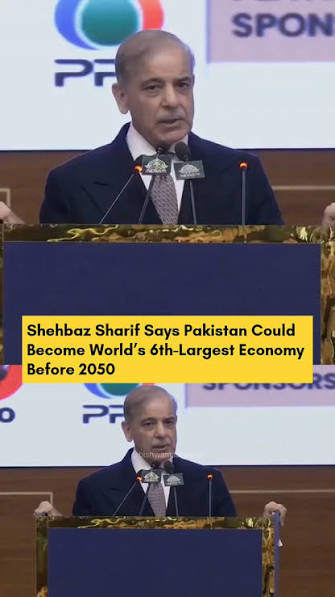
Prime Minister Shehbaz Sharif recently stated that Pakistan has the potential to become the world’s sixth-largest economy by the year 2050. This ambitious claim was made during his address at the Pakistan Minerals Investment Forum held in Islamabad. Sharif's assertion is particularly notable as it comes 25 years ahead of the projection made by Goldman Sachs, which estimated that Pakistan would reach this economic milestone by 2075, contingent upon the implementation of appropriate policies and institutional frameworks.
During his speech, Sharif highlighted the critical need for investment in the country’s mineral processing and manufacturing sectors. He pointed out that developing these industries is essential for Pakistan to harness its natural resources effectively and boost economic growth. The Prime Minister's remarks reflect a broader strategy to attract foreign investment and stimulate local industries, which are vital for the nation’s economic development.
The Goldman Sachs report, which has been referenced frequently in discussions about Pakistan's economic future, did not provide a forecast for the country achieving sixth place before 2050. Instead, it outlined a scenario where Pakistan could ascend to this rank by 2075, assuming that the necessary reforms and institutional improvements are made. Sharif's statement, therefore, represents an aspiration rather than a direct revision of the Goldman Sachs estimate.
In light of these developments, the Pakistani government is actively seeking to attract both domestic and international investors to develop its mineral resources. The country is rich in various minerals, and the government believes that with the right investments, it can significantly enhance its economic standing on the global stage.
Sharif's comments have sparked discussions among economists and industry experts regarding the feasibility of such rapid economic growth. While some analysts express optimism about Pakistan's potential, others caution that achieving such ambitious goals will require substantial reforms in governance, infrastructure, and investment climate.
As Pakistan navigates its economic challenges, the focus on mineral investment could play a pivotal role in shaping its future. The Prime Minister's call for investment is a clear indication of the government's commitment to fostering a conducive environment for economic growth and development.
In conclusion, while the timeline proposed by PM Shehbaz Sharif may seem optimistic, it underscores the government's vision for a more prosperous Pakistan. The coming years will be crucial in determining whether these aspirations can be transformed into reality through effective policy implementation and investment.
Published by Banx Network. This article is part of the Banx decentralized media programme, powered by the BXE token on the XRP Ledger.