
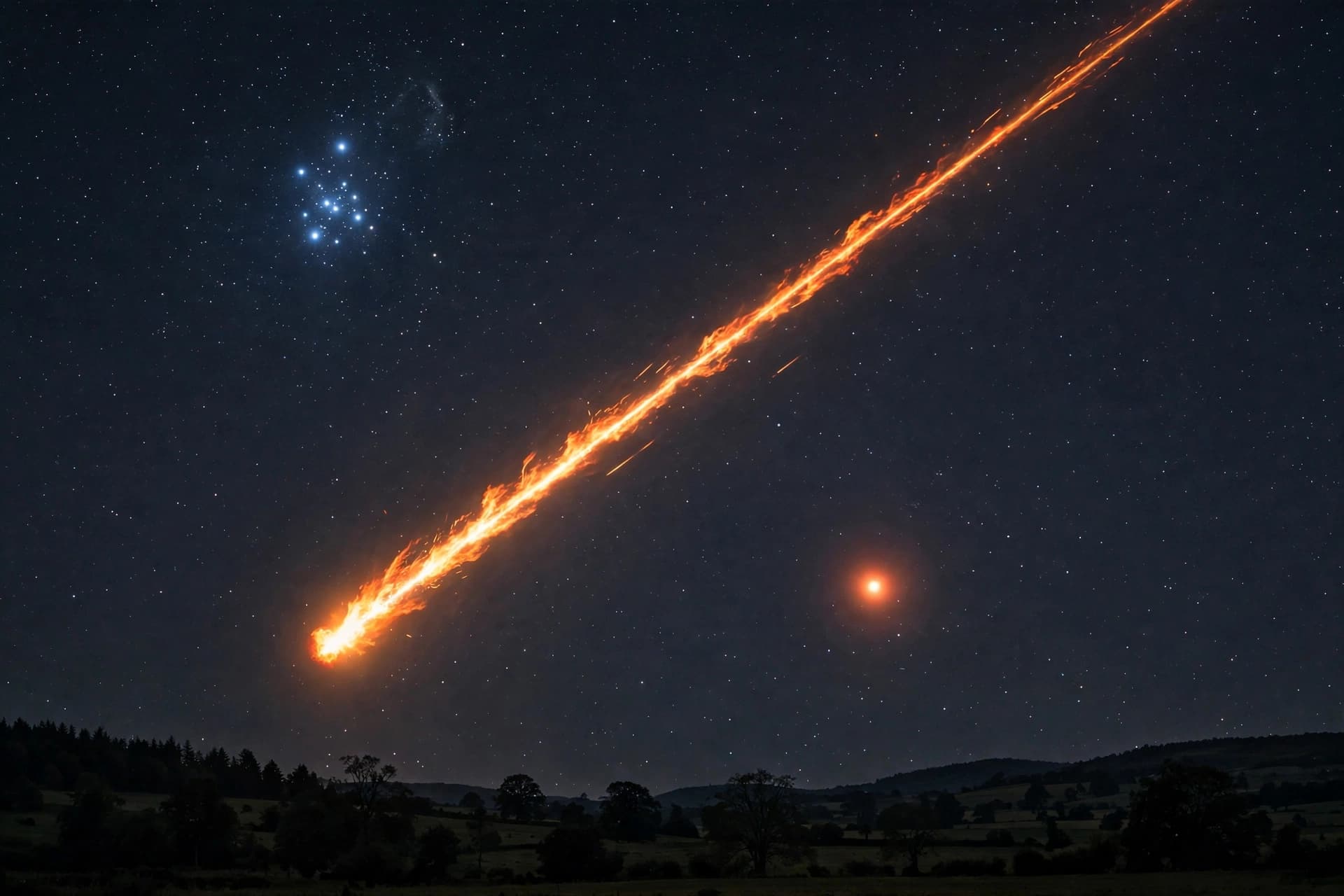
There is a particular kind of patience required for watching the Taurids. They do not arrive in the torrents of the Perseids or the Geminids, those reliable August and December shows that reward even the casual observer with dozens of shooting stars. The Taurids are different. They are sparse, yielding perhaps five to ten meteors an hour under ideal conditions. But what they lack in quantity, they make up for in character. These are the fireballs—slow, bright, lingering streaks that cross the sky with a deliberateness that feels almost theatrical, as if the universe has decided to take its time.
The Taurids are not a single shower but two overlapping streams, the Southern and Northern Taurids, both originating from debris left behind by Comet 2P/Encke . Because their radiants lie near the constellation Taurus, which sits close to the ecliptic, they are visible from both hemispheres, a rarity among meteor showers . The Southern Taurids are already active, having begun in late September, and will peak on the night of November 4-5 . The Northern Taurids become active around October 20 and peak on November 11-12 . The nickname "Halloween Fireballs" comes from the broad overlap of the two streams in late October and early November, when both are active simultaneously .
What makes a Taurid fireball worth waiting for is its pace. These meteors enter Earth's atmosphere at roughly 27 kilometers per second—comparatively slow for a meteor . That slowness allows larger fragments, some the size of pebbles or larger, to burn intensely rather than vaporize instantly, producing the brilliant, long-lasting trails that skywatchers prize . They can glow with the brightness of Venus and leave luminous streaks that persist for seconds after the meteor itself has faded . "You don't see a Taurid meteor; you watch it," as one astronomy writer put it .
This year offers a particular advantage. The moon will be a thin crescent during both peak periods, providing almost no interference with viewing . The Southern Taurids' November peak coincides with a moon just 17 percent illuminated, rising only a couple of hours before dawn . The Northern Taurids' peak in mid-November will have even darker skies, with the moon at just 5 percent illumination . Conditions, in other words, are close to ideal.
The best time to watch is after midnight, when Taurus has risen high in the sky . No special equipment is needed—just a dark location away from streetlights and a willingness to look up for an extended period. The radiant point, near the Pleiades cluster, provides a general direction, but the meteors can appear anywhere in the sky . Bring a blanket or a chair. The Taurids do not perform on demand.
There is something almost contemplative about a meteor shower like this one. It does not demand attention with a spectacle. It simply offers, now and then, a bright line drawn across the darkness—a reminder that the Earth is passing through the remnants of something ancient, and that the sky, if we are patient enough to watch it, still has stories to tell.
AI Image Disclaimer: The images accompanying this article are AI-generated and are intended for illustrative purposes only.
Sources:
· Space.com · American Meteor Society (cited within reports) · EarthSky
Published by Banx Network. This article is part of the Banx decentralized media programme, powered by the BXE token on the XRP Ledger.



