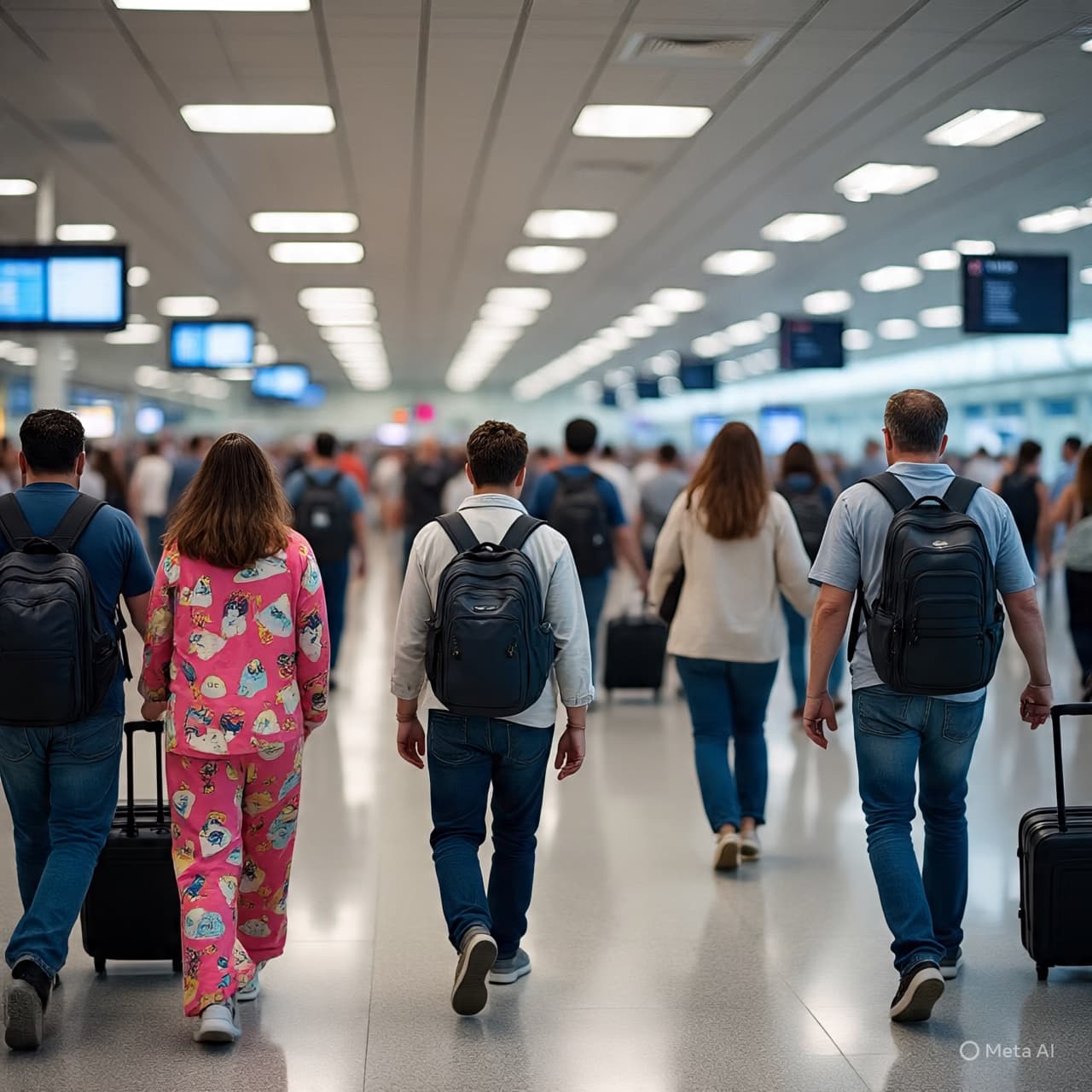
At many American airports in recent days, travelers pulling down hoodies and adjusting pajama pants at security — not out of sleepiness, but in defiance. The soft rustle of flannel and cotton has replaced the shuffle of suitcases and heels, as more people choose comfort over convention — turning a simple bedtime outfit into a subtle act of protest.
The catalyst was a plea from Sean Duffy, the U.S. Transportation Secretary, who asked travelers to “dress with respect” for air travel. He suggested that wearing jeans and a decent shirt — rather than pajamas or slippers — might help restore what he sees as civility in airports and onboard flights.
Instead of compliance, many responded with what some have dubbed “malicious compliance.” Videos began circulating on social media showing passengers arriving at check-in and boarding gates in full pajamas — sometimes with slippers — a quiet message to officials: if you suggest we dress up, we’ll show up… in pajamas.
For many travelers, the choice is about practicality and discomfort. Amid delays, cramped seats, sky-high fees, and unpredictable service, pajamas feel like a statement: comfort over conformity, ease over etiquette. As one traveler on TikTok put it: “I will be wearing my slippers.” Another added that civility has more to do with attitude than apparel.
Supporters of the protest argue that the government’s focus on dress is tone-deaf — diverting attention from real problems in air travel: delays, high costs, minimal amenities, and declining service quality. Meanwhile, critics of the “pajama protest” say it’s disrespectful — that airports deserve a baseline of decorum reflective of public spaces. The divide speaks to larger questions about entitlement, civility, and who gets to define respect.
the wave of flannel and fleece traveling through America’s airports this holiday season isn’t just about what people wear — it’s about what they demand from their travel experience. Comfort, dignity, and agency. And in a crowded terminal, that soft silhouette in pajamas might say more than a suit ever could.
AI Image Disclaimer The images accompanying this article are created with AI tools and meant solely as conceptual illustrations — they are not real photographs.
Sources The Washington Post; NDTV; Fox News; Financial Express; Yahoo News.
Published by Banx Network. This article is part of the Banx decentralized media programme, powered by the BXE token on the XRP Ledger.