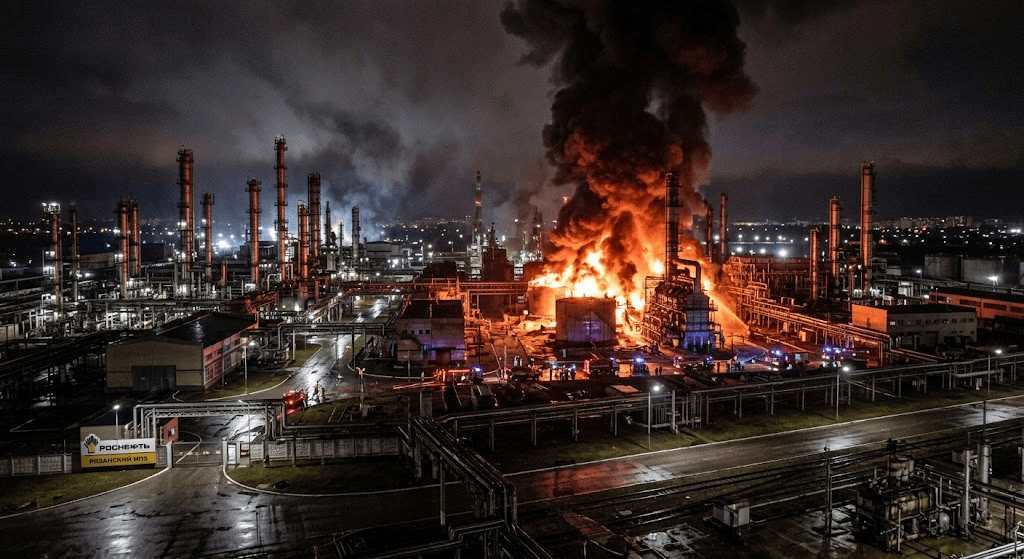
RYAZAN, Russia — An overnight drone strike targeted the Ryazan oil refinery, setting off fires and damaging infrastructure at one of central Russia’s largest energy facilities.
Residents in Ryazan, located roughly 120 miles southeast of Moscow, reported a sequence of low-flying drones followed by distinct explosions in the early hours. Regional Governor Pavel Malkov confirmed that emergency services were dispatched to manage a fire at an industrial site caused by falling drone debris, maintaining that preliminary reports indicated no casualties. Local monitoring channels and social media footage showed plumes of smoke and flames rising above the facility.
The facility—operated by state oil giant Rosneft—is a key processing node in the region. With an annual capacity of approximately 17 million metric tons, the plant accounts for roughly 5% of Russia’s total refining output and supplies crucial refined fuel to the capital region and military logistics networks.
The strike forms part of a broader, ongoing campaign targeting Russian energy infrastructure. Drones were also reported active over neighboring administrative regions overnight, forcing air defense systems into action across several locations in central and southern Russia.
Local authorities have not yet released an official statement regarding potential production halts or the full extent of structural damage to the refinery’s primary processing units.
The repeated strikes on key refining facilities like Ryazan have intensified pressure on Russia’s domestic fuel supply and regional energy exports. Defense analysts note that disabling primary distillation units forces operators into costly, time-consuming repairs, severely constraining the output of gasoline and diesel required for both civilian consumption and military logistics.
Furthermore, the persistent targeting of industrial hubs far from the frontline highlights the growing reach and sophistication of long-range strike capabilities. As air defense assets remain stretched across vast territories, critical infrastructure within hundreds of miles of the border faces continuous exposure, signaling an ongoing tactical shift focused on degrading economic and military support lines.
Published by Banx Network. This article is part of the Banx decentralized media programme, powered by the BXE token on the XRP Ledger.