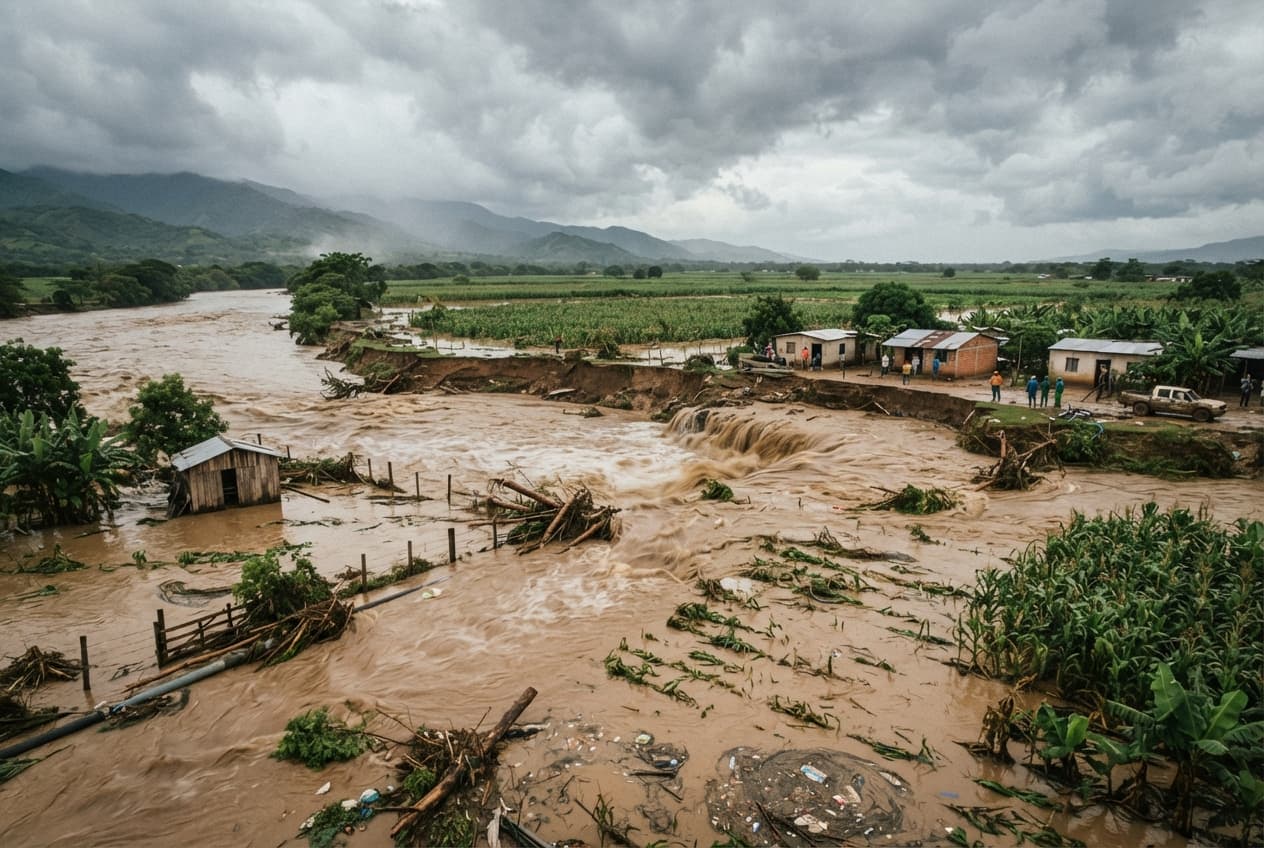
Cortés, Honduras—Muddy river water breached earthen levees before dawn on Monday, swamping dozens of rural farming communities across the northern valley. Continuous upstream precipitation pushed the river system past its maximum threshold, sending swift currents pouring directly into residential zones and agricultural acreage. Families woke to find knee-high water inside their homes, forcing frantic midnight evacuations toward higher highway embankments.
Local disaster response committees activated emergency protocols, deploying rubber dinghies to rescue stranded residents trapped by fast-flowing brown water. Municipal coordinators reported that telephone lines and electrical grids failed immediately as utility poles toppled under the strain of saturated soil. Evacuees huddled under plastic tarps along the roadside, watching their livestock and possessions disappear beneath the spreading inundation.
Agronomists warned that the loss of banana and corn crops would devastate the local agrarian economy for months following the disaster. Regional authorities faced sharp criticism from farming cooperatives regarding deferred maintenance on vulnerable dykes that have degraded over successive rainy seasons. Government engineers defended their response timelines, citing unprecedented water volumes that overwhelmed even reinforced flood barriers.
Medical mobile units established triage tents near the highway overpass to vaccinate displaced populations against waterborne pathogens and treat minor injuries. Volunteers distributed bottled water and dry rations to exhausted families waiting for the floodwaters to recede from their properties. Police units patrolled abandoned neighborhoods to prevent opportunistic looting while homeowners remained stranded in temporary shelters.
Heavy cloud cover persisted over the mountain ranges, threatening additional downpours and compounding anxiety among emergency personnel on the ground. Heavy machinery staged near the breached levees awaited stable conditions before attempting to plug the widening gap in the riverbank. Transport trucks carrying emergency relief supplies found themselves delayed by flooded secondary roads leading into the disaster zone.
Municipal leaders declared a state of emergency across the entire department to unlock federal relief funds and accelerate equipment deployments. Local residents spent the afternoon salvaging waterlogged furniture and clearing mud from entryways as the current slowly lost momentum.
Disaster management teams maintained a high-alert posture as downstream gauges continued recording dangerous water elevations into the evening.
Published by Banx Network. This article is part of the Banx decentralized media programme, powered by the BXE token on the XRP Ledger.