There are mornings in Utah when the horizon feels impossibly wide, when the desert air carries the faint chill of night and the mountains stand like patient witnesses to time itself. On such a morning, the Moon may appear unchanged at first — steady, pale, and distant — until, slowly, almost imperceptibly, it begins to dim.
A total lunar eclipse is expected to unfold in the coming days, and for those watching from Utah, the spectacle will take shape in the early hours before sunrise. Unlike the drama of a solar eclipse, which demands special glasses and careful preparation, a lunar eclipse asks only that one look up. The Earth, moving between the Sun and the Moon, casts its shadow outward, and the familiar white disc gradually enters darkness.
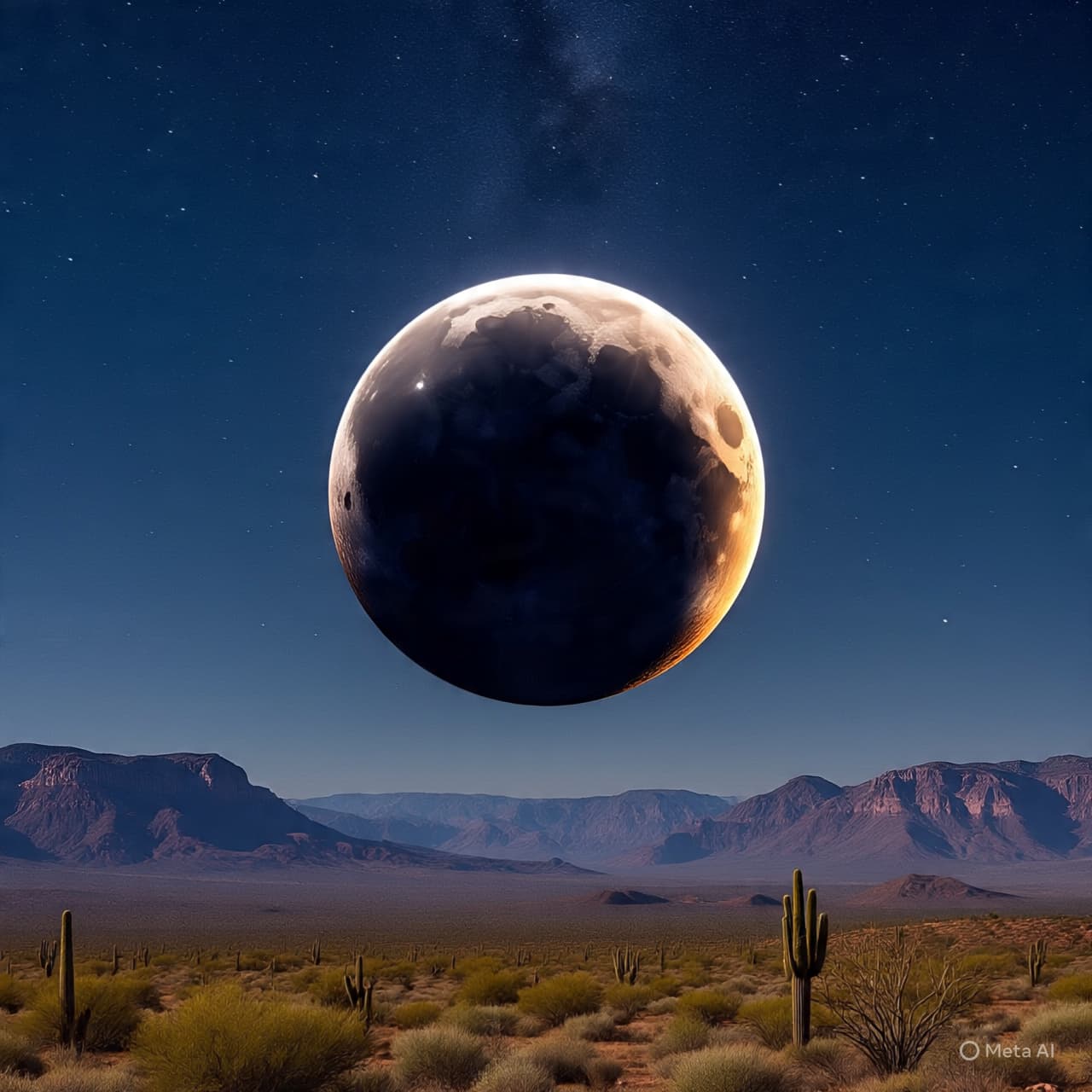
As the eclipse deepens, the Moon will slip into Earth’s umbra — the central, darkest part of its shadow. This is when the transformation becomes most striking. Instead of vanishing, the Moon often turns a muted copper or rust-red hue. The color comes from sunlight bending through Earth’s atmosphere, filtered and scattered, with red tones reaching the lunar surface. It is the same quiet physics that paints sunsets over the Great Salt Lake in shades of ember and rose.
For Utah, visibility will depend largely on two simple companions: time and weather. The eclipse is expected to occur in the pre-dawn hours, meaning observers will need to rise while most of the state still sleeps. If skies remain clear — as they often do in the high desert climate — the Moon should be visible above the western horizon during the most dramatic phase. Clouds, of course, could intervene, but forecasts closer to the date will offer a clearer picture.
From the Wasatch Front to the red rock country of southern Utah, vantage points abound. City lights may soften the view slightly, but unlike faint meteor showers or distant comets, a total lunar eclipse is bold enough to pierce through moderate light pollution. In rural valleys and open plateaus, the effect can feel especially profound: a quiet landscape beneath a darkening sky, the Moon glowing as if lit from within by memory rather than sunlight.
Lunar eclipses are not rare in the grand rhythm of celestial events, yet each carries its own atmosphere. The pace is unhurried. The change unfolds over hours, allowing observers to step outside, return indoors, and step out again to find the Moon altered further still. There is no sudden gasp of darkness as with a solar eclipse, no abrupt shift in temperature or birdsong. Instead, there is a gradual deepening — a reminder of planetary motion occurring whether or not we pause to notice.
For many, the appeal lies not only in the science but in the setting. Utah’s varied landscape offers a natural amphitheater: snow-capped peaks catching the first suggestion of dawn, sandstone formations etched against a paling sky, salt flats stretching into quiet infinity. In these places, the eclipse may feel less like an event and more like a conversation between Earth and sky.
The term “blood moon” often accompanies total lunar eclipses, though the phrase can suggest something more dramatic than the reality. The red tone is typically soft, sometimes subtle, shaped by atmospheric conditions at the time. Dust, volcanic particles, and even weather patterns around the globe can influence how dark or bright the Moon appears. Each eclipse, in that sense, becomes a portrait painted by the planet itself.
For viewers in Utah, the practical advice remains simple: look west before dawn, give your eyes a few moments to adjust, and allow time for the transformation. No telescope is required, though binoculars can enhance detail along the lunar surface as shadows creep across familiar craters and plains.
Astronomers confirm that the total phase will be visible across much of the western United States, including Utah, provided skies cooperate. The eclipse will begin with partial shading before reaching totality, then gradually return to its usual brilliance as Earth’s shadow moves on. The entire process will span several hours in the early morning, ending as daylight approaches.
In clear conditions, residents across the state should be able to see the eclipse without special equipment. Viewing will be best before sunrise while the Moon remains above the horizon.
AI Image Disclaimer Visuals are AI-generated and serve as conceptual representations.
Sources (Media Names Only) NASA Space.com Time and Date The Salt Lake Tribune AccuWeather
Published by Banx Network. This article is part of the Banx decentralized media programme, powered by the BXE token on the XRP Ledger.