Twilight is often associated with transition, a brief moment when day yields to night and familiar landscapes change character beneath shifting light. On a distant world beyond our solar system, however, twilight may be far more unusual. Observations from the James Webb Space Telescope have revealed evidence suggesting dramatically different twilight conditions across an alien planet.
The discovery emerged from detailed observations of an exoplanet orbiting a distant star. Using its advanced infrared instruments, the James Webb Space Telescope continues to provide unprecedented insight into atmospheric conditions on worlds far beyond Earth.
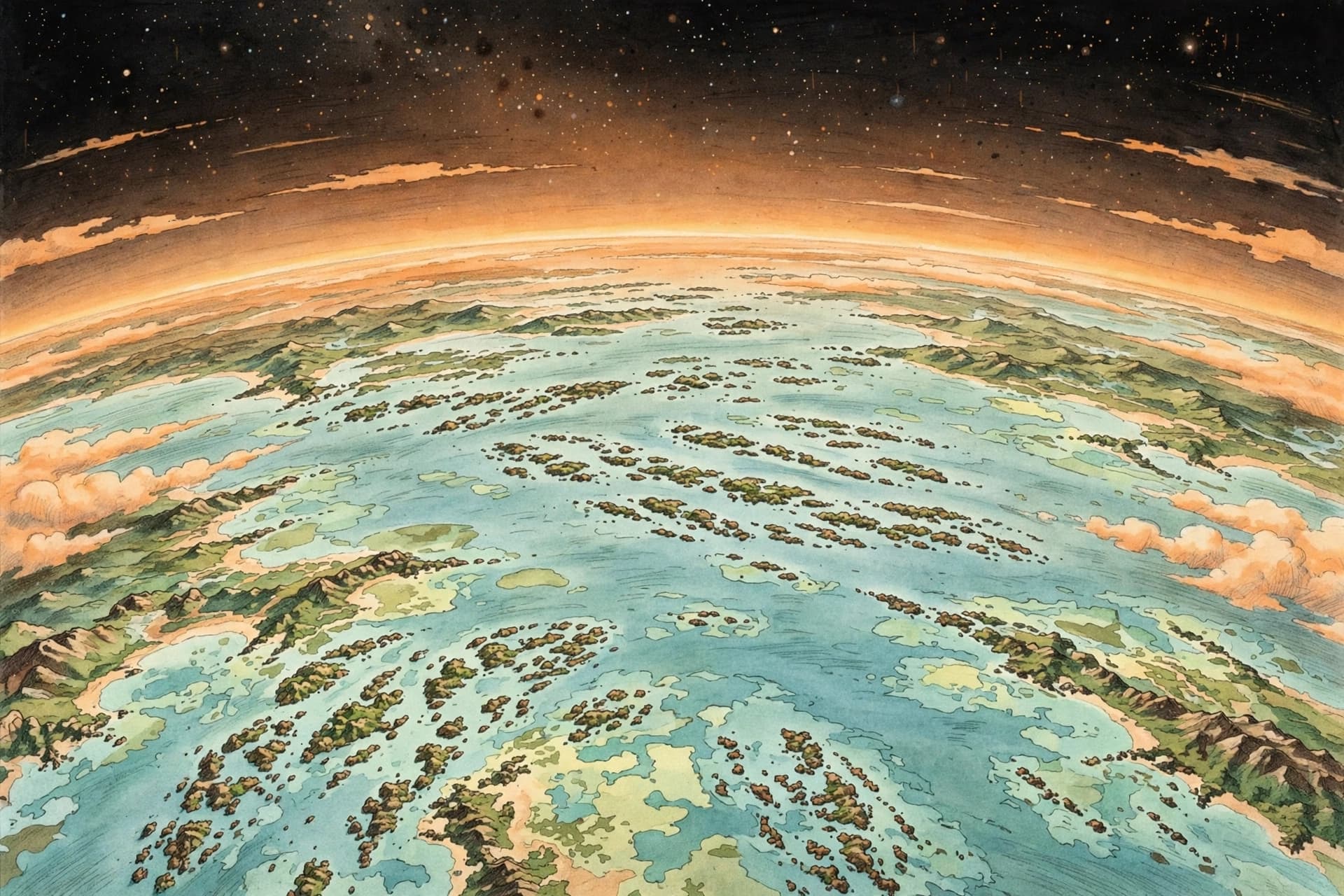
Researchers found indications that opposite sides of the planet experience markedly different environmental conditions. These contrasts influence how light interacts with the atmosphere during transitional periods between day and night.
Differences in temperature, cloud formation, and atmospheric chemistry appear to contribute to the unusual twilight phenomena. Rather than experiencing a relatively uniform transition, the planet may display distinct visual and physical characteristics depending on location.
Such observations help scientists understand the complex dynamics governing exoplanet atmospheres. Many of these worlds orbit close to their host stars, creating extreme conditions that differ significantly from those found within our solar system.
The James Webb Space Telescope is particularly well suited for this work because it can analyze light passing through distant atmospheres. By examining specific wavelengths, researchers can identify molecules and atmospheric processes that would otherwise remain hidden.
Studies of alien worlds are expanding rapidly as observational capabilities improve. Each new dataset contributes to a growing picture of the diversity of planetary environments throughout the galaxy.
While these distant planets remain beyond the reach of direct exploration, telescopes allow scientists to investigate their characteristics with increasing precision. Atmospheric research has become one of the most active areas of modern astronomy.
The findings underscore the remarkable variety of conditions that exist beyond Earth and highlight the continuing role of the James Webb Space Telescope in advancing planetary science.
AI Image Disclaimer: Visual representations accompanying this article may include AI-generated artistic reconstructions based on scientific observations.
Sources Verification Check:
NASA James Webb Space Telescope Mission Nature Astronomy Space.com Scientific American
Published by Banx Network. This article is part of the Banx decentralized media programme, powered by the BXE token on the XRP Ledger.