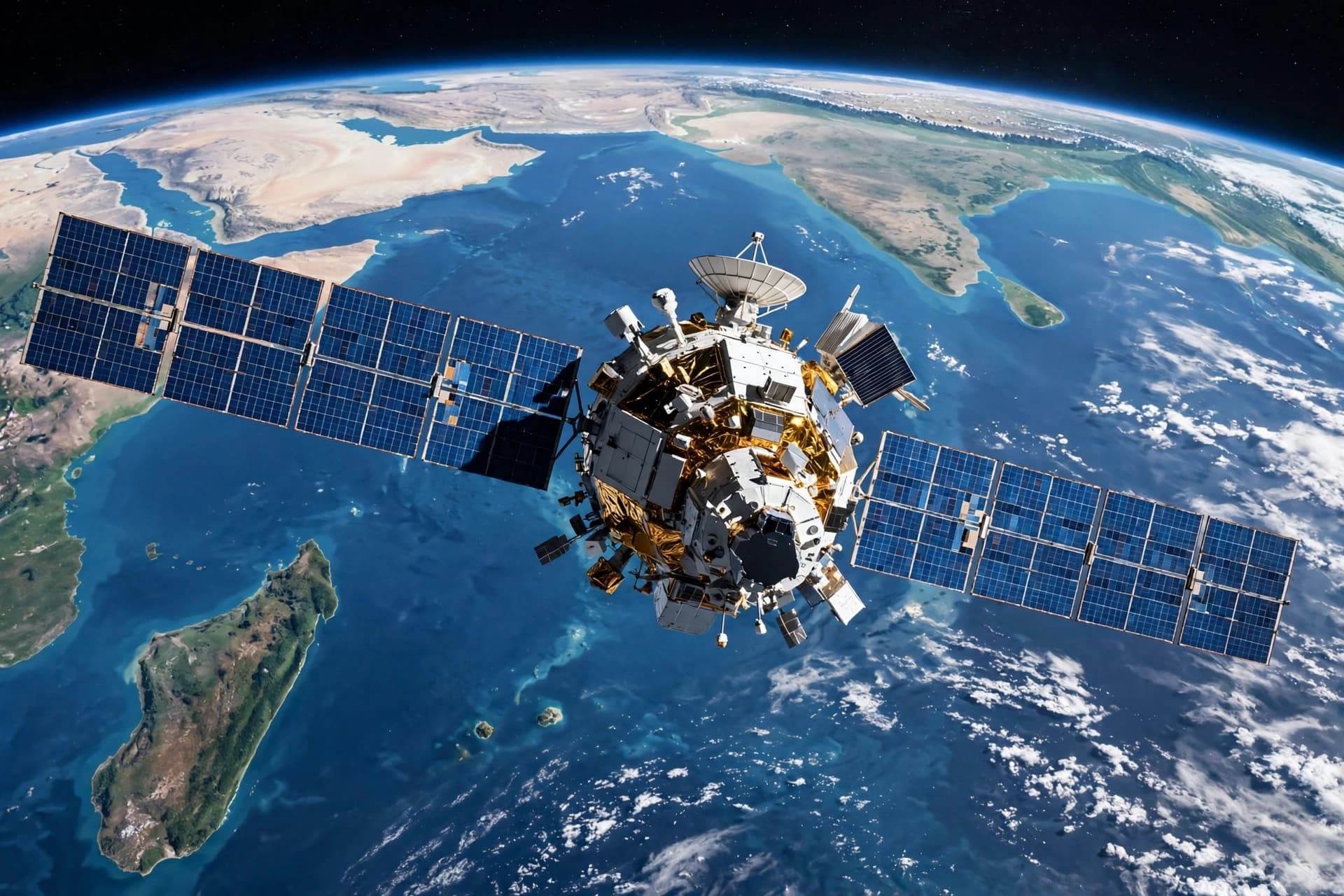
There is a certain poetry in using one world to reach another—in borrowing the gravity of home to carry a spacecraft farther than any single rocket could manage alone. On September 28, the European Space Agency's JUICE spacecraft did exactly that, skimming just 8,640 kilometers above the Indian Ocean and letting Earth's gravity fling it toward Jupiter.
The flyby deflected JUICE's trajectory by approximately 20 degrees and increased its velocity by 3.5 kilometers per second—roughly 12,600 kilometers per hour. It was the third gravity assist of the mission, following the first-ever lunar-Earth flyby in August 2024 and a Venus flyby in August 2025 .
"All flybys are risky, requiring very careful planning and continuous monitoring," said Claire Vallat, JUICE project scientist. But she noted that this Earth flyby was simpler operationally than the 2024 lunar-Earth maneuver. "This is great news for science, because it means we will be able to turn Juice in all different directions to point its science instruments at different parts of Earth and the moon" .
The precision required was extraordinary. In the four weeks before the flyby, spacecraft operators had six opportunities to adjust JUICE's approach trajectory. They needed only one small nudge . Spacecraft operations manager Angela Dietz explained that this careful planning conserved propellant: "This gives us more to use at Jupiter to carry out observations of the planet's icy moons" .
The stakes of such frugality are not abstract. Without gravity assists, reaching Jupiter would require immense amounts of fuel—not only to accelerate but also to slow down enough to enter orbit rather than shooting through the Jovian system entirely. By using the gravity of Earth, Venus, and the Moon, JUICE will arrive at Jupiter in July 2031 with enough fuel remaining to enter orbit around the planet and then, in 2034, move to an orbit around Ganymede, the largest moon in the solar system .
During the flyby, JUICE's ten scientific instruments were active, calibrating on real surfaces and collecting data about Earth and the Moon. The spacecraft also spent several days in Earth's magnetotail, gathering measurements that can later be compared with other missions .
One final Earth flyby remains, scheduled for January 2029. After that, JUICE will be on its own—a small vessel carrying the hopes of European science toward a distant, icy world, guided by the quiet mathematics of gravity.
---
AI Image Disclaimer: All visuals in this article are AI-generated and are for illustrative purposes only.
Sources: European Space Agency, Space.com, Agerpres, Universe Space Tech, Qatar News Agency
Published by Banx Network. This article is part of the Banx decentralized media programme, powered by the BXE token on the XRP Ledger.