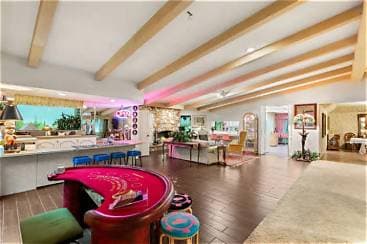
Morning arrives softly across California, slipping through eucalyptus leaves in the north and gliding over sun-warmed stucco in the south. In this vast and varied landscape, where mountains meet coastline and deserts stretch toward distant cities, the idea of “home” has always carried layers of meaning. Here, price is not merely a number but a reflection of geography, history, and the quiet negotiation between dream and reality.
At the $2.5 million mark, California homes reveal a striking truth: value changes shape depending on where one stands. In San Francisco, that sum may secure a compact, carefully restored Victorian, its charm folded neatly into narrow streets and fog-brushed mornings. Space is measured in efficiency, views are borrowed from bay and sky, and proximity often outweighs square footage. In Los Angeles, the same budget may open the door to a mid-century hillside home, glass walls framing palms and city lights, where architecture leans into light and openness rather than density.
Travel inland or southward, and the picture shifts again. In parts of Orange County or San Diego, $2.5 million can offer ocean breezes, multiple bedrooms, and outdoor living spaces shaped for long afternoons rather than compact routines. In wine country, the figure may translate into acreage, vineyards nearby, and a slower rhythm tied to seasons rather than traffic patterns. Each home reflects not only market forces but the tempo of life surrounding it.
These contrasts are not accidental. California’s housing market has long been shaped by scarcity, zoning, geography, and sustained demand from both domestic and international buyers. Coastal constraints and economic concentration compress prices upward, while inland regions stretch them outward, offering more land and flexibility. At this price tier, buyers are often balancing emotional pull with practical choice, deciding whether they value proximity, privacy, or possibility.
Yet even at $2.5 million, trade-offs remain unavoidable. Renovation needs, aging infrastructure, wildfire risk, and insurance costs increasingly enter conversations once dominated by aesthetics alone. What once felt like a finish line can, in California, feel more like a threshold — a starting point for further investment, adaptation, or compromise.
There is also a quieter undercurrent to these homes, one less visible in listings. They sit within a broader story of affordability challenges and shifting demographics, where the gap between aspiration and access continues to widen. The $2.5 million home becomes not just a dwelling, but a marker — illustrating how far the market has traveled, and how uneven that journey has been across communities.
In closing, $2.5 million homes across California continue to reflect sharp regional differences, shaped by location, land availability, and long-standing demand. Whether offering modest space in dense coastal cities or larger footprints inland, these properties underscore how place remains the most decisive factor in the state’s housing equation.
AI Image Disclaimer Images in this article are AI-generated illustrations, meant for concept only.
Sources (media names only):
The New York Times Architectural Digest Los Angeles Times The Wall Street Journal Mansion Global
Published by Banx Network. This article is part of the Banx decentralized media programme, powered by the BXE token on the XRP Ledger.