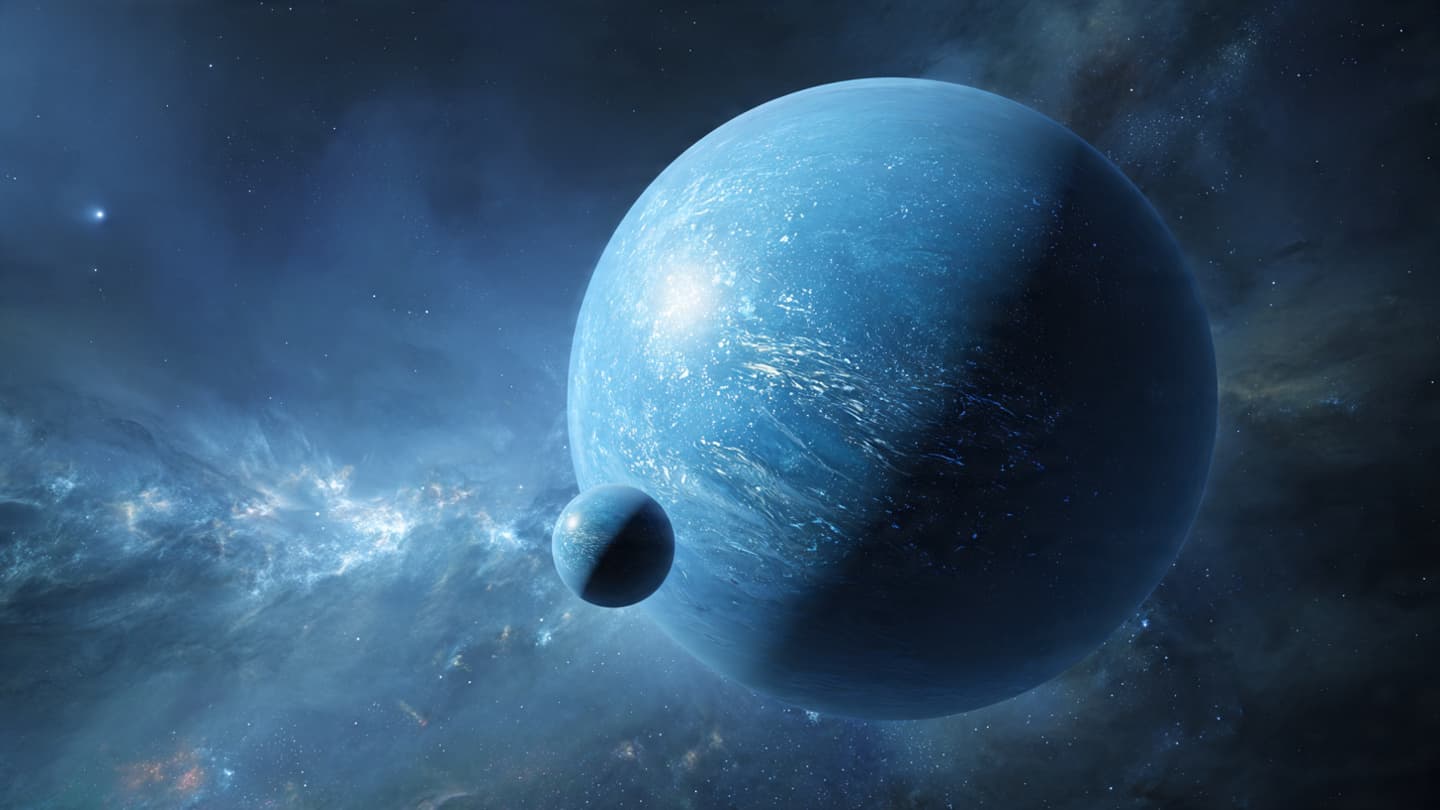
In the distant darkness beyond Saturn, Neptune circles the Sun like a cold blue lantern drifting through deep time. Around it moves a collection of unusual moons, each carrying clues from a turbulent chapter in the solar system’s history. Among them is Nereid, a small and irregular moon that scientists now believe may be the surviving remnant of an ancient cosmic upheaval.
Researchers studying Neptune’s outer moons have proposed that Nereid could be the last major survivor of a violent gravitational disruption that occurred billions of years ago. The theory centers on Triton, Neptune’s largest moon, which scientists believe was captured by the planet long after Neptune itself formed.
Unlike many large moons in the solar system, Triton travels in a retrograde orbit, moving opposite Neptune’s rotation. This unusual motion has long suggested that Triton did not originate alongside Neptune’s other satellites. Instead, astronomers think it may once have been a dwarf planet or large object pulled inward by Neptune’s gravity.
According to recent research, Triton’s arrival may have dramatically destabilized Neptune’s original moon system. Gravitational interactions could have caused collisions, ejections, or orbital chaos that destroyed many earlier satellites. In this scenario, Nereid survived while much of the former system disappeared.
Nereid itself has puzzled astronomers for decades because of its highly eccentric orbit. At times it moves relatively close to Neptune, while at other points it drifts far away. Scientists say this unusual path may preserve evidence of ancient gravitational disturbances that reshaped the planet’s surrounding environment long ago.
Modern computer simulations are helping researchers reconstruct how Neptune’s moon system may have evolved after Triton’s capture. By modeling orbital behavior across millions of years, astronomers hope to better understand how giant planets influence nearby objects and how chaotic events shaped the outer solar system.
The findings also contribute to a broader scientific effort to understand planetary formation and migration. Many worlds in the solar system likely experienced periods of instability during their early development, when collisions and gravitational shifts were far more common than they are today.
Astronomers say further observations of Neptune and its moons may provide additional evidence in the future. For now, Nereid remains a quiet survivor orbiting far from Earth, carrying traces of an ancient celestial drama that unfolded long before humanity ever looked toward the stars.
AI Image Disclaimer: Some illustrations connected to this report may be AI-generated visualizations based on current astronomical research.
Sources: NASA, Space.com, New Scientist, Scientific American, Astronomy Magazine
Published by Banx Network. This article is part of the Banx decentralized media programme, powered by the BXE token on the XRP Ledger.