The fossil record is often compared to a library with many missing pages. Most discoveries reveal only fragments of lives lived millions of years ago, leaving scientists to carefully assemble stories from scattered clues. Occasionally, however, nature preserves a moment so remarkable that it seems to pause time itself, offering a rare glimpse into the rhythms of an ancient world.
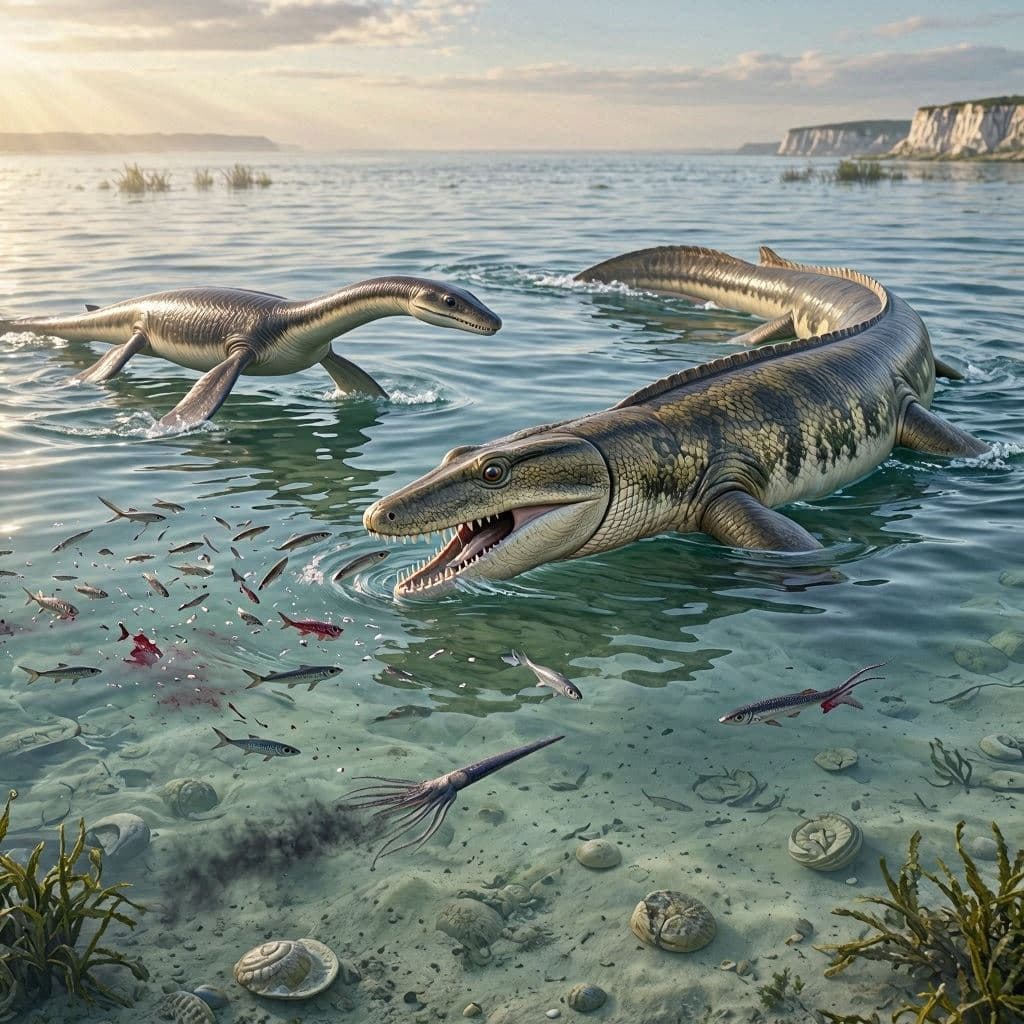
Paleontologists have described an extraordinary fossil dating to the Cretaceous Period that preserves an exceptionally rare chain of predation. The specimen reveals a large marine reptile that had consumed another marine predator, which itself still contained the remains of its own recent meal. The unusual preservation has prompted comparisons to a "turducken," a layered dish in which one animal is placed inside another, because the fossil captures multiple levels of the prehistoric food chain in a single discovery.
The fossil was recovered from marine rock layers that once formed part of an ancient ocean covering portions of the Earth more than 90 million years ago. Exceptional burial conditions protected the skeletons before decomposition and scavengers could disturb them, allowing scientists to study an ecological interaction that is almost never preserved in the fossil record.
Researchers explained that stomach contents are rarely fossilized because soft tissues usually decay long before burial. In this case, however, the remains of prey survived within the digestive tract, enabling scientists to reconstruct the final feeding sequence with unusual confidence. Such discoveries provide direct evidence of ancient diets rather than relying solely on tooth shape or indirect ecological comparisons.
The specimen also sheds light on the complex marine ecosystems that flourished during the Cretaceous Period. Ancient oceans were inhabited by large reptiles, fish, sharks, and countless invertebrates that formed intricate food webs. Rather than simple predator-and-prey relationships, the fossil demonstrates that even formidable marine hunters could become prey for even larger animals.
Scientists emphasize that discoveries like this help refine our understanding of prehistoric ecosystems. By examining fossilized stomach contents alongside skeletal anatomy, researchers can better understand feeding behavior, predator size, ecological competition, and the transfer of energy through ancient marine environments. Each well-preserved specimen contributes valuable information that cannot be obtained through isolated bones alone.
The findings also illustrate the importance of continued paleontological exploration. Rare fossils preserved under exceptional geological conditions often answer long-standing scientific questions while raising new ones about evolution, biodiversity, and environmental change during Earth's distant past. Advances in imaging technology continue allowing researchers to examine delicate fossils without damaging them.
Although separated from the present by tens of millions of years, the fossil offers a vivid reminder that life has long been shaped by interconnected relationships between predators and prey. Preserved within layers of ancient stone, this remarkable discovery provides one of the clearest snapshots yet of the dynamic food webs that once governed Earth's prehistoric oceans.
AI Image Disclaimer:
The accompanying images are AI-generated artistic reconstructions based on scientific descriptions and fossil evidence. They are intended for educational illustration and are not photographs of the actual fossil.
Sources:
Current Biology Cell Press Smithsonian Magazine Live Science
Published by Banx Network. This article is part of the Banx decentralized media programme, powered by the BXE token on the XRP Ledger.