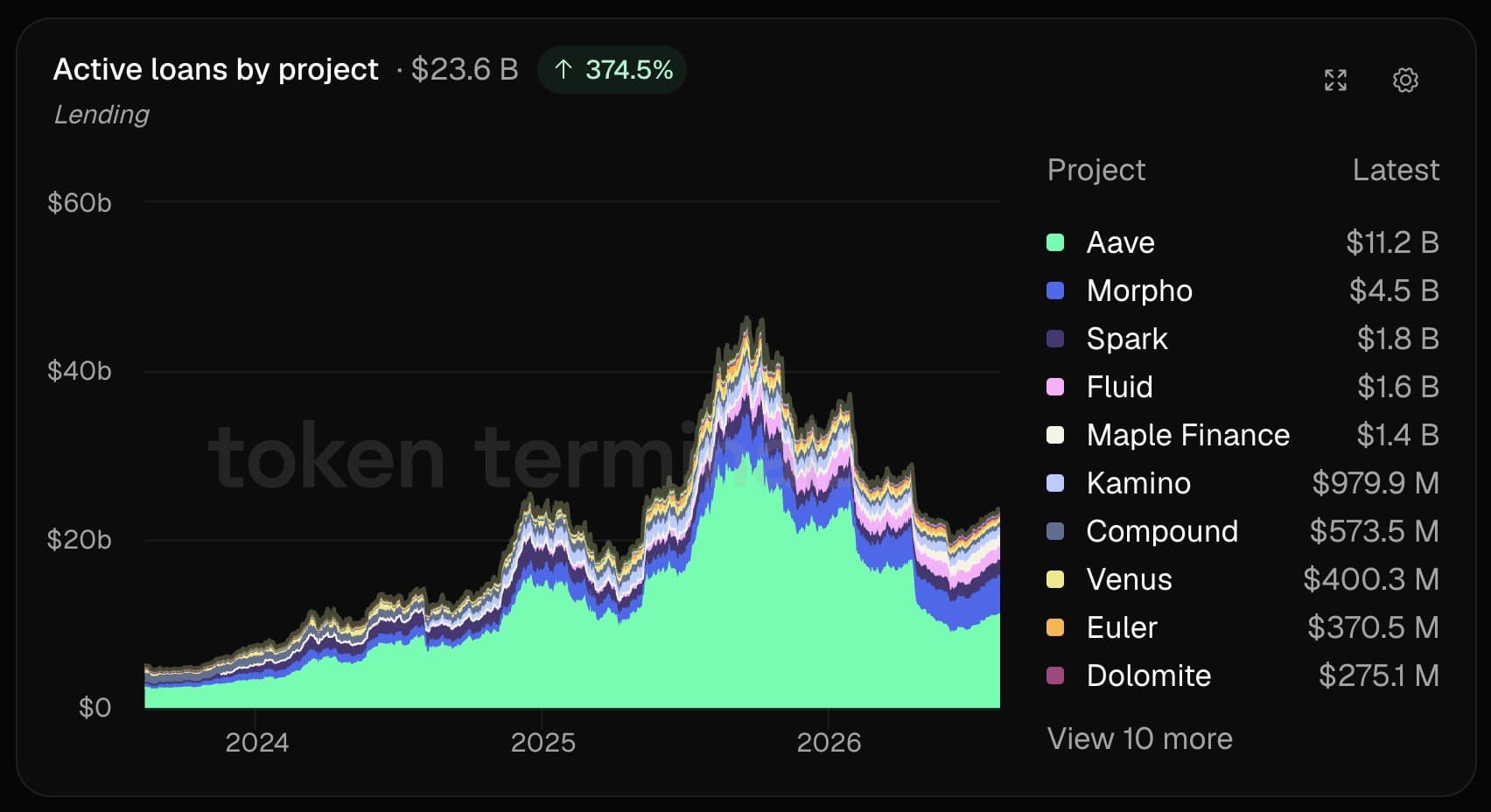
The onchain lending market has grown into a significant part of decentralized finance, with active loans reportedly reaching approximately $23.6 billion. The figure highlights how lending has moved beyond being a small experimental corner of crypto and increasingly resembles a functioning credit market with multiple competing protocols. Aave remains the largest lending protocol in the data shown, with approximately $11.2 billion in outstanding loans. That represents about 47.7% of the tracked market, putting Aave well ahead of its competitors. Morpho follows with approximately $4.5 billion, while Spark accounts for around $1.8 billion. Other protocols, including Fluid, Maple Finance, Kamino, Compound, Venus, Euler and Dolomite, collectively represent another substantial portion of the market. The growth of onchain lending is important because blockchain networks allow lending markets to operate through transparent smart contracts rather than relying exclusively on conventional banking intermediaries. Users can supply assets to lending pools and earn returns, while other participants can borrow against collateral. Transactions and outstanding positions can be monitored directly on the underlying blockchain or through analytics platforms. The expansion also demonstrates the increasing importance of collateralized digital credit. Most decentralized lending systems require borrowers to provide collateral, reducing some of the counterparty risks associated with unsecured borrowing. If the value of collateral falls sufficiently, automated mechanisms can liquidate positions according to predetermined rules. However, the $23.6 billion figure should not be interpreted as equivalent to the size of the conventional global lending system. Onchain lending remains much smaller than traditional bank and credit markets. It also carries risks that differ from conventional finance, including smart-contract vulnerabilities, volatile collateral values, liquidity shocks and governance risks. The distribution of lending activity is nevertheless revealing. Aave's nearly half-market share demonstrates the strength of established protocols, while the significant positions held by Morpho and Spark show that competition is developing around different approaches to decentralized credit. The market's expansion also creates opportunities for tokenized real-world assets. As financial institutions bring Treasury securities, funds and other assets onto blockchain networks, those assets could potentially become collateral or settlement instruments within digital lending ecosystems. This could create a bridge between traditional finance and decentralized financial infrastructure. Another important development is the growing sophistication of lending protocols. Modern platforms can incorporate risk parameters, automated liquidations, interest-rate mechanisms and other features that allow financial markets to operate continuously. This creates a form of programmable credit infrastructure that can function across borders without traditional banking hours. Yet rapid growth can amplify risks. When lending markets expand quickly, leverage can increase alongside liquidity. A sharp decline in major collateral assets can trigger liquidations, causing further selling pressure. Protocols therefore need robust risk-management systems even when their underlying technology operates automatically. The $23.6 billion figure ultimately represents more than a cryptocurrency statistic. It shows that blockchain-based credit markets have reached a scale where their development deserves attention from both crypto investors and traditional financial institutions. If tokenization continues expanding, the boundary between decentralized lending and conventional financial markets could become increasingly blurred. Banks, asset managers and fintech companies may eventually interact with onchain credit markets rather than treating them as a completely separate ecosystem. The next stage will therefore be determined not simply by how much capital enters decentralized lending, but by whether these systems can maintain liquidity, manage risk and provide sustainable credit through different market conditions.
Published by Banx Network. This article is part of the Banx decentralized media programme, powered by the BXE token on the XRP Ledger.