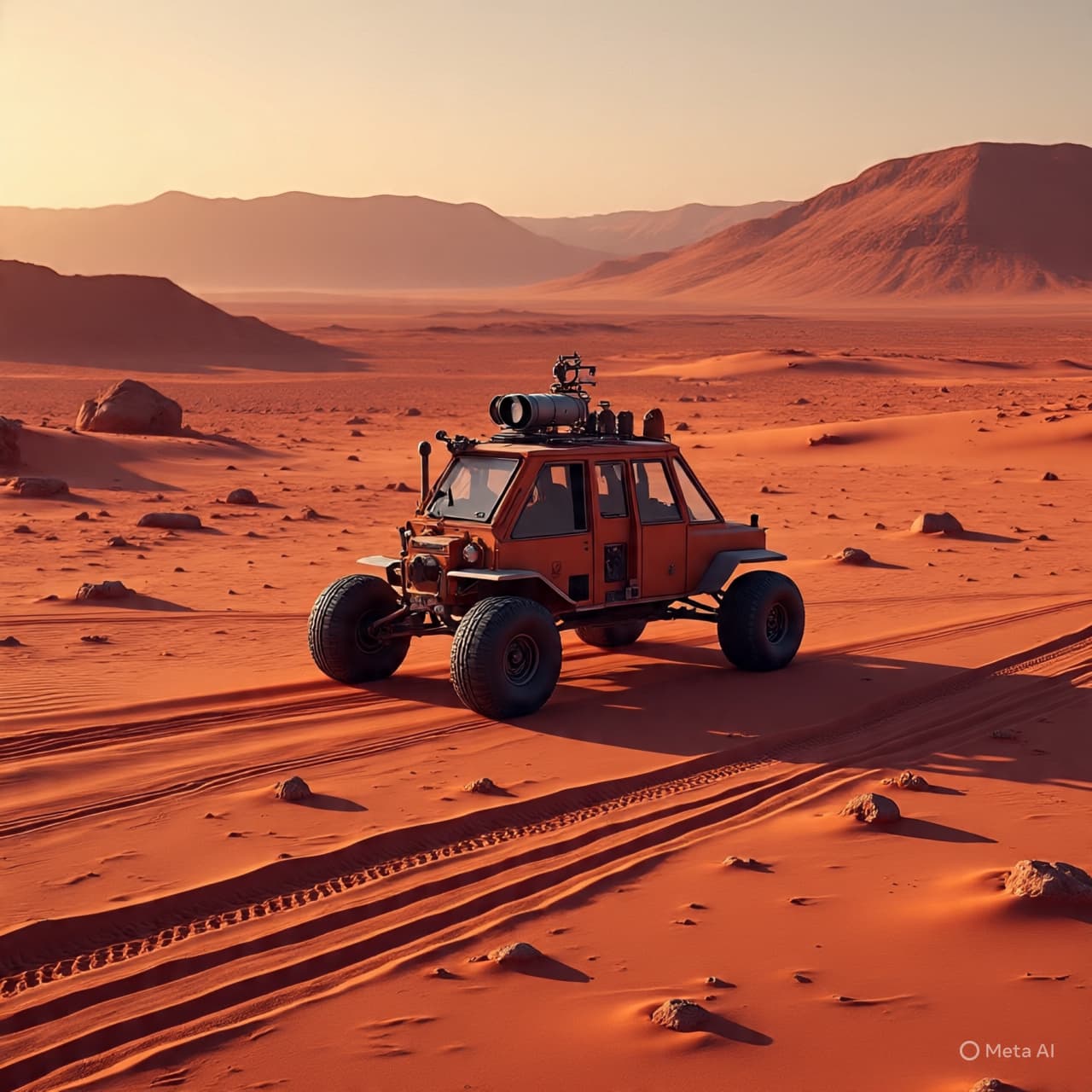
On the rust-colored plains of Mars, where dust drifts across ancient riverbeds and silence stretches unbroken for miles, a lone rover continues its patient journey. It does not hurry. It does not speak. Yet with each careful movement, it carries the quiet ambition of Earth. And now, through a new chapter of technological refinement, it carries something more—greater independence.
has enhanced the capabilities of its rover, allowing it to navigate the Martian terrain with increased autonomy. While Perseverance has always possessed onboard systems to avoid hazards, recent advancements in software and artificial intelligence are enabling it to make more complex driving decisions without waiting for instructions from Earth.
The challenge of operating on Mars is not merely distance, but delay. Signals between Earth and Mars can take anywhere from several minutes to nearly half an hour one way. That delay makes real-time remote control impossible. Instead, engineers send detailed instructions in advance, and the rover executes them cautiously. With enhanced autonomous navigation, Perseverance can now interpret its surroundings more efficiently, selecting safer and more optimal paths across rocky ground.
Central to this improvement is a refined version of the rover’s AutoNav system. Using stereo cameras and onboard computing, Perseverance constructs three-dimensional maps of the terrain ahead. It identifies obstacles—sharp rocks, steep slopes, sand traps—and calculates routes in real time. The upgraded algorithms allow the rover to drive faster and cover more ground during each Martian day, or sol.
This greater autonomy is not about replacing human oversight, but about extending capability. Scientists on Earth still define the rover’s broader objectives, such as exploring the Jezero Crater and collecting rock samples for future return missions. Yet within those objectives, Perseverance now has more freedom to decide how best to move.
The benefits are practical and scientific. Covering greater distances means accessing more geologically diverse sites. It also allows the mission team to allocate communication windows more efficiently, focusing on data analysis rather than routine driving commands. In an environment where each sol presents both opportunity and constraint, efficiency becomes a form of exploration.
Autonomy also prepares the way for future missions. As space agencies contemplate more distant exploration—whether robotic missions to the outer planets or eventual human expeditions to Mars—intelligent systems capable of adapting to unpredictable terrain will become increasingly essential. Perseverance serves not only as a scientific instrument, but as a testbed for these evolving technologies.
There remains careful balance. Engineers continuously test and validate updates before deployment, ensuring reliability in a landscape where repairs are impossible. Mars is unforgiving, and caution remains a guiding principle.
For now, Perseverance continues its steady progress across ancient sediment, its wheels tracing quiet arcs through red dust. With enhanced autonomy, it advances not just across Martian ground, but toward a future where exploration is shared more deeply between human intention and machine intelligence. The rover’s journey continues, guided by both distant minds and its own growing capacity to decide.
AI Image Disclaimer Images in this article are AI-generated illustrations, meant for concept only.
Source Check — Credible Media Coverage Exists:
BBC The New York Times The Guardian Nature News Space.com
Published by Banx Network. This article is part of the Banx decentralized media programme, powered by the BXE token on the XRP Ledger.