Far beyond the quiet regularity of Earth’s orbit, a distant star flickers with uncertainty. Its light, faint and rhythmic, carries a suggestion rather than a declaration — a possibility that somewhere 146 light-years away, a cold world may be circling patiently, suspended between darkness and warmth.
Astronomers call it a candidate, not a confirmation. The planet has not been seen directly. Instead, its presence is inferred through subtle variations in starlight and motion, the kind of gravitational whispers that often precede discovery. What draws attention is not its size alone, but its distance from its star — a region where temperatures could allow liquid water to persist, at least in theory.
This world, if it exists, would be colder than Earth, receiving less stellar energy and orbiting a dimmer sun. Ice may dominate its surface, and any atmosphere would need to work hard to trap heat. Yet habitability is not defined by comfort. It is defined by possibility. Scientists note that even frozen planets can harbor subsurface oceans, sustained by internal heat or atmospheric pressure, widening the definition of where life might endure.
The uncertainty lies in the data itself. Signals hint at a planet roughly Earth-sized, but noise and stellar activity complicate the interpretation. The star’s own behavior can mimic planetary influence, blurring the line between detection and illusion. As a result, the planet remains a hypothesis — compelling, fragile, and unfinished.
Still, its location matters. At 146 light-years, this system is close enough for future telescopes to examine more carefully. Improved instruments may one day separate signal from shadow, revealing whether the planet is real, and if so, whether it holds an atmosphere capable of softening its cold.
In astronomy, not every discovery arrives fully formed. Some come as questions, lingering at the edge of certainty. This possible cold Earth does not yet expand our list of habitable worlds. Instead, it expands something quieter: our patience. It reminds us that the search for life is as much about waiting as it is about finding — about listening carefully to the universe before deciding what it is trying to say.
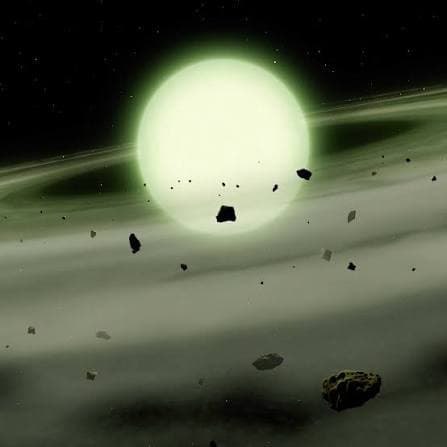
AI Image Disclaimer Illustrations are AI-generated and serve as conceptual representations.
Sources The Astrophysical Journal Nature Astronomy European Southern Observatory
Published by Banx Network. This article is part of the Banx decentralized media programme, powered by the BXE token on the XRP Ledger.