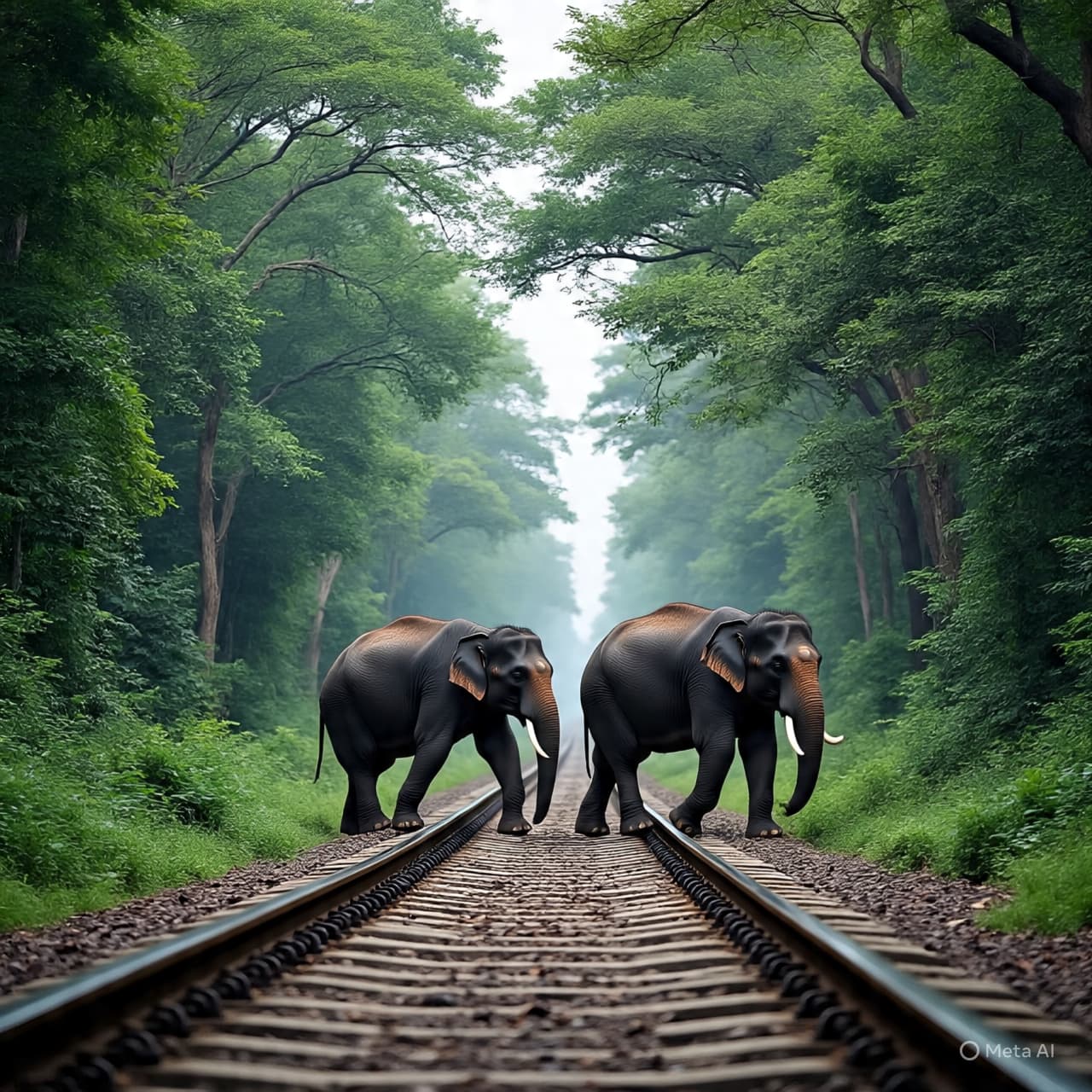
In the dusky hours before dawn in Assam’s forested landscapes — where mist hugs the earth and ancient trees stand as silent sentinels — a tragedy unfolded that once again underscored the fragile thread on which life balances between human progress and the timeless rhythms of the wild. In the early morning hours of December 20, 2025, a high‑speed passenger train collided with a herd of Asiatic elephants crossing the railway tracks in northeastern India, killing seven majestic creatures and injuring a young calf. That collision, terrible in its suddenness, as though time itself stood still in an instant of impact, reverberated far beyond the tracks, touching the hearts of those committed to protecting both people and wildlife.
The Rajdhani Express, a Delhi‑bound train that bridges distant corners of the nation, was carrying about 650 passengers when its driver spotted the elephants — a herd of roughly a hundred — on the line. Despite using emergency brakes, the train could not avoid striking several of the animals. The force of the impact caused the engine and five coaches to derail, a jarring pause in a journey that otherwise continued without human injury. Passengers were moved safely to alternate rail services, continuations of their journeys underscored by a sobering reminder that modern life and nature still inhabit the same fragile spaces.
The collision occurred in Hojai district, an area not officially marked as one of Assam’s designated elephant corridors — those stretches of track known for frequent wildlife crossings — highlighting how unpredictable and widespread human‑wildlife interactions have become in a region where forested habitat meets expanding infrastructure. Assam itself is home to an estimated 7,000 wild Asiatic elephants, one of the largest populations of these endangered giants in India. Yet collisions between trains and these gentle giants have been tragically familiar in recent years, especially during times when elephants wander in search of food or new grazing grounds amid the harvest season.
Every elephant lost in such an accident is a story unfinished: mothers whose journeys guided their families across generations, calves learning the rhythms of forest life, silent wanderers whose paths weave through deep green undergrowth and along rivulets that glint in the sun. Their deaths stir reflections on the collision of worlds — of steel rails laid for human need slicing through ancestral elephant migratory paths, of pressing demands for development set against the legacy of species that have roamed for millennia.
Underscoring the severity of the situation, wildlife experts note that train collisions with elephants are not rare in this region. At least a dozen such deaths have been documented in Assam since 2020, a grim tally that speaks to the ongoing conflict between mobility and conservation. While infrastructure brings people together, it also cuts through habitats, leaving conservationists and policymakers grappling with how best to protect endangered wildlife without stalling the rhythms of daily life.
In the aftermath of the collision, veterinarians carried out post‑mortems on the fallen elephants, preparing them for respectful burial as family members of the herd watched in solemn silence from the forest edge. Railway authorities and local government officials have indicated that restoration efforts are underway and that train services have been adjusted to reduce disruptions. But for many, the focus inevitably shifts to prevention — how to better anticipate the presence of wildlife, improve warning systems, and map infrastructure to minimize such heart‑wrenching losses in the future.
Beyond statistics and schedules, the emotional weight of this episode lies in a shared awareness that coexistence is neither easy nor guaranteed. In the quiet days that follow, as wild herds move once more through shaded trails and as trains glide down iron tracks, the memory of those seven elephants will linger — a very real reminder of both the cost of progress and the enduring need for thoughtful stewardship of the world we share.
AI Image Disclaimer “Illustrations were produced with AI and serve as conceptual depictions.”
Sources Associated Press / ABC News Reuters AP News The Independent Sky News
Published by Banx Network. This article is part of the Banx decentralized media programme, powered by the BXE token on the XRP Ledger.