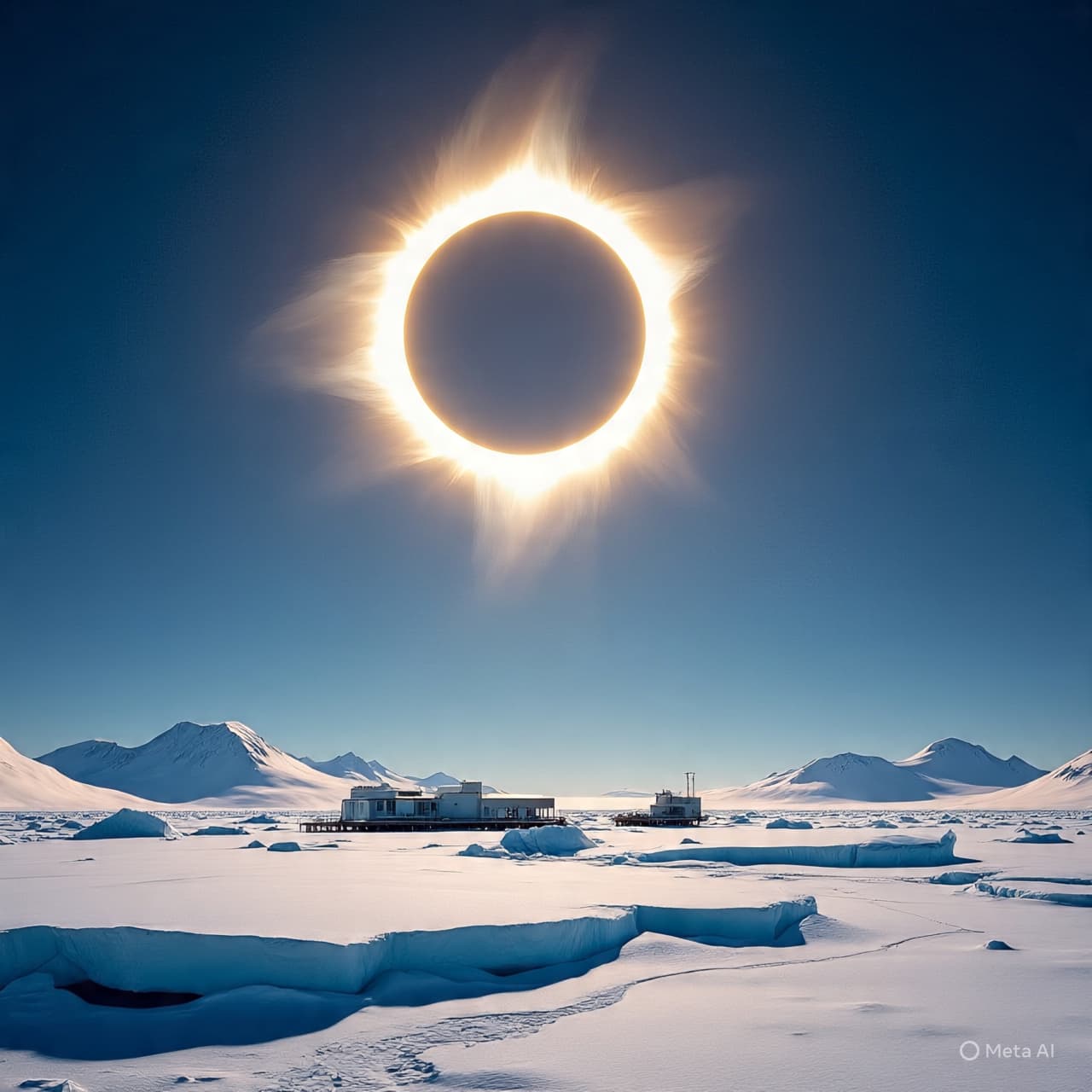
There are moments when our world — so full of routines, to-do lists, and morning coffees — seems to pause in a way that invites quiet wonder. Yesterday, the sky offered one such moment: a “ring of fire” solar eclipse unfolded above the frozen expanses of Antarctica, a celestial alignment that juxtaposes Earth’s everyday rhythms with the vast choreography of the cosmos. For a few minutes, the Sun, Moon, and Earth shared a remarkable geometry that few eyes on the planet were positioned to see, yet the event rippled across our shared sense of space and time as a reminder of our place under the sky.
In its simplest form, a solar eclipse occurs when the Moon travels between the Earth and the Sun, casting a shadow on our planet. But on February 17, 2026, the Moon — at a slightly greater distance in its elliptical orbit — appeared too small to fully blanket the Sun. This subtle difference created what astronomers call an annular solar eclipse, where the Moon’s silhouette sits within the Sun’s disc, leaving a glowing ring of sunlight visible around it. This “ring of fire” lasted a short but striking span as observers stationed in Antarctica witnessed the peak of the eclipse within a narrow band of annularity.
For those few observers — scientists at remote research stations such as Concordia and Mirny — the sky dimmed and brightened in a pattern both familiar and extraordinary. At its height, up to 96 percent of the Sun’s surface was obscured, leaving only a narrow circle of light to frame the Moon’s dark disc. Annularity — the phase that produces this ring — lasted a couple of minutes over the icy horizon, a fleeting spectacle visible to perhaps only a few dozen people above the Antarctic continent, the sea of ice animating sunlight into a shape that has inspired human curiosity across cultures and centuries.
Elsewhere, the eclipse unfolded more discreetly. Skywatchers in parts of southern Africa and the southern tip of South America saw partial phases, where the Sun appeared as though something had taken a bite out of it rather than a complete circle of fire. In those regions, the sky light dimmed gently, shadows sharpened, and the sense of midday was tinged with a softness that reminded many why people across time have paused their everyday rhythms to watch the heavens.
What makes this particular eclipse especially poetic is not only its rarity — annular eclipses occur when the Moon is at just the right distance to create the ring effect — but also its location. Vast stretches of the globe are rarely illuminated by such events, and this one swept across an environment where human footprints are minimal and silence vast: a stark, icy stage for an interplay of light and shadow. Yet even when observers are few, the eclipse can be felt in how it connects observers around the world to an ancient tradition of looking upward, listening inward, and finding perspective in relative motion of our home planet and its nearest companion in the sky.
Annular eclipses do not plunge the world into night as total eclipses can, but the subtler transformation — the solar disc’s bright ring against the dark lunar silhouette — evokes a gentle astonishment. It is a reminder that nature’s clocks are not bound to human calendars, that time and orbits and light play out according to a broader geometry that we are privileged to witness.
For many observers far from the Antarctic, the event has been experienced through images, livestreams, and the voices of scientists and enthusiasts describing what happened. In a media environment dominated by immediate concerns of modern life, it can feel almost ironic that such an event unfolded where so few could see it in person. Yet there is a kind of quiet grace in knowing that above us — regardless of where we stand on Earth — the Sun and Moon continue their age-old dance.
In the simplest, most direct terms: a rare annular solar eclipse occurred on February 17, 2026, producing a “ring of fire” effect most fully visible in remote Antarctica, with partial eclipse phases observed in parts of southern Africa and South America. This event marked the first solar eclipse of the year, and it unfolded according to the precise celestial mechanics that govern Moon-Sun-Earth alignments.
AI Image Disclaimer Visuals are created with AI tools and are not real photographs.
Sources
• Space.com news reporting on the annular solar eclipse visible over Antarctica and its mechanics.
• EarthSky overview of the February 17, 2026 eclipse and its “ring of fire.”
• Sky at Night Magazine details on where the eclipse is visible and its geographic limitations.
• Forbes coverage of the rare solar eclipse and partial visibility across Africa and the Indian Ocean region.
Published by Banx Network. This article is part of the Banx decentralized media programme, powered by the BXE token on the XRP Ledger.