If glaciers could whisper, the vast expanse of ice that is Antarctica’s Thwaites Glacier might sound like an old, slow hymn — deep, resonant, and pulsing with the rhythms of time itself. Scientists have long listened for its song, not out of idle curiosity but because this leviathan of ice holds clues to future seas and changing climates. Recently, a team of researchers ventured to hear that music from within, lowering a camera and instruments deep into the glacier’s icy heart, only to discover that even the best-laid plans can melt into something unexpected beneath such colossal forces.
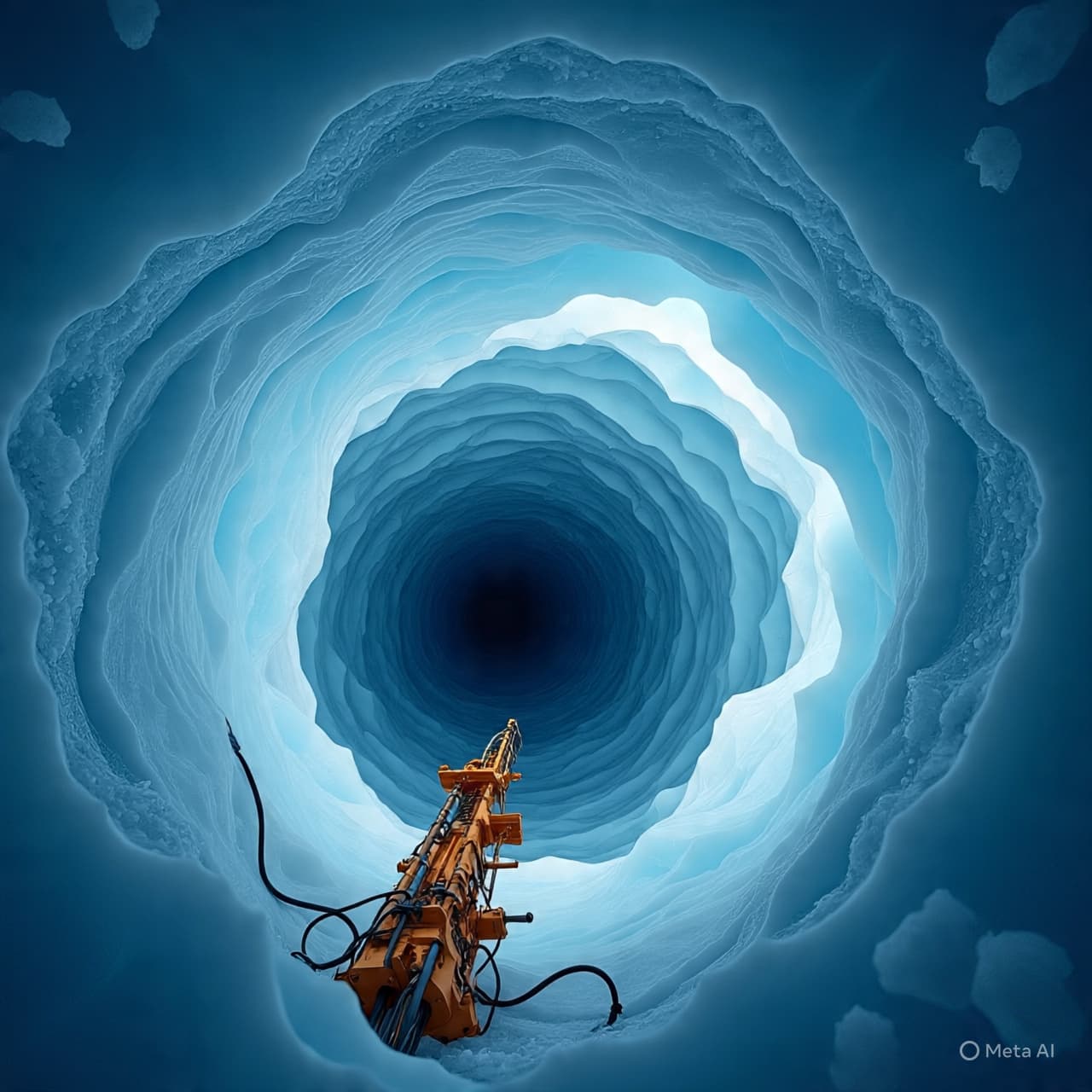
For decades, Thwaites — often called the “Doomsday Glacier” — has been at the center of scientific imagination because of its size, instability, and potential influence on global sea levels. Scientists from the British Antarctic Survey and the Korea Polar Research Institute traveled to West Antarctica with a careful plan: melt a narrow shaft through the glacier with hot water and send a camera — and later sensors — nearly a kilometer down to observe the hidden world beneath. These unseen under-ice caverns and melting processes could reveal how warm ocean waters reach the glacier’s base and hasten its retreat.
With measured patience and a gentle lowering of cables, the camera revealed a dreamlike interior — a grotto of ice, veined and layered, carved by ancient flows and current forces. The footage offered a rare glimpse of crevassed chambers unseen by human eyes, illustrating both the beauty and complexity of the glacier’s internal structure. Scientists hoped to follow this with the deployment of long-term monitoring equipment that could transmit data on ocean temperatures and ice movements for years.
Yet the mission took an unexpected turn. As the team prepared to install heavier instrumentation intended for prolonged observation, parts of the equipment became lodged within the borehole — a reminder that such ambitious undertakings are at the mercy of nature’s own restless changes. Shifting ice and the rapid refreezing of the narrow shaft conspired to hamper the final stage, leaving the instruments frozen in place and the scientists to reflect on what went both right and wrong.
Still, this attempt was not without reward. Even partial data and rare visual records from the glacier’s underbelly add to the growing body of knowledge about how heat from warm ocean currents influences ice loss. These insights will help future expeditions refine their strategies and deepen understanding of one of Earth’s most enigmatic cryospheric giants.
The effort underscores a larger truth of polar science: that understanding a changing world requires both bravery and humility. In trying to reach one of the most hidden places on Earth, the scientists were reminded that even failure can speak volumes — illuminating challenges and shaping the path ahead with quiet wisdom.
Scientists reported that while some instruments intended for long-term deployment beneath Thwaites Glacier were lost when they became stuck, the team successfully lowered a camera and captured rare footage of the ice’s internal structures. Preliminary measurements helped confirm interactions between warm seawater and glacier ice that are believed to accelerate melting. Researchers say future missions will build on these observations to better model glacier behavior and refine predictions of sea-level changes.
AI Image Disclaimer (Rotated Wording) Illustrations were produced with AI and serve as conceptual depictions.
Credible Source List:
Discover Wildlife – “Scientists lower camera into ginormous ‘Doomsday Glacier’ … mission doesn’t go to plan” (news) PBS NewsHour – researchers face serious obstacles measuring fast-melting glacier Times of India – scientists failed to drill deepest hole into Thwaites Glacier MoneyControl – rare footage, setbacks, and glacier melting data Thwaites Glacier project overview / background info
Published by Banx Network. This article is part of the Banx decentralized media programme, powered by the BXE token on the XRP Ledger.