

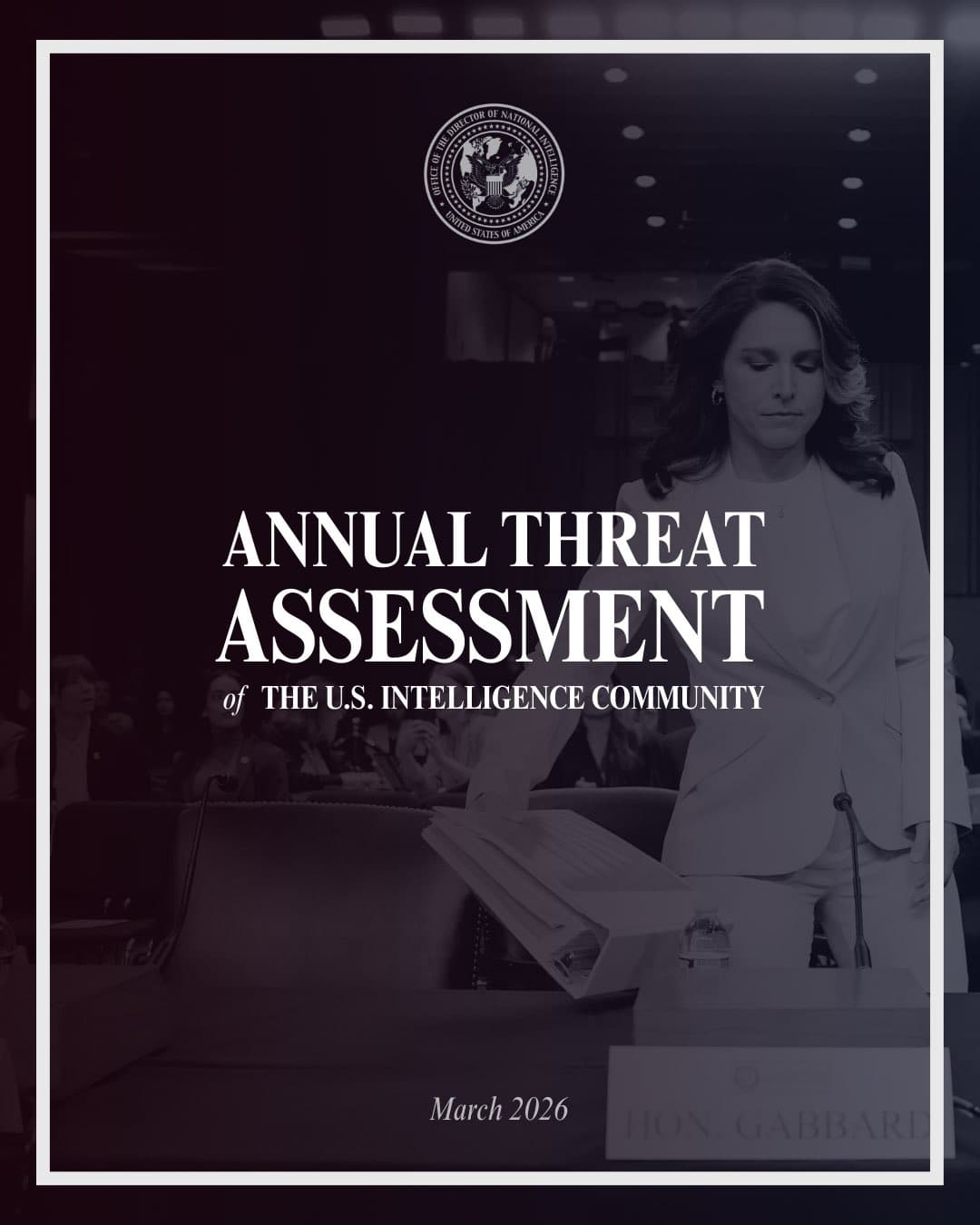
Key Highlights
- Release Date:The 2026 Annual Threat Assessment was published in March 2026.
- Key Focus Areas:The report addresses threats from strategic competitors, cyber risks, and terrorism.
- Public Interest:The announcement has garnered nearly 300,000 views, reflecting high demand for transparency.
The Office of the Director of National Intelligence (ODNI) has officially published its 2026 Annual Threat Assessment (ATA), providing a comprehensive analysis of the most pressing national security threats facing the United States today. Released in March 2026, this document synthesizes insights from all 18 intelligence agencies, combining classified and unclassified findings into a public roadmap of global dangers. The assessment comes at a time marked by heightened geopolitical tensions, rapid technological advancements, and evolving asymmetric warfare tactics that challenge traditional defense strategies.
[What the Annual Threat Assessment Typically Covers]
While the full 2026 report is accessible on the ODNI website, historical patterns suggest several critical focus areas that are likely to be addressed. Strategic competitors, particularly China and Russia, remain central concerns. The assessment is expected to detail military modernization efforts, territorial ambitions, cyber capabilities, and strategies aimed at undermining U.S. influence globally. China's expanding presence in the Indo-Pacific and Russia's ongoing aggression in Europe are anticipated to feature prominently in the analysis.
Cyber and technology threats are also a significant focus of the assessment. State-sponsored hacking, ransomware syndicates, and intellectual property theft rank among the top concerns. The report evaluates emerging technologies—including artificial intelligence, quantum computing, hypersonic weapons, and autonomous systems—for both the opportunities they present and the vulnerabilities they create.
Transnational terrorism continues to pose a threat, despite the degradation of capabilities among groups like ISIS-K and Al-Qaeda affiliates. The assessment examines regional instability in Africa, the Middle East, and Central Asia as breeding grounds for extremism, highlighting the ongoing risks these groups pose to global security.
Weapons of mass destruction remain a critical area of concern, with the assessment providing detailed analysis of proliferation risks stemming from North Korea's nuclear program, Iran's advancing capabilities, and potential black-market transfers of dangerous materials.
Health and environmental security are increasingly factored into threat calculations, with pandemic preparedness, bioweapons risks, and climate-driven instability gaining prominence in the assessment.
[Why This Release Matters]
The Annual Threat Assessment serves as a foundational document guiding U.S. policy decisions, defense spending, and diplomatic strategies. Lawmakers, military leaders, and allied nations scrutinize its findings to align resources with emerging dangers. The public's interest in the assessment reflects a growing awareness of interconnected global threats. The announcement alone has already drawn nearly 300,000 views, indicating intense demand for transparency in intelligence assessments and the importance of understanding the evolving landscape of national security threats.
Published by Banx Network. This article is part of the Banx decentralized media programme, powered by the BXE token on the XRP Ledger.




