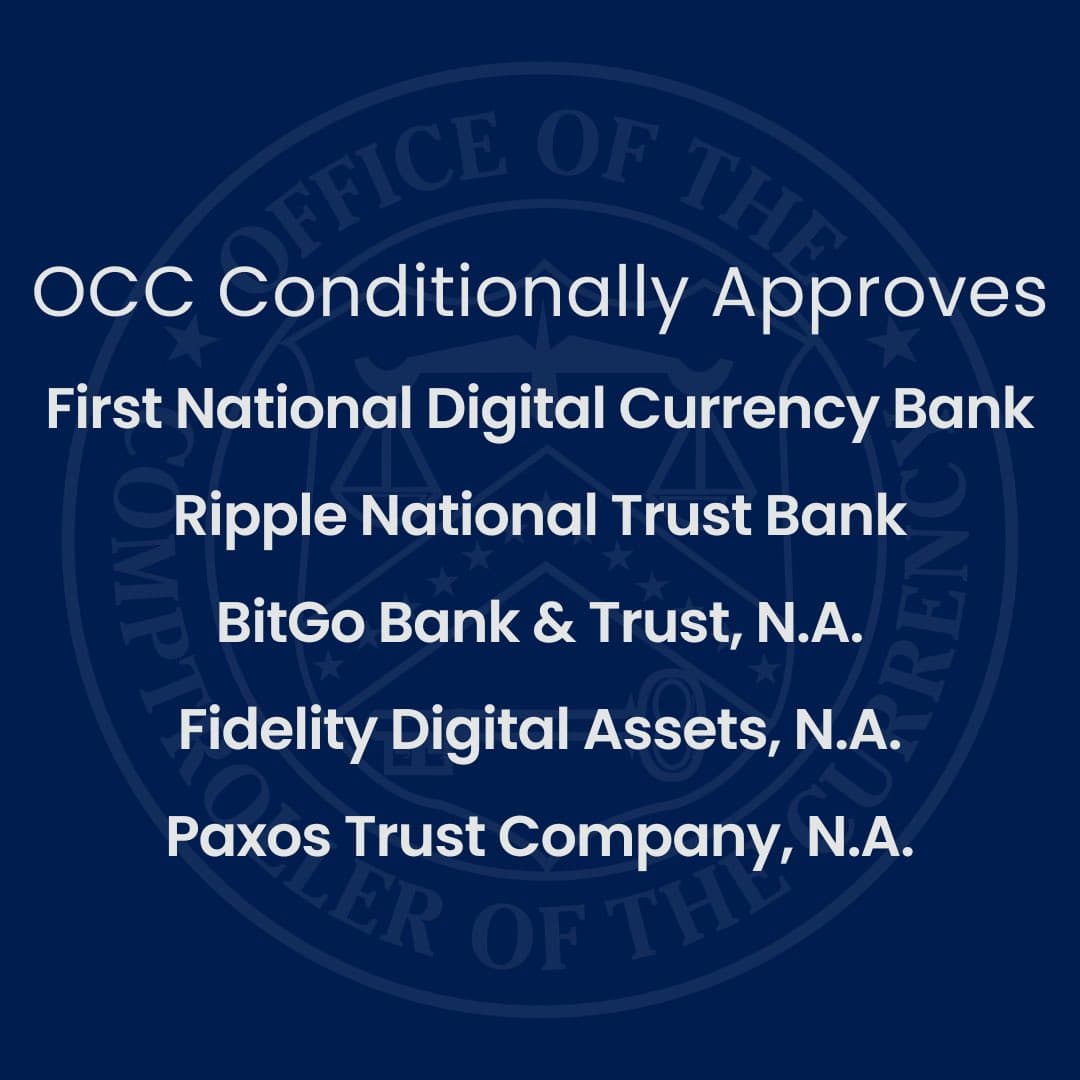
In a landmark regulatory move, the U.S. Office of the Comptroller of the Currency (OCC) has conditionally approved five digital-asset institutions to operate as national trust banks. This decision signals a major shift in how the United States approaches cryptocurrency and blockchain-based finance.
The institutions receiving conditional approval include First National Digital Currency Bank, Ripple National Trust Bank, BitGo Bank & Trust, N.A., Fidelity Digital Assets, N.A., and Paxos Trust Company, N.A. These approvals allow the firms to move closer to operating under federal banking oversight, rather than existing in regulatory grey zones.
A national trust bank charter permits companies to custody assets, process payments, and provide settlement services nationwide without taking traditional retail deposits. For digital-asset firms, this is critical. It enables them to securely hold crypto assets for institutions while complying with strict U.S. banking standards.
The approval is described as “conditional”, meaning each institution must still satisfy final requirements such as capital adequacy, risk management controls, cybersecurity standards, and anti-money-laundering compliance. Once those conditions are met, the banks can begin full operations.
The inclusion of well-known names like Fidelity and Paxos highlights growing institutional confidence in digital assets. At the same time, the approval of a Ripple-linked trust bank strengthens the role of blockchain-based payment systems in regulated financial infrastructure, particularly for cross-border settlement and liquidity management.
Rather than rejecting or banning digital assets, the OCC’s action shows a different strategy: integration through regulation. By bringing crypto-focused firms under federal supervision, regulators aim to improve transparency, consumer protection, and financial stability.
This move also sends a clear message globally. The U.S. is positioning itself not as an opponent of digital finance, but as a jurisdiction willing to shape and control its evolution. As traditional banking and blockchain technology continue to converge, these conditional approvals may mark the beginning of a new chapter in regulated digital finance.
Published by Banx Network. This article is part of the Banx decentralized media programme, powered by the BXE token on the XRP Ledger.