Key Highlights
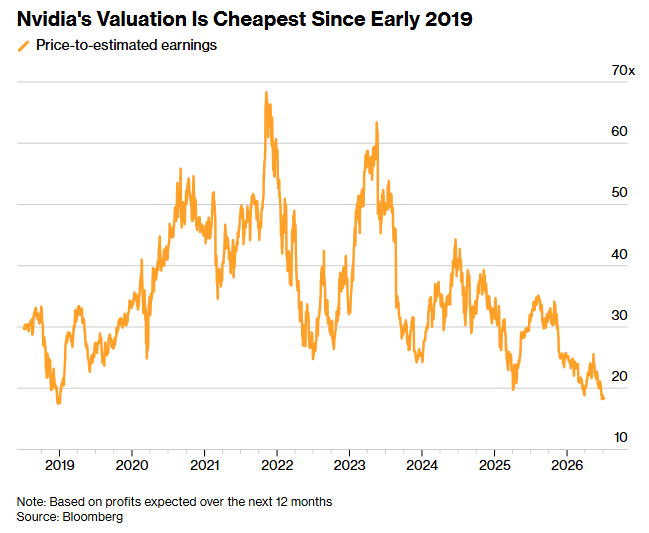
- Nvidia's valuation metrics have fallen to multi-year lows.
- The decline reflects changing investor expectations amid rapid earnings growth.
- Nvidia remains a key player in AI infrastructure, driving significant investments.
Nvidia's valuation metrics have recently fallen to levels not seen in several years, igniting discussions among investors regarding whether the company is overvalued, fairly priced, or potentially undervalued in light of its future growth prospects. The decline in valuation multiples does not necessarily indicate weakness in the business; rather, it reflects a combination of rapidly expanding earnings and shifting investor expectations. While Nvidia's share price has soared during the AI boom, its profits have also surged at an extraordinary pace.
Many analysts focus on price-to-earnings (P/E) ratios and forward earnings multiples when evaluating technology companies. A falling multiple can occur even when a stock rises if earnings growth outpaces the increase in market capitalization. This phenomenon is particularly relevant for Nvidia, which has seen its stock price fluctuate amid changing market conditions.
Nvidia continues to be a central supplier of graphics processors and AI accelerators utilized in data centers worldwide. The demand from cloud providers, governments, research institutions, and enterprises is driving large-scale infrastructure investments. As the company plays a pivotal role in artificial intelligence, it has transformed from a semiconductor manufacturer into one of the most strategically important firms in global technology.
Investors now view Nvidia as a key beneficiary of long-term AI adoption across various industries. Supporters argue that AI spending is still in its early stages, and future demand could justify substantial additional growth. They believe that as more sectors integrate AI technologies, Nvidia's position will strengthen, leading to increased revenues and market share.
However, critics caution that competition, regulatory developments, and cyclical technology spending could eventually compress margins and slow expansion. The valuation discussion surrounding Nvidia highlights a broader market question: whether AI infrastructure investment represents a temporary boom or the foundation of a multi-decade transformation. Nvidia sits at the center of this debate, making its valuation one of the most closely watched indicators in global financial markets.
As investors navigate these complexities, the future trajectory of Nvidia's valuation will likely depend on its ability to maintain its competitive edge in the rapidly evolving AI landscape. The company's performance in the coming quarters will be critical in determining whether it can sustain its growth momentum or if external pressures will hinder its progress.
Published by Banx Network. This article is part of the Banx decentralized media programme, powered by the BXE token on the XRP Ledger.