There is a particular gravity that settles over a city when the tools of public safety become visibly more militarized—when the officers who walk among us carry not just a sidearm but a rifle, and the vehicles that patrol the streets are built for rapid, forceful response. In Sydney this week, that gravity arrived with the unveiling of the Armed Response Command, a permanent unit that represents the most significant shift in NSW policing in a generation.
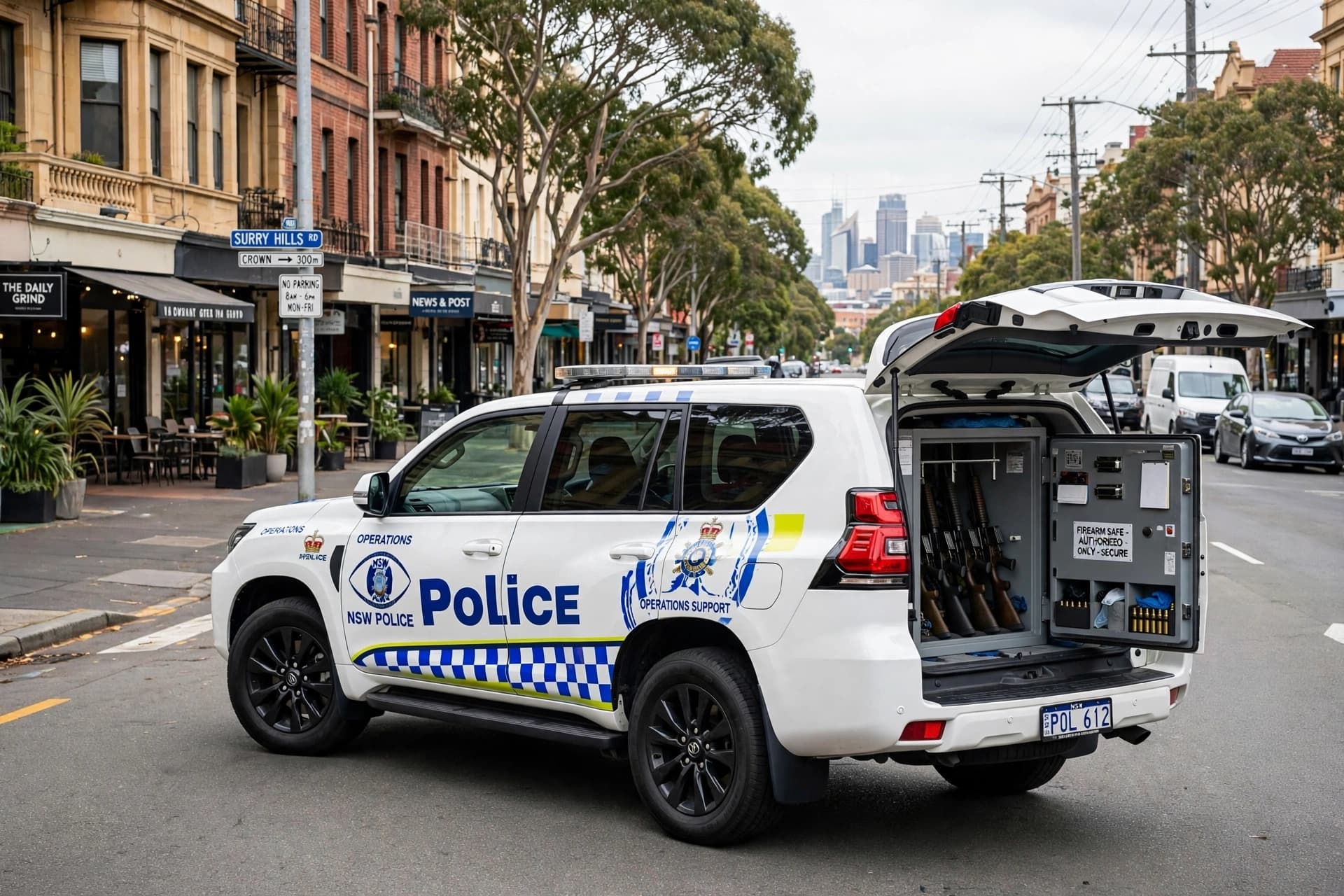
The unit, backed by a $94.3 million investment, will comprise 250 officers and 28 civilian staff at full strength. Officers will be equipped with the Australian Combat Assault Rifle, manufactured by Lithgow Small Arms, and a fleet of purpose-built vehicles including BMW X5s and Toyota LandCruisers, each fitted with specially designed gun safes . Training is underway, and the public will begin seeing these officers and vehicles on Sydney streets in the coming weeks .
The ARC is the Minns government's response to the Bondi Beach terror attack of December 2025, in which 15 people were killed during a Jewish holiday celebration. During that attack, police equipped with 9mm Glock pistols faced attackers armed with shotguns and scoped rifles. Senior police later told the Royal Commission into anti-Semitism and Social Cohesion that officers had been "placed at significant risk" . A delegation traveled to the United Kingdom and Germany in January to study rapid response models before designing the ARC .
The unit evolves from Operation Shelter, a temporary taskforce launched in October 2023 to address heightened community tensions. What was once a reactive surge operation will now be a permanent, round-the-clock presence, with officers no longer rotated out of their local commands during major incidents . A 24/7 Police Operations Centre will support the command with response, coordination, training, and intelligence .
Premier Chris Minns framed the change as a necessary adaptation to a shifting security environment. "The security challenges facing our state have changed, and our policing model needs to change with them," he said. "We hope these officers are never called on to respond to a major incident. But if one happens, NSW Police are ready" .
Not everyone has welcomed the expansion. Writing in the Sydney Morning Herald, associate professor Andrew Poe noted that research on proactive policing is mixed, with some studies suggesting that expanded police powers can increase rather than decrease major crimes. He raised concerns about the impact on legally authorized protesters and the difficulty of holding such units accountable once established . NSW Police Commissioner Mal Lanyon, however, described the unit as a deterrent "for those who wish to commit harm, incite hatred or cause fear" .
The ARC is expected to become fully operational in the coming months. For now, the people of Sydney will see its officers and vehicles on their streets, and they will have to decide for themselves what that visibility means.
AI Image Disclaimer: The images accompanying this article are generated by artificial intelligence and are intended for illustrative purposes only.
Sources: NSW Government, Australian Broadcasting Corporation, Gold Coast Bulletin, Sydney Morning Herald
Published by Banx Network. This article is part of the Banx decentralized media programme, powered by the BXE token on the XRP Ledger.