
Key Highlights
- Discovery:NASA's Curiosity rover found pure sulfur crystals on Mars.
- Significance:This finding adds complexity to our understanding of Martian environments.
- Exploration:The discovery occurred in a sulfate-rich area on Mount Sharp.
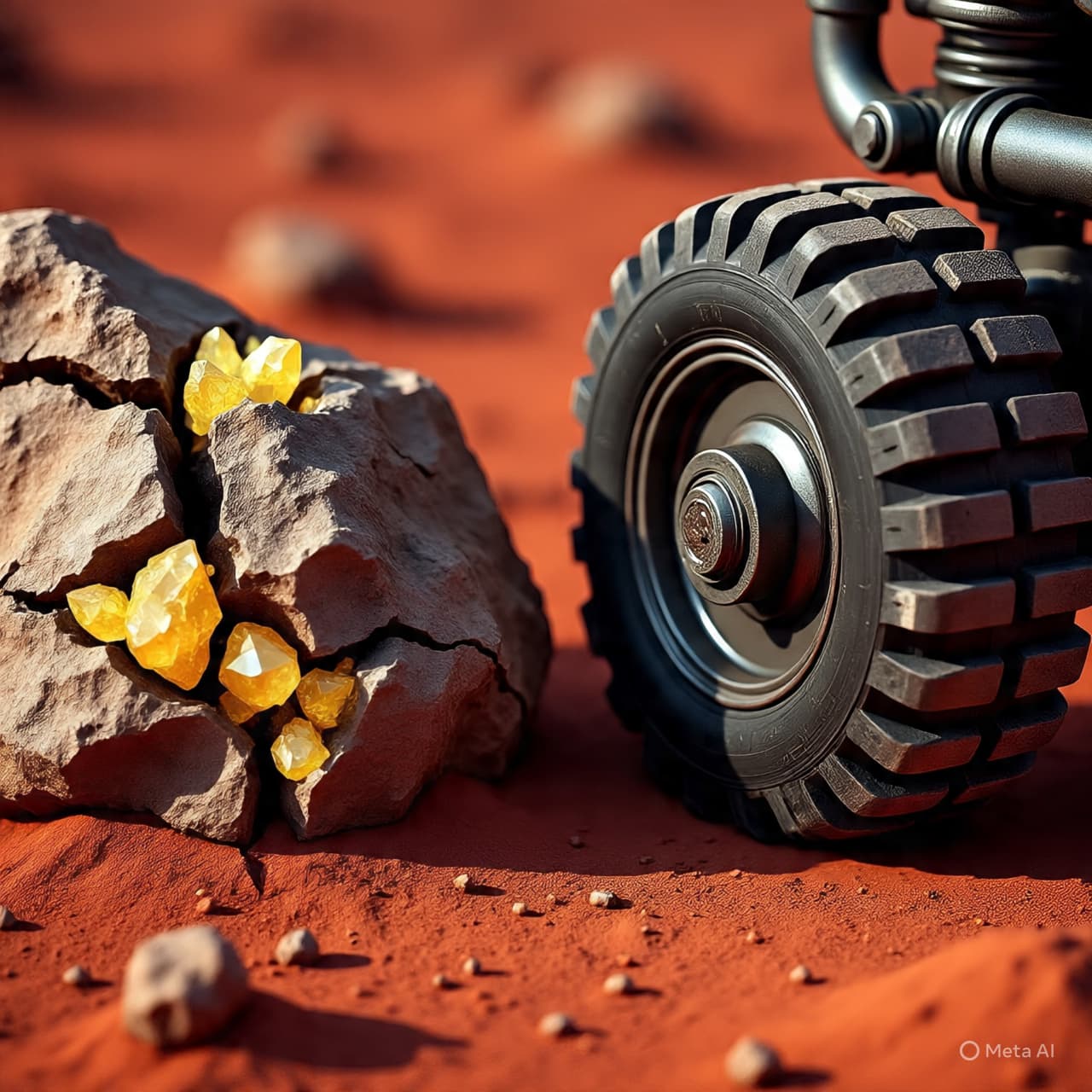
NASA's Curiosity rover has made a groundbreaking discovery on Mars, revealing pure sulfur crystals within a rock that was unexpectedly cracked open during its exploration. This finding, which occurred in 2024, marks a significant moment in Martian geology, as it presents elemental sulfur in a form never before seen on the planet. Previously, sulfur was only found in combination with other elements, typically as sulfate salts formed from ancient water evaporation.
The discovery took place in a region known for its rich geological history, specifically on the slopes of Mount Sharp. This layered mountain serves as a record of Mars' climatic changes over time. The presence of pure sulfur crystals raises intriguing questions about the planet's past environments. Scientists are now tasked with understanding the conditions that could lead to such a unique formation, as the crystals were found unbound to oxygen or other elements, standing out starkly against the Martian landscape.
Researchers speculate that the formation of these sulfur crystals could be linked to various geological processes, including intense evaporation, volcanic activity, or unique groundwater chemistry. Some scientists even suggest that cycles of wetting and drying could have played a role, potentially influenced by microbial activity similar to that on ancient Earth, although no evidence of life on Mars has been established. This discovery does not provide proof of biological activity but instead opens up new avenues for understanding the planet's environmental history.
Curiosity's finding is particularly remarkable given the circumstances of its discovery. The rover was not specifically targeting this rock; it simply drove over it, applying enough pressure to fracture the surface. This serendipitous moment underscores the nature of exploration, where meticulous planning is often complemented by unexpected discoveries. The team is now analyzing similar rocks in the vicinity, gathering images and measurements to identify patterns that could shed light on the sulfur's origins.
While this discovery does not fundamentally alter our understanding of Mars, it adds layers of complexity to the narrative of the planet's geological history. The presence of pure sulfur suggests that Mars may have experienced a variety of environmental conditions, oscillating between wet and dry phases, and potentially offering a more hospitable environment than previously thought. This finding serves as a reminder that Mars still holds many secrets beneath its surface, waiting to be uncovered by future missions.
As scientists continue to study the implications of this discovery, they are reminded of the vastness of Mars and the potential for further revelations. The unexpected presence of sulfur crystals not only enhances our understanding of the planet's past but also ignites curiosity about what other surprises lie hidden in the Martian terrain. With each new finding, we inch closer to unraveling the mysteries of our neighboring planet, highlighting the importance of continued exploration and research.
On a planet characterized by its silence and expansive horizons, the discovery of pure sulfur within a seemingly ordinary rock serves as a powerful reminder of the ongoing quest for knowledge about Mars and its history.
Published by Banx Network. This article is part of the Banx decentralized media programme, powered by the BXE token on the XRP Ledger.



