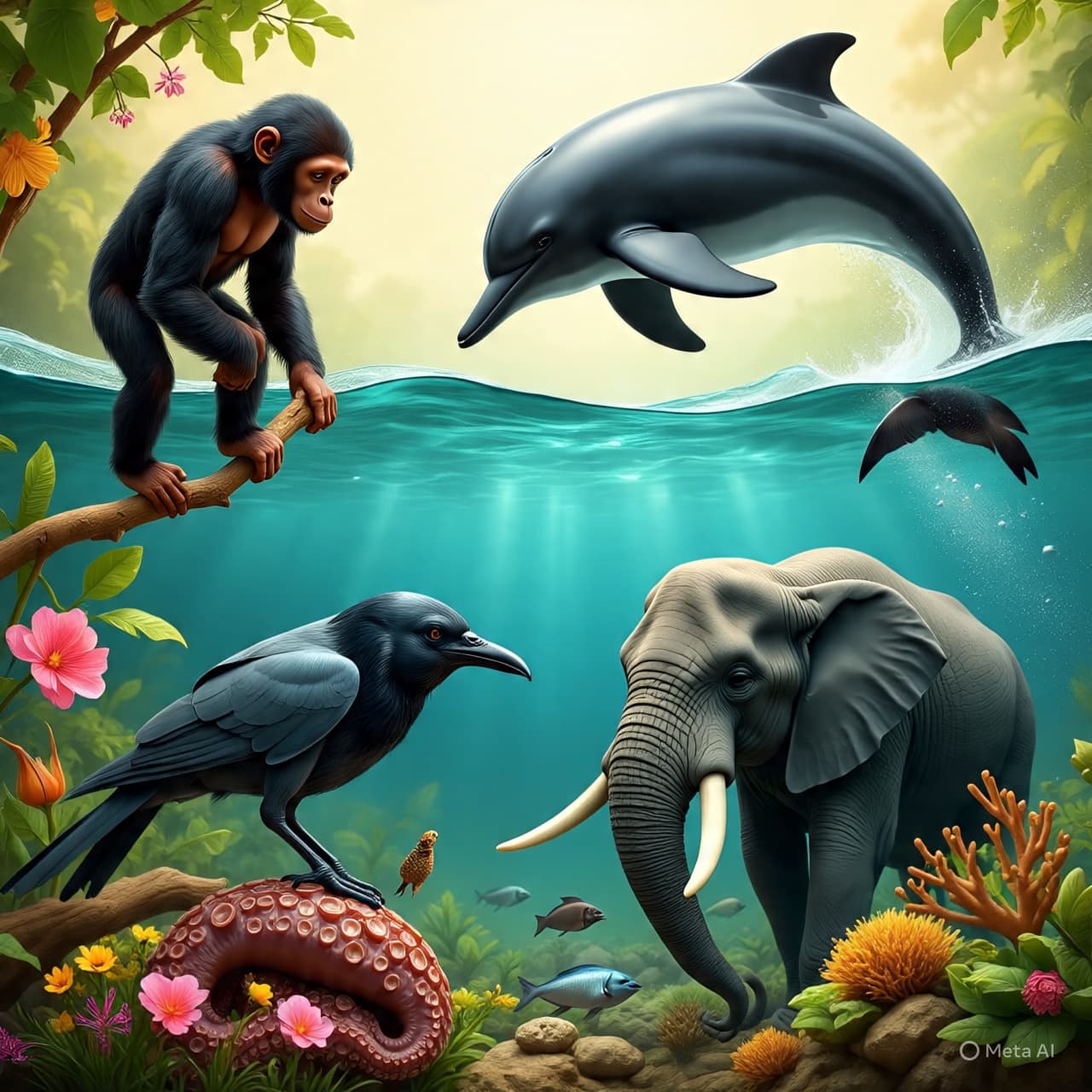
Intelligence does not always announce itself. It does not require language, cities, or written memory. In the natural world, it appears in quieter forms—in problem-solving without instruction, in social bonds without contracts, in adaptation without foresight. Across species, intelligence emerges not as a single trait, but as a collection of abilities shaped by environment, survival, and time.
Among animals, some stand apart not because they resemble humans, but because they challenge what intelligence can look like.
Great apes sit closest to us on this spectrum. Chimpanzees, bonobos, orangutans, and gorillas demonstrate self-recognition, tool use, emotional complexity, and cultural learning passed from one generation to the next. They plan, deceive, cooperate, and grieve. Their intelligence is social and strategic, grounded in memory and relationship, reflecting minds built for navigating intricate group dynamics.
Dolphins follow closely, though their intelligence unfolds in an entirely different medium. In oceans where hands are useless and visibility is limited, dolphins evolved complex communication, cooperative hunting strategies, and advanced problem-solving. They recognize themselves in mirrors, invent behaviors, and appear to call one another by distinct signature whistles. Their intelligence is fluid, acoustic, and deeply social, shaped by movement and sound rather than objects.
Elephants carry intelligence on a slower, heavier scale. Their strength lies not in speed, but in memory and emotional awareness. Elephants recognize individuals decades later, respond to death with ritualized behavior, and demonstrate empathy toward injured companions. They solve problems deliberately, often cooperatively, and navigate vast landscapes guided by memory that spans generations.
Corvids—especially crows and ravens—compress remarkable intelligence into small bodies. They use tools, understand cause and effect, plan for future needs, and solve multi-step puzzles that rival primate performance. Living in environments that reward flexibility, corvid intelligence is sharp, opportunistic, and inventive, revealing that brain size alone does not define cognitive power.
Octopuses complete this list in the most alien way. Their intelligence is decentralized, with much of their neural processing distributed through their arms. They escape enclosures, manipulate objects, learn through observation, and display individual personalities. Solitary by nature, their intelligence evolved not for social negotiation, but for rapid adaptation and problem-solving in unpredictable environments.
Ranking intelligence across species is always imperfect. Each of these animals excels in ways that matter to its own survival. Intelligence, in this sense, is not a ladder but a landscape, with different peaks shaped by different pressures.
What these animals share is not similarity to humans, but complexity. They remind us that intelligence is not owned by one species or measured by one standard. It emerges wherever life demands creativity, memory, cooperation, or adaptation—and it takes forms far richer than we once imagined.
AI Image Disclaimer Illustrations were created using AI tools and are conceptual representations.
Sources Nature Scientific American National Geographic Proceedings of the National Academy of Sciences
Published by Banx Network. This article is part of the Banx decentralized media programme, powered by the BXE token on the XRP Ledger.