
Key Highlights
- Incident:A rockslide in Norway's fjord region resulted in the death of a driver.
- Response:Emergency services deployed helicopters and geological teams to the scene.
- Safety Review:Authorities are reviewing rockfall mitigation measures across the region.
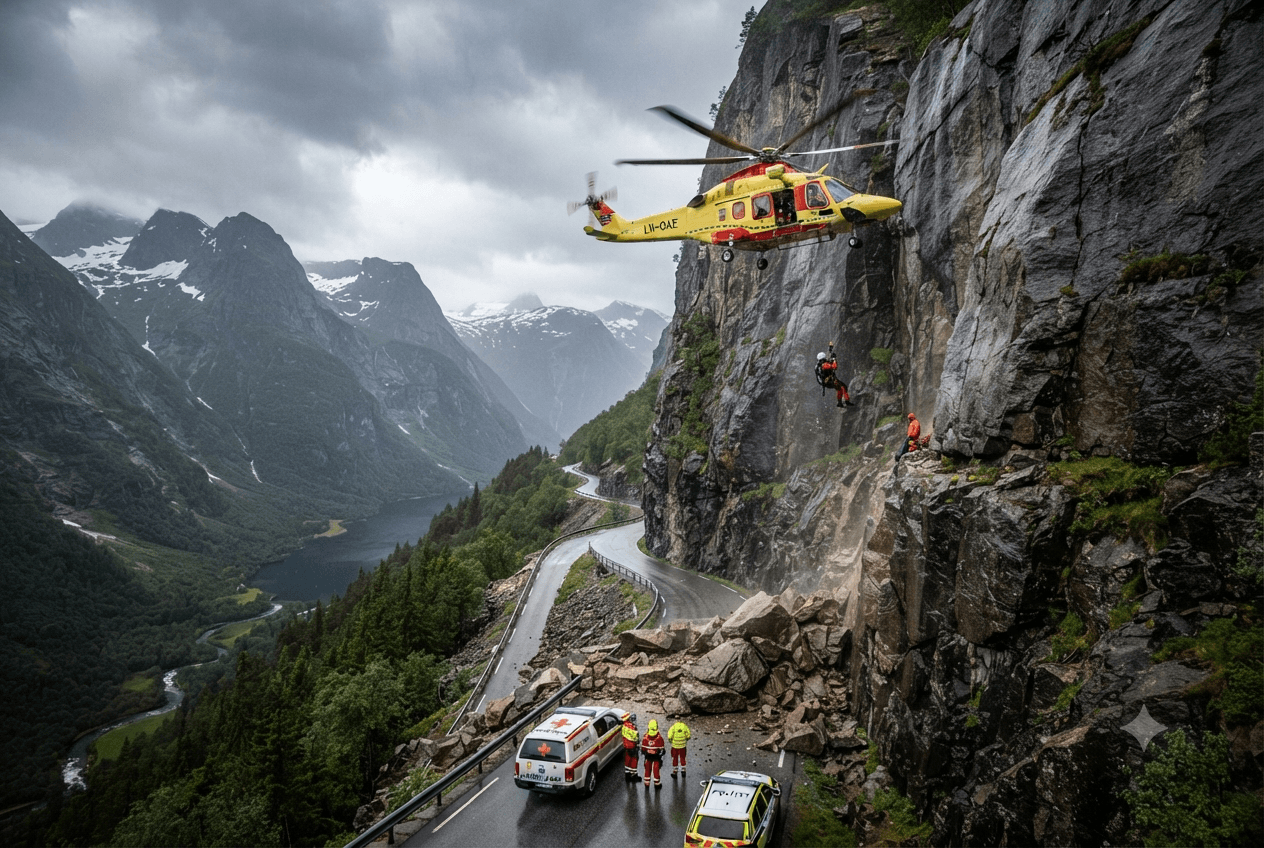
Oslo, Norway—A massive wall of rock detached from a sheer cliff face Friday afternoon, crashing directly onto a coastal fjord highway and crushing a moving passenger car. Emergency rescue services deployed helicopters and specialized geological teams to the remote western Norwegian road corridor following automated emergency alerts. First responders found the vehicle completely flattened beneath tons of granite boulders and shattered stone. Paramedics and mountain rescue personnel confirmed that the sole driver inside the car died instantly upon impact.
Geologists inspecting the unstable mountainside reported that persistent heavy rainfall and thermal expansion triggered the sudden structural failure above the roadway. Tons of debris blocked both traffic lanes and tumbled over the asphalt edge directly into the deep fjord waters below. Road maintenance crews established wide security perimeters across the affected sector, warning motorists of continued rockfall hazards throughout the surrounding valleys. Transport authorities closed a fifty-kilometer stretch of the coastal highway indefinitely while heavy excavation equipment cleared the blocked route.
State transport ministers expressed condolences to the victim's family and announced an urgent safety review of rockfall mitigation nets across western fjord regions. Engineers utilized thermal drones to scan upper cliff faces for secondary fracture lines before allowing cleanup crews to approach the wreckage. Local community leaders renewed calls for accelerated federal funding to construct protective concrete avalanche sheds over vulnerable coastal road segments. Recovery operations stretched late into the evening under floodlights as forensic teams cleared the crushed vehicle from the debris field.
The tragic event has raised concerns about the safety of roadways in mountainous regions, particularly in light of changing weather patterns that may increase the frequency of such incidents. Authorities are now under pressure to implement more robust safety measures to protect motorists traveling through these scenic yet perilous areas.
As investigations continue, the community mourns the loss of the driver, highlighting the need for improved infrastructure and emergency preparedness in the face of natural disasters.
Published by Banx Network. This article is part of the Banx decentralized media programme, powered by the BXE token on the XRP Ledger.



