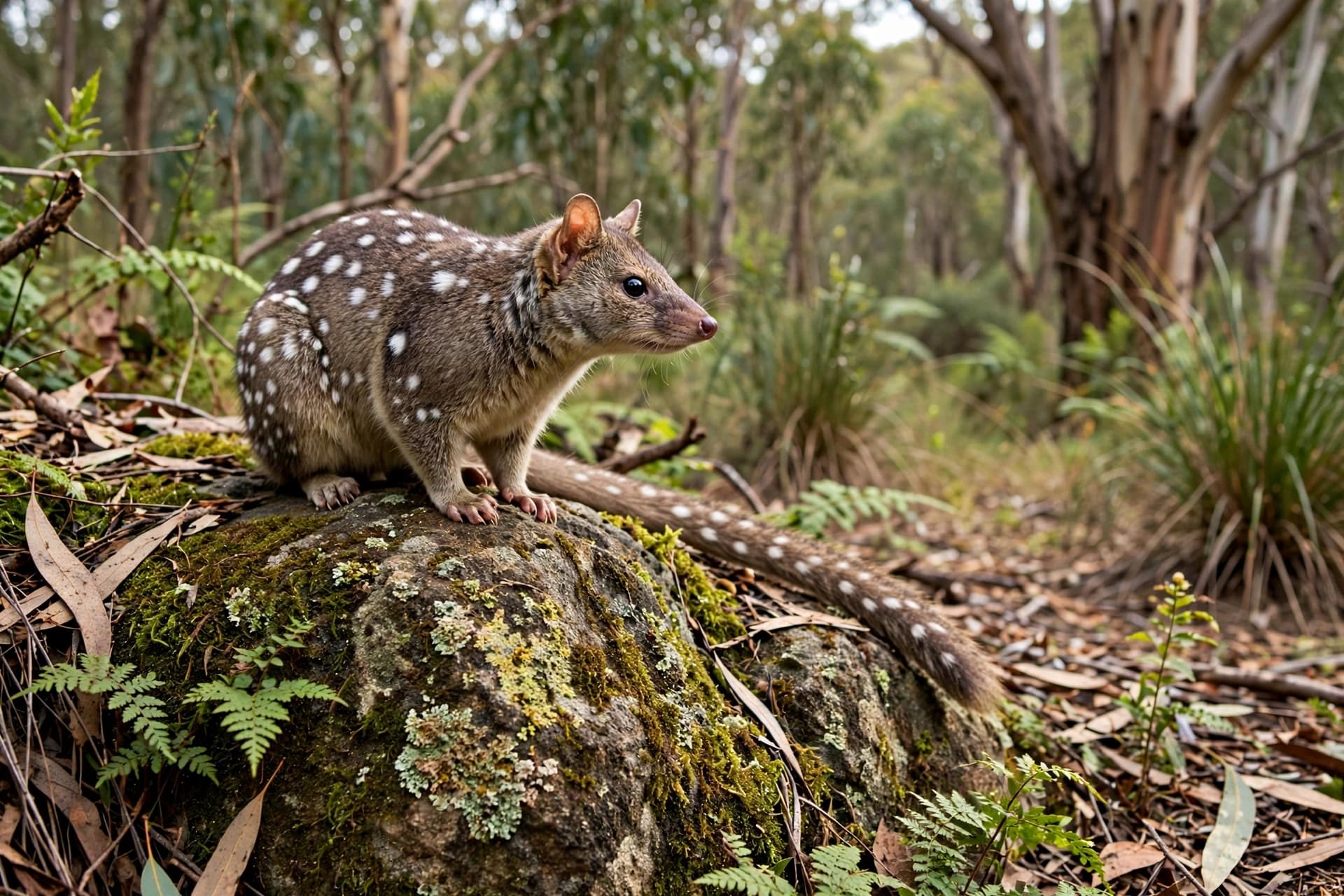
There is a particular poignancy in moving a creature to save it—a recognition that the place it once thrived has become a place it cannot survive, and that the only hope lies in a journey to somewhere new. In northern Australia, that recognition has arrived for the northern quoll, a small, spotted marsupial that once ranged across the continent's top half but has seen its numbers collapse over the past century. This month, conservationists are preparing to translocate a group of quolls from a stronghold in Far North Queensland to a fenced refuge near Townsville, in an effort to establish a new population in a landscape where their greatest threats have been removed.
The plan, led by the Australian Wildlife Conservancy, involves moving northern quolls from Brooklyn Wildlife Sanctuary—a property in Far North Queensland that supports an estimated 300 quolls—to Mount Zero-Taravale Wildlife Sanctuary, where a 950-hectare feral predator-free fenced area awaits. The timing of the translocation is being carefully calibrated. Researchers recently recorded two females at Brooklyn carrying up to eight pouch young each, and the size of those young will determine when the move can occur. "Translocating animals with pouch young carries risks, so females cannot be moved if their young are either too small or too developed," explained Dr. Alexander Watson, AWC Regional Ecologist.
The need for such measures is stark. Northern quolls were once prevalent throughout northern and eastern Australia. But since the 1930s, their range has contracted dramatically—by at least 45 percent overall, and by more than 75 percent in Queensland, where over 400,000 square kilometers of former habitat now lie empty. The primary cause was the arrival of cane toads. Quolls are carnivorous marsupials that eat a wide variety of prey, including the poisonous toads. When they eat a toad, they die. The impact was swift and devastating, and it was compounded by feral cats, foxes, and changes to fire regimes.
What makes the quoll's situation particularly precarious is its unusual life history. Male northern quolls die shortly after breeding, meaning that populations depend heavily on the survival of offspring. A small increase in juvenile mortality can translate into a large decline in overall population size. For a species already pushed to the edges of its former range, every pouch young matters.
The Mount Zero-Taravale refuge represents a different kind of hope. The fenced area excludes feral cats and foxes—the two predators that, alongside cane toads, have driven the quoll's decline. It also provides an opportunity for the species to persist in a landscape where it can be managed and monitored. The quolls will join the northern bettong, another endangered marsupial, which was released into the same fenced area in 2023. If successful, it will be the only population of northern quolls on mainland Australia living in a feral predator-free environment.
Dr. Gabrielle Beca, an AWC Wildlife Ecologist, described the moment of finding the pouch young as a special one for the team—the tiny "quoll jellybeans" a sign that the species is responding to careful land management. At Brooklyn, early dry-season burning creates a mosaic of burnt and unburnt vegetation, providing shelter and reducing pressure from predators. It is a model that conservationists hope to replicate elsewhere. The translocation is not a permanent solution—the cane toad cannot be removed from the landscape—but it is a way of buying time, of holding a place for a species that has lost so much ground. The quolls will be moved, the fence will hold, and the population, if all goes well, will grow. In a country with the world's worst record of mammal extinctions, that is no small thing.
AI Image Disclaimer: The visual elements in this article were created using AI generation tools and are intended for illustrative purposes only.
Sources: Australian Wildlife Conservancy, NESP Threatened Species Recovery Hub, Wiley Online Library
Published by Banx Network. This article is part of the Banx decentralized media programme, powered by the BXE token on the XRP Ledger.