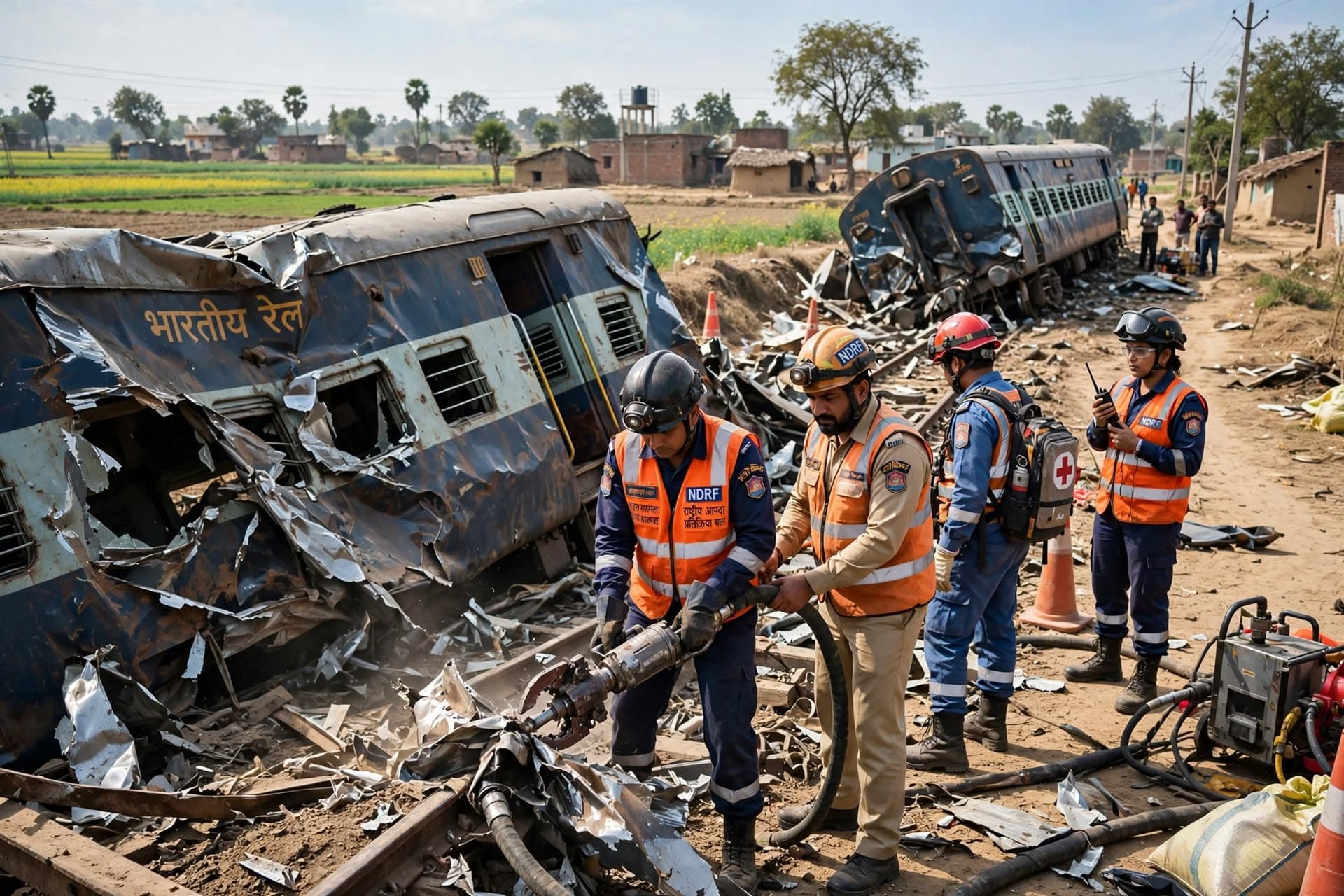
Kanpur, India—A passenger commuter train jumped the tracks at 06:15 IST Sunday in northern India, causing four passenger coaches to overturn down an embankment and killing twelve passengers. Emergency response teams and local villagers rushed to the wreckage, utilizing metal cutters and hydraulic jacks to extract survivors trapped beneath twisted metal framework. Authorities confirmed over thirty wounded individuals were evacuated to district medical facilities under emergency escort.
Disaster response force personnel deployed heavy cranes to stabilize tilted train cars while medical teams established triage units along the gravel track bed. Field doctors treated victims suffering from severe crushing injuries, bone fractures, and deep lacerations before ambulances transferred them to regional hospitals. Relatives of passengers gathered along the perimeter embankments, frantically searching passenger manifests for news of missing family members.
Preliminary technical reports indicate a broken rail joint or track alignment fault may have caused the locomotive wheels to slip off the steel line at high speed. The impact sheared off secondary coupling bolts, sending four densely populated passenger carriages sliding into a mud ditch beside the main line. Railway engineers secured the train's black box telemetry recorder to evaluate operating speed and braking applications prior to the derailment.
Mainline rail traffic across the northern corridor ground to a complete halt, forcing railway authorities to cancel twenty-four regional passenger trains and re-route long-distance express services. Heavy breakdown trains equipped with heavy industrial lift gear arrived on site to begin lifting fallen coaches off the track bed. Track maintenance crews began replacing broken wooden ties and bent rails along a three-hundred-meter section of damaged line.
Ministry of Railways Senior Official Rajesh Sharma delivered a press update near the disaster site late Sunday afternoon. "We have twelve confirmed fatalities resulting from this tragic derailment, and rescue operations have now transitioned to track clearing," Sharma stated. "A high-level safety commission has been established to investigate whether structural fatigue or mechanical failure caused this incident."
Passengers who survived the derailment described feeling a sudden violent shuddering motion followed by a loud metallic crunch as coaches tilted onto their sides. Civil society groups organized blood donation drives at nearby municipal hospitals to supply trauma wards treating severely injured survivors. Local administration officers arranged temporary shelter, food, and emergency transport for uninjured passengers stranded at the crash site.
Coroner teams processed the bodies of the twelve deceased victims at the district civil hospital mortuary for formal identification and release to surviving relatives. Government officials announced immediate financial compensation packages for the families of the deceased and injured passengers. Railway safety inspectors meticulously photographed fractured rail segments and wheel assemblies before heavy machinery cleared the right-of-way.
Civil engineering crews worked through the evening under high-intensity floodlights to repair damaged track beds and restore single-line service. Railway police units maintained a strict security cordon around overturned coach frames to safeguard personal luggage and physical evidence. Structural restoration work continues as official investigators begin formal witness hearings.
Published by Banx Network. This article is part of the Banx decentralized media programme, powered by the BXE token on the XRP Ledger.