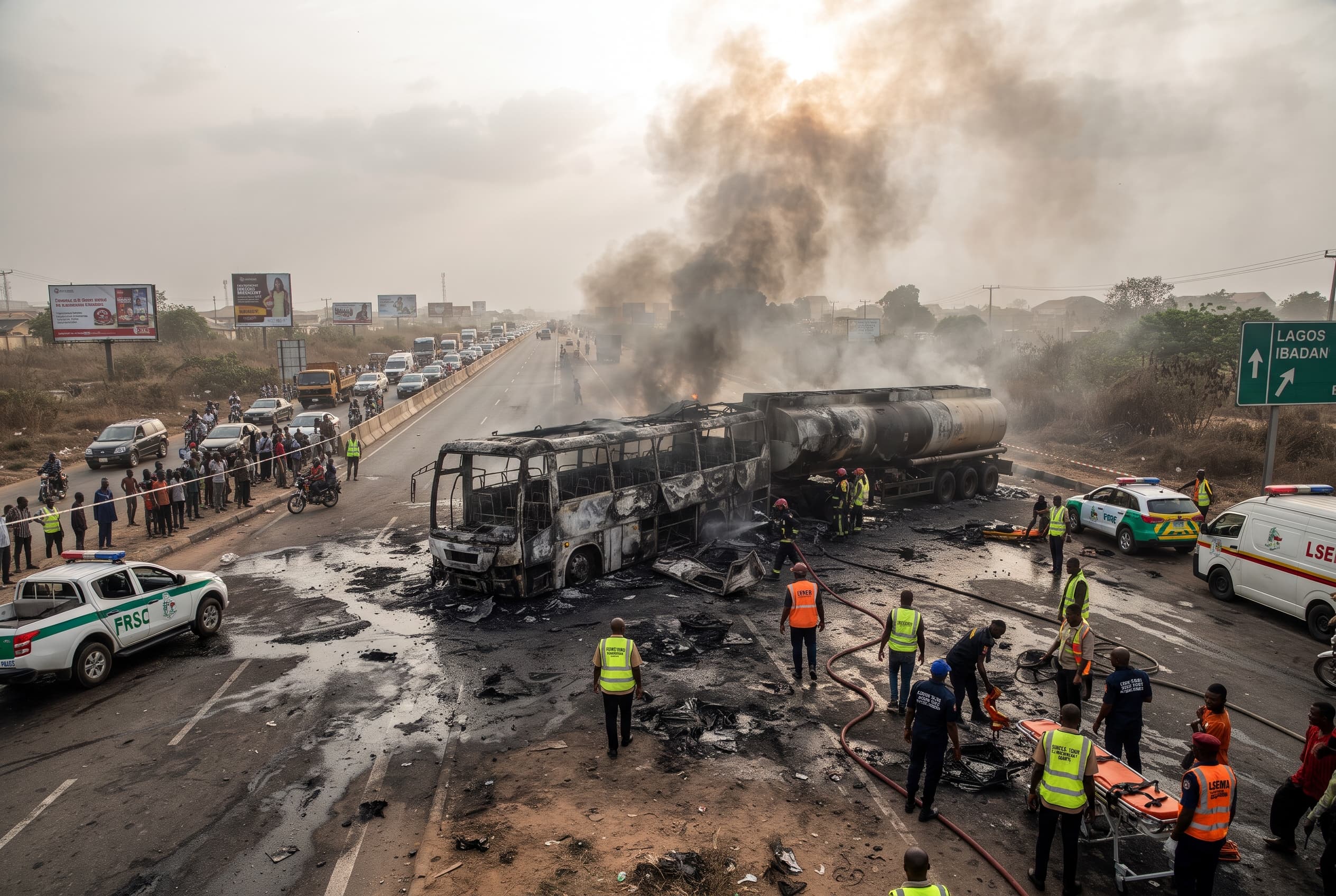
Abuja, Nigeria— Twenty people were killed and five critically injured on October 24, 2026 when four vehicles smashed into each other on one of Nigeria's busiest highways, turning a morning commute into a mass-casualty scene that burned for over an hour.
The collision happened around 9:30 a.m. on the Lagos-Ibadan expressway near the Sagamu interchange, a notorious bottleneck where trucks, buses and private cars compete for space. Witnesses said a fuel tanker lost control while overtaking, struck a commercial bus, then pushed it into two other vehicles. Fuel spilled. Then fire.
Federal Road Safety Corps officers counted 20 bodies at the site. Five survivors were pulled from twisted metal with severe burns and fractures and taken to Olabisi Onabanjo University Teaching Hospital. Two are on ventilators. The bus was carrying market traders heading to Ibadan. The identities of most victims had not been released by evening.
"The tanker was on high speed. It swerved, the bus could not avoid it," a roadside trader who saw the crash said. "People were shouting. The fire started immediately. We tried with buckets, but the heat was too much." Police said visibility was clear, but the road surface was slick from a light overnight drizzle.
The Lagos-Ibadan corridor handles more than 250,000 vehicles a day and has been under phased reconstruction for years. Lanes narrow without warning, diversions lack signage, and heavy trucks often drive at night to avoid checkpoints. The corps said preliminary findings point to dangerous overtaking and possible brake failure on the tanker. A full inspection of the wreckage is pending.
"We have warned repeatedly about overloading and speed violations on this corridor," a senior FRSC sector commander said. "Today we have 20 dead in less than 10 minutes. Our men retrieved bodies that were burned beyond recognition. Families are waiting at the morgue."
Traffic was backed up for 14 kilometers in both directions. Soldiers and civil defense officers cordoned off the area while a crane lifted the charred chassis off the road. The tanker company said it was cooperating with investigators and that the driver, who died in the crash, had 18 years of experience.
Relatives gathered at the hospital gate in Sagamu. One woman said her brother called at 8 a.m. saying he had boarded the bus. "His phone rang till noon. Now it is switched off," she said. Officials said DNA tests may be needed for several victims.
Nigeria records one of the highest road fatality rates in Africa. Enforcement remains thin, trucks are often poorly maintained, and emergency response is delayed by distance and congestion. The expressway was partially reopened at 4 p.m., but diesel slicks still marked the asphalt.
Investigators were securing the tanker’s tachograph and interviewing the five survivors when they are stable enough to speak.
Published by Banx Network. This article is part of the Banx decentralized media programme, powered by the BXE token on the XRP Ledger.