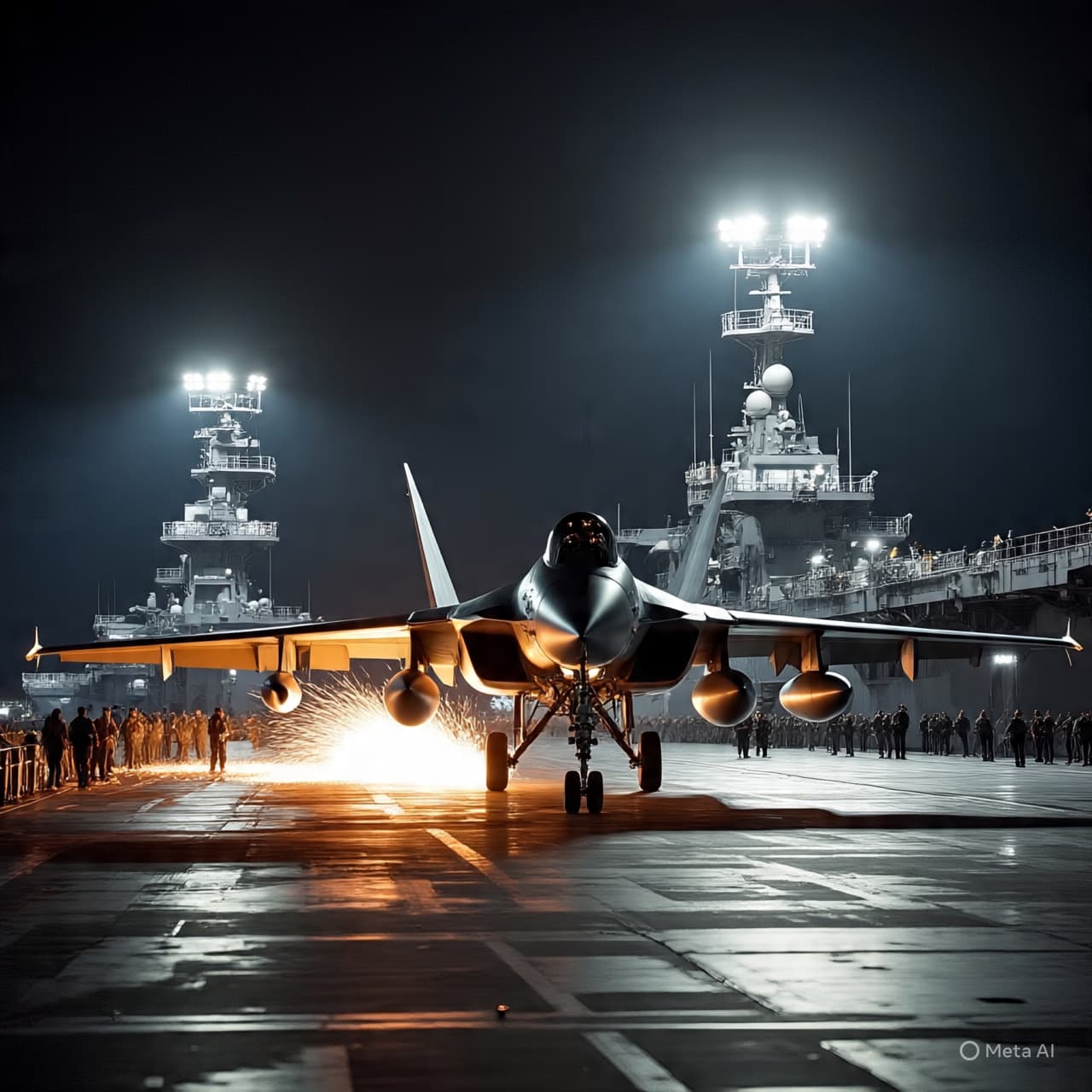
The night air rested heavy above the deck of the carrier, as if holding its breath — when suddenly, a boom cracked the calm and sparks flew, scattering light and hope across a scene that a moment before had held promise. In those few frantic seconds, a $60 million jet vanished into the dark water below, carrying with it not only steel and fuel but the fragile confidence of a crew that trusted routine.
What unfolded aboard USS Harry S. Truman was the tragic unspooling of what should have been a standard landing. The jet — an F/A-18F Super Hornet — touched down normally. But then one of the arresting gear cables snapped. The machinery meant to absorb its energy disintegrated. A steel cable shot across a machinery room. Sparks erupted. Sailors inside, moments earlier safe at their stations, scrambled as shards of hardware clanged dangerously close.
The jet veered off-center, unable to halt or gain enough speed to climb away. On deck, commands rang out — “EJECT!” — and two aviators leapt from the cockpit, plunging into the Red Sea, rescued minutes later by a helicopter. The aircraft, worth tens of millions, was lost. And in its wake, questions. How could a small missing part — a washer in a clevis pin assembly — lead to such devastation? How had maintenance standards slipped so far aboard a flagship in active deployment?
According to the investigation, the failure was not merely mechanical — it was institutional. Understaffed and overworked maintenance crews. Operators who lacked adequate training. A tempo of deployments that pushed gear beyond safe limits. The missing washer was the trigger — but worn-out procedures, fatigue, and rushed standards built the trap. This was not war’s fury, but erosion — the slow decay of protocol under pressure.
The loss adds to a troubling string of serious mishaps during this deployment: previously, another jet had slipped off the hangar deck during towing; a vessel collision; a friendly-fire shootdown; even lost equipment during combat maneuvers. The repetition underscores a deeper problem — the weight of constant operations, the strain on sailors and systems, the risk of routine becoming perilous under wear.
Caught between the demands of mission and the fragility of human and mechanical limits, the crew and leadership now face reckoning. Repairs can rebuild decks and renew cables — but restoring confidence, discipline, readiness: that takes time. And trust.
In the glow of rescue lights and after the sea settled its turbulence, what remains is a stark reminder: even the most advanced machinery depends on the smallest part, the quiet diligence of maintenance, the calm attention to detail. A missing washer altered course for a jet, but the deeper lesson points to vulnerability — not to enemy missiles, but to human frailty under strain.
As the carrier group continues its deployment, emergency reviews and reforms are underway. But for now, that night — that boom, those sparks — will stand as a warning etched in steel and memory.
AI Image Disclaimer: “Illustrations were produced with AI and serve as conceptual depictions.”
Sources (media names only): Business Insider; Stars and Stripes; AP / Associated Press; The Guardian; CNN.
Published by Banx Network. This article is part of the Banx decentralized media programme, powered by the BXE token on the XRP Ledger.