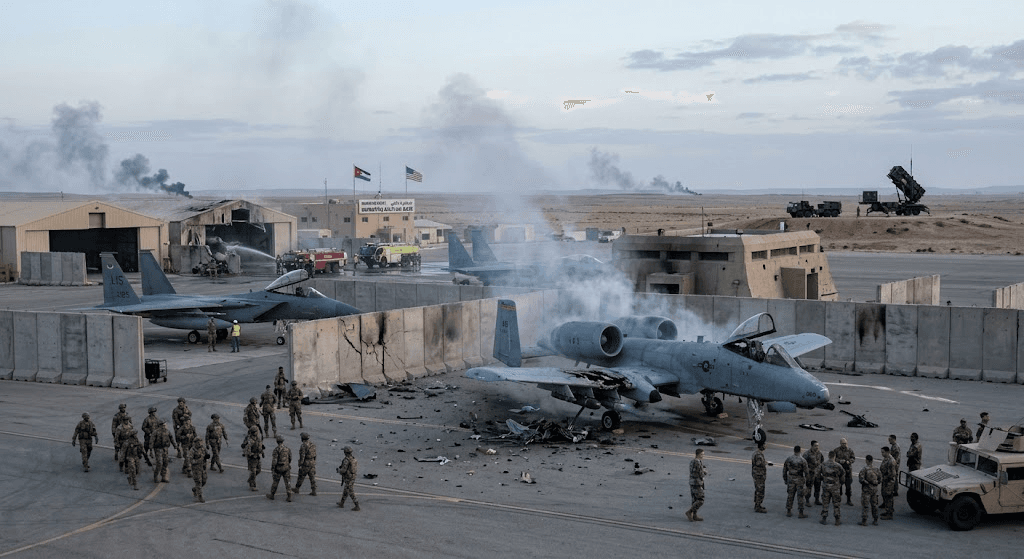
AMMAN, Jordan — Multiple U.S. military aircraft sustained damage overnight during a major ballistic missile barrage targeting Muwaffaq Salti Air Base in Jordan. The attack, claimed by Iran’s Islamic Revolutionary Guard Corps (IRGC), marks a sharp escalation in regional hostility following retaliatory U.S. actions in the Gulf.
The missile strike targeted maintenance zones, flight lines, and shelters housing American aircraft at the air base near Al-Azraq. A U.S. Air Force A-10 Thunderbolt II attack aircraft suffered severe structural damage, including a severed wing. In addition, approximately eight F-15 Strike Eagle fighter jets received minor damage from shrapnel and blast shockwaves.
Despite the damage to heavy military hardware, official reports confirm there were no U.S. or Jordanian military casualties resulting from the strike. Service teams quickly evaluated the affected aircraft, successfully repairing and returning the F-15s to active service shortly after the attack ended.
Jordanian and U.S. air defense systems were heavily engaged during the assault, launching dozens of Patriot interceptor missiles to counter the incoming threat. Jordanian military authorities reported that air defenses intercepted 18 out of 20 ballistic missiles fired toward the installation, with remaining debris falling in unpopulated areas.
The overnight barrage followed U.S. military strikes against five Iranian crude oil tankers earlier in the week, an action taken after attacks on a U.S. Navy warship in maritime transit routes.
Muwaffaq Salti Air Base serves as a primary logistical and strike hub for U.S. Air Forces Central operations. Central Command officials emphasized that despite the damage to equipment, operational readiness at the installation remains active. Security protocols across regional facilities have been elevated to maximum alert as coalition forces bolster air defense coverage along key operational corridors.
The strike on Muwaffaq Salti Air Base has intensified diplomatic friction, prompting coalition allies to issue severe warnings regarding regional stability and freedom of navigation. In response to the missile barrage, defense officials in Washington and Amman announced immediate measures to fortify air defense architecture, reinforcing anti-missile batteries and secondary interceptor networks across eastern Jordan.
Simultaneously, international maritime and security monitors cautioned that tit-for-tat exchanges targeting critical airpower hubs and energy shipping lanes risk triggering broader economic and geopolitical instability throughout the Middle East. As technical crews work to repair structural damage on-site, Joint Chiefs of Staff advisors are weighing further deterrent options to protect allied forces stationed across the region.
Published by Banx Network. This article is part of the Banx decentralized media programme, powered by the BXE token on the XRP Ledger.