Key Highlights
- Directive Issued:CBN mandates migration to ISO 20022 by October 31, 2025.
- Global Integration:Adoption aligns Nigeria with international payment standards.
- Enhanced Security:New standards improve data accuracy and fraud prevention.
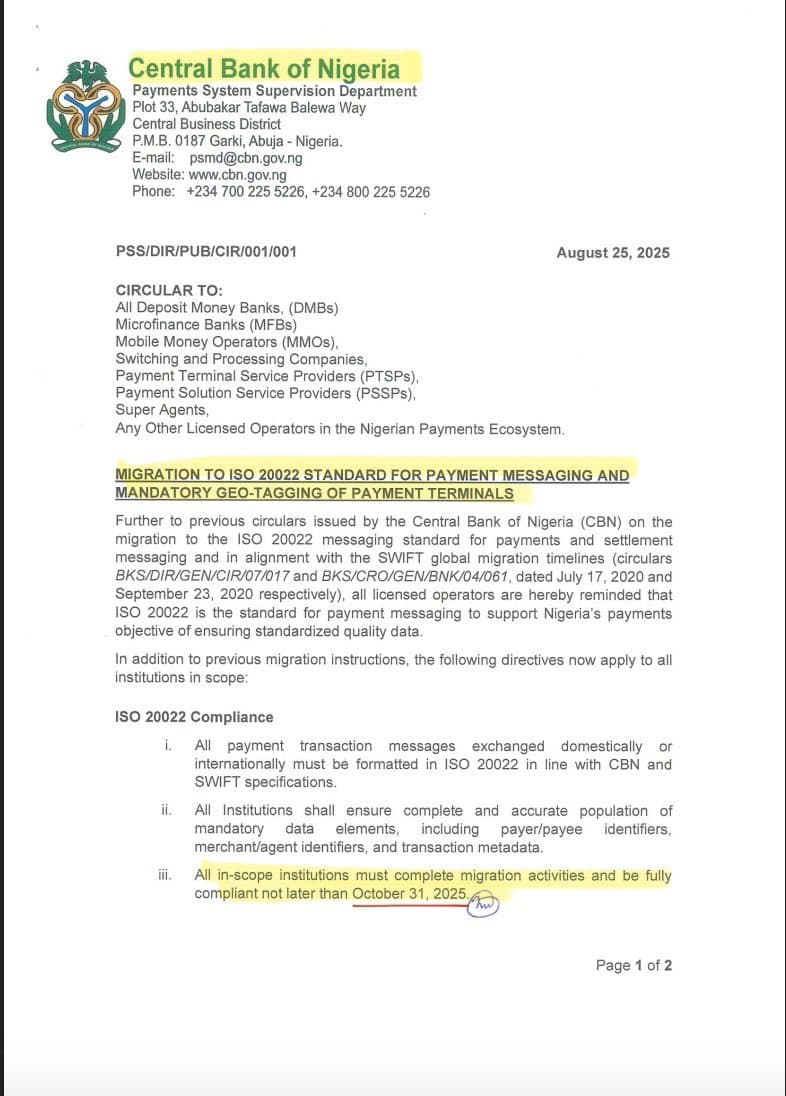
On August 25, 2025, the Central Bank of Nigeria (CBN) announced a pivotal directive that is set to transform the landscape of payments and potentially enhance cryptocurrency adoption in Africa's largest economy. The directive requires all banks, mobile money operators, fintech companies, and payment service providers to transition to ISO 20022 messaging standards and implement geo-tagging for all payment terminals by October 31, 2025.
This move towards ISO 20022 is significant as it aligns Nigeria with a global standard that is already being adopted by financial institutions worldwide, including SWIFT. By integrating this messaging system, Nigeria will enhance its connectivity to international financial networks, facilitating smoother cross-border transactions and improving the overall efficiency of its payment systems.
One of the primary benefits of adopting ISO 20022 is the enhancement of data quality and transparency in transactions. The new standard mandates that every payment must include detailed information such as payer and payee IDs, merchant details, and location data. This level of detail not only helps in reducing fraud but also strengthens compliance with regulatory requirements, making it easier for authorities to monitor and trace transactions.
Moreover, the interoperability of ISO 20022 presents a unique opportunity for the integration of blockchain-based payment systems. As the financial landscape evolves, digital assets like XRP and Stellar, which are already ISO 20022-compliant, can be more easily integrated into Nigeria's payment ecosystem. This could pave the way for increased cryptocurrency adoption, as businesses and consumers alike may find it easier to transact using digital currencies.
In addition to the messaging standard, the CBN's directive includes a requirement for geo-tagging all point-of-sale (POS) and payment terminals. This measure aims to enhance accountability within the payment system, as it allows regulators to track the physical locations of transactions. By preventing the existence of ghost merchants—businesses that do not physically exist—this initiative could significantly reduce fraudulent activities and illicit transactions.
The CBN's directive is a bold step towards modernizing Nigeria's financial infrastructure. As the country prepares for this transition, stakeholders across the financial sector must collaborate to ensure a smooth migration to ISO 20022. The implications of this change are vast, potentially reshaping the future of payments and digital currency in Nigeria.
Published by Banx Network. This article is part of the Banx decentralized media programme, powered by the BXE token on the XRP Ledger.