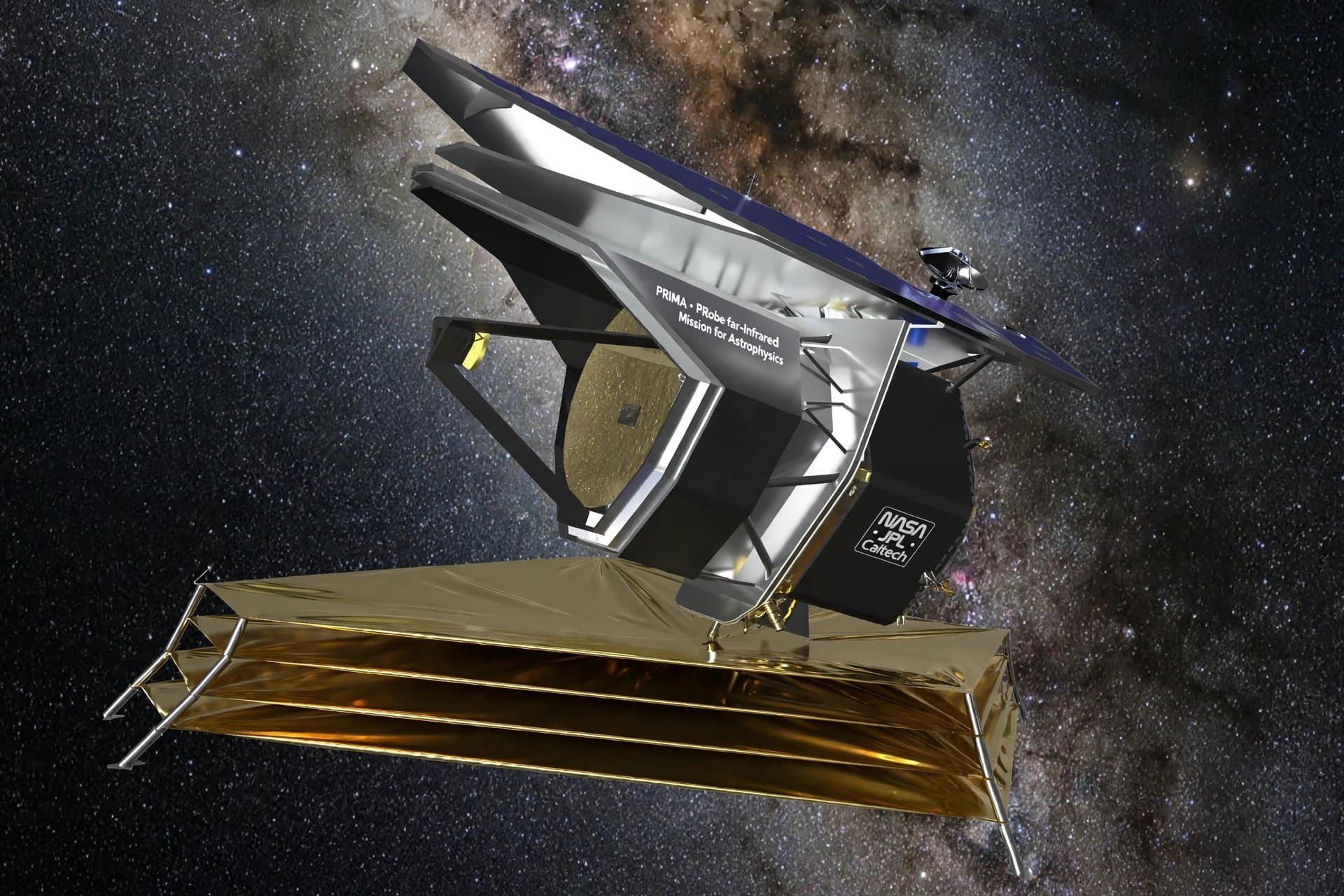
There is a particular ambition in building a telescope that sees what no other telescope can see—one designed not to observe the same wavelengths with greater clarity, but to open an entirely new window on the universe, to detect the light that has been invisible to every previous instrument. On Monday, NASA officials unveiled the PRIMA space telescope, a far-infrared observatory that will explore a portion of the electromagnetic spectrum that remains largely uncharted. PRIMA—the Probe of Infrared Mission for Astrophysics—is designed to survey the cosmos in wavelengths that reveal the cold, dusty, and distant regions where stars and planets form, and where some of the universe's most profound mysteries may reside .
The telescope, scheduled for launch in 2031, will be the first NASA mission to conduct a wide-field, high-sensitivity survey in the far-infrared, a band of the spectrum that is difficult to observe from the ground because Earth's atmosphere absorbs most of the relevant wavelengths. PRIMA will carry three instruments: a wide-field camera and spectrograph, a high-resolution spectrometer, and a coronagraph designed to block the light of bright stars and image the faint disks of debris and forming planets around them .
What makes PRIMA particularly significant is its ability to address questions that span multiple fields of astrophysics. In the far-infrared, astronomers can observe the thermal emission from cool dust—material that is too cold to shine in visible light but that is abundant in the interstellar medium and in the disks around young stars. This dust is the raw material of planets, and by studying its distribution and properties, PRIMA will help answer how planetary systems form and evolve. The telescope will also survey distant galaxies, observing the infrared light that has been stretched by the expansion of the universe, revealing the history of star formation and the growth of supermassive black holes over cosmic time .
NASA officials described the mission as a complement to the James Webb Space Telescope, which observes in the near- and mid-infrared. PRIMA's far-infrared capabilities will allow it to see cooler objects and to penetrate deeper into the dusty regions that Webb cannot observe. Together, the two telescopes will provide a more complete picture of the infrared universe than either could alone. The mission is part of NASA's Explorer program, which supports relatively low-cost, highly focused science missions. PRIMA was selected from among several proposals and is expected to cost approximately $500 million.
The telescope's name, PRIMA, reflects its role as a pathfinder—a first probe of a wavelength band that has been largely unexplored. It will not answer every question about the infrared universe, but it will open a door that has been closed for too long. For astronomers, the opportunity to see the universe in a new light is not merely an incremental advance. It is a chance to discover something that no one anticipated, to find the objects and phenomena that only reveal themselves when you look in a way you have never looked before. PRIMA is that look. The universe, as always, is waiting.
AI Image Disclaimer: All images in this article are AI-generated and are intended for illustrative purposes only.
Sources: NASA, SpaceNews, Nature
Published by Banx Network. This article is part of the Banx decentralized media programme, powered by the BXE token on the XRP Ledger.